 43
43

Shockstrips — SOUND SAFETY
 Photo
Photo
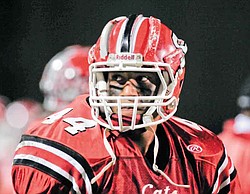
Struthers running back Dave Stewart (44) wears a football helmet outfi tted with Shockstrips™, a patent-pending sports product developed by Dr. Steven D. Novicky and his wife, Kim, of Canfield, which may help prevent brain injuries in young athletes by raising the level of protection provided by virtually any helmet, be it for football, hockey, baseball, lacrosse or cycling.
 Photo
Photo
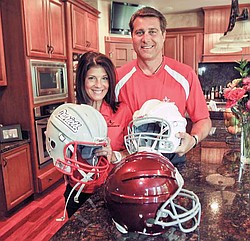
Dr. Steven D. Novicky and his wife, Kim, of Canfield, developed a patent-pending sports product called Shockstrips™, which may help prevent brain injuries in young athletes by raising the level of protection provided by virtually any helmet, be it for football, hockey, baseball, lacrosse or cycling.
An approved product developed by an area chiropractor may to help to prevent brain injury among football players and other young athletes
CANFIELD
A local chiropractor’s patent-pending device that adheres to the outside of sports helmets could reduce brain injuries and concussions caused by helmet-to-helmet collisions.
ShockstripB launched Aug. 3, consists of seven strips of AktonB, a medical-grade material, that helps reduce the probability of traumatic brain injuries and concussions and hearing loss to athletes of all ages, said the product’s inventor, Dr. Steven D. Novicky of Canfield.
Shockstrip pads, being tried by several local youth and high school players, has also changed the sound of the game at field level, said Dr. Novicky, a 1981 graduate of Boardman High School.
“Football referees have told me that instead of a cracking noise when helmet meets helmet, the sound is a thud,” said Dr. Novicky said.
He said the Shockstrip helmet pads depress upon impact and help absorb and deflect the violent vibration from helmet-to-helmet impact that causes shot-term brain injuries, concussions, hearing problems and headaches as well as serious long-term effects including early-onset dementia.
Development of Shockstrip began a decade ago when Dr. Novicky, 48, noticed an “epidemic” of high school athletes coming to his practice with neck pain and headaches and other concussion-like symptoms at the same time each year — late summer and early fall when football practice and games began.
“When I asked these patients how often they were butting helmet-against-helmet and they said ‘all the time,’ I started exploring what could be done to decrease the impact,” he said.
As further motivation, Dr. Novicky, who attended Slippery Rock University in Pennsylvania and graduated from Cleveland Chiropractic College in Kansas City, Mo., discovefred a study that found youth football players who experienced direct or incidental helmet-to-helmet hits have a 19 times greater chance of early onset dementia by age 30.
Two years and seven prototypes later, the first of which was made of Silly Putty, Shockstrip, originally called the “brain bumper,” became a reality, he said.
Last week the Ohio High School Athletic Association (OHSSA) approved the use of the Shockstrip on the field, Dr. Novicky said.
State and federal law bans the removal of padding from inside helmets but nothing prohibits adding padding to the outside, said Dr. Novicky’s wife, the former Kim Dominic of Hubbard.
Mrs. Novicky, 44, a graduate of Youngstown State University with a degree in business education, is manager of their two Chiropractic Care and Rehabilitation offices in Northern Ohio and is president of Shockstrip and handles marketing for the company. Dr. Novicky is the firm’s chief executive officer.
“It is a great team effort. Kim is my best critic and supporter. There were days when I wanted to throw in the towel and she kept me going,” he said.
Shockstrip pads have been independently tested at two laboratories certified by the National Operating Committee on Standards for Athletic Equipment. The tests showed a substantial decrease the severity index and head injury criteria measurements of impact used by sports equipment manufacturers and independent testing facilities, the Novickys said.
The tests showed a reduction in the probability of micro-traumatic brain injuries and the stress forces on the cervical spine, they said.
The real test though is on the field of play, and the preliminary reports from area football coaches and players has been positive, Dr. Novicky said.
“I believe in this product,” said Mark Asher, football coach at Struthers High School, after one game with three of his starting players wearing helmets equipped with Shockstrip pads.
“I’m in football coaching for kids and anything that can make the players safer, you have to look into,” said Asher, who has been around a lot of big-time college football.
He has was an assistant coach at Ohio State, at Youngstown State University from 1991-1996, and head coach at Otterbein College, among other coaching stops.
He said three Struthers players using the Shockstrip pads in their first game of the season reported the blows didn’t seem as jarring.
David Stewart, linebacker and running back, had a hit put on him and the other team’s player’s helmet came off and Stewart said “he hardly felt a thing,” Asher said.
“I definitely think Shockstrip pads have a future in football and other sports,” said Asher, who plans to have all his players wearing Shockstrip pads within the next couple of weeks.
Shockstrip pads are also being used by Youngstown’s Westside Patriots, members of the North Eastern Ohio Youth Football League.
“One of the player’s mother said she can relax more during the games now that she hears a thud instead of a crack when her son bangs helmets with another player,” said Dr. Novicky, who is the Patriots’ team physician.
The Shockstrip set, all of which is made in the United States, includes seven strip pads, enough for one helmet, a tube of Loctite Æ 4205 adhesive, step-by-step instructions, and warranty information. It can be purchased for $75 plus tax and shipping and handling at www.shockstrip.com or by contacting the Novickys at info@shockstrip.com.
The football penalty flag was invented in Youngstown, why not an evolution in helmets, Dr. Novicky said.
“My hope is that someday a young man or woman comes up to me and says you saved my health,” he said.
| Player | Team | Yds |
|---|---|---|
| Click here for more |
| Player | Team | Yds | Click here for more |
|---|
| Player | Team | Yds | Click here for more |
|---|


Subscribe Today
Sign up for our email newsletter to receive daily news.
Want more? Click here to subscribe to either the Print or Digital Editions.
AP News