 43
43

OHSAA proposes rule to adjust playoff balance
OHSAA playoff proposal
A proposal by the Ohio High School Athletic Association’s Competitive Balance Committee would add three additional factors to determining which division a team would be a part of in a playoff tournament. Along with enrollment, the factors would include:
School boundary factor: This factor takes into account how students are obtained into the district. Different multipliers will be assigned to a school depending on if the students live in the district, or if the district has an open-enrollment option. The degree of the open enrollment is also taken into account.
Socioeconomic factor: The amount of free lunches a school provides is correlated into the amount of money allocated to athletic programs. The multiplier will take into account the number of free lunches given to students.
Tradition factor: This multiplier looks at how a program had fared over the course of four years, or one full student class. State championship game appearances, state tournament game appearances, and regional finals appearances are all factored into a school’s recent program history.

 Video
Video

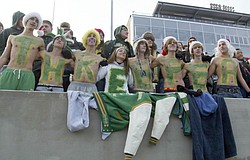
Ursuline State CHAMPS
 Gallery


By Joe Scalzo
and Jon Moffett
Youngstown
A new bylaw could bring better balance to the prep playoffs.
After evaluating its playoff format in several sports, the Ohio High School Athletic Association has proposed a rule that would add multipliers and variables to the divisional rankings used for tournaments.
Schools will vote on the bylaw in May. If accepted, it would go into effect no later than the 2013-14 season.
Currently, teams are placed in divisions based on enrollment only. The proposal would add three factors: school boundary, socioeconomic situation and tradition. Enrollment would form the base number, which would then be multiplied by certain percentages based on the three-part formula.
The school’s boundary would factor in whether a district offers open enrollment, and to what degree.
“If you’re a private school, and your students could come in from literally anywhere, that would be the largest multiplier,” said Canfield athletic director Greg Cooper. “If you were a private school, but you were limited to several dioceses, you would have a smaller multiple.”
The socioeconomic factor takes into account the number of free lunches a school provides through separately-funded programs — the idea being a cash-strapped school system will have a smaller athletic budget.
The tradition multiplier would be based on a four-year sample size — or one full class of students.
Under the proposed bylaw, Mooney’s football team, for instance, would have stayed in Division III last fall, while Ursuline would have moved from Division V (where it has won the last three state football titles) to Division IV.
Although competitive balance has been an issue within the state for several years, Howland football coach Dick Angle said he isn’t sure the proposal is the answer.
“The system does need to be tweaked, but I don’t know if it needs tweaked as much as they’re trying to do it,” said Angle, whose school has a limited form of open enrollment in that it replaces only the students who leave the district. “You’ve got to have a doggone calculus degree to find out where you’re going to be.”
Between 1999 and 2010, 43 percent (146 of 340) of the state championships in selected team sports were won by non-public schools, even though non-public schools make up only 17 percent of the total membership of the OHSAA.
“The unfortunate thing is enrollment is going down in the state of Ohio but while the parochials’ enrollment has gone down, the talent level hasn’t necessarily changed,” said Angle. “I know the kind of athletes Ursuline has; I had the same 60 great-looking athletes. The difference is, there were 1,000 students when I was there. Now they have 400.
“If I were a Division V team, I probably wouldn’t be very happy playing them. But if they move up to I or II or III, those schools aren’t happy, either.”
Under the proposal, the changes would initially only apply to football, soccer and volleyball in the fall, basketball in the winter and baseball and softball in the spring.
Since 1999, Mahoning Valley teams have won 15 state titles in those sports. Ursuline won six (four in football, one in girls basketball and one in baseball), with Mooney won four (three in football, one in boys soccer). Boardman (softball in 2001), Canfield (baseball in 2007, softball in 2008), Poland (football in 1999) and West Branch (girls basketball in 2004) have the others.
Ursuline athletic director Sean Durkin said he has no problem with the enrollment multiplier as long as public schools with open enrollment face the “same kind of consequences.”
“It’s not every time where you have a private school advantage,” said Durkin, who met with other Catholic school athletic directors last summer to discuss the OHSAA’s study. “There are a lot of public schools with open enrollment that are just as big as the private schools and their students don’t have to pay tuition.”
Durkin said he questions the merit of factoring in recent success.
“It kind of seems like they’re punishing people who have been successful,” said Durkin, who coached the Irish to a Division III baseball title in 2000 and a Division III girls basketball crown in 2004. “But we’re kind of tired of hearing that every time we have success, it’s because we’re a private school.
“Just put us where you want to put us and we’ll do the best we can to compete.”
Mooney football coach P.J. Fecko said he doesn’t see the bylaw causing significant changes.
“In the big picture, it doesn’t matter,” he said. “I’ve seen studies of other places as far as using multipliers [for schools drawing from several districts] and there was one in particular where, five years later, the statistics were exactly the same as far as the number of champions.
“So, I don’t think it’ll be anything earth-shattering.”
Fecko said the team was just two students over the Division IV limit, so the bylaw would likely only affect the Cardinals if they dropped back down to Division IV, where they competed for much of the last decade. Fecko said he thinks schools in Division I — and possibly Division II — might actually be inclined to vote against the bylaw, since it will only serve to increase competition in those divisions.
“Anything you throw out there is going to have critics,” he said. “How people vote is going to depend on how it affects their particular situation.
“For us, I don’t care what division we’re in. Just roll out the ball and we’ll play.”
Although the proposed bylaw would primarily affect postseason play, there would be an added benefit in the football regular season. Beating a Division IV Ursuline team, for instance, would be worth more computer points than a Division V Irish team.
“Maybe if we go up in divisions, we can get a local team to play us in football,” Durkin said.
| Player | Team | Yds |
|---|---|---|
| Click here for more |
| Player | Team | Yds | Click here for more |
|---|
| Player | Team | Yds | Click here for more |
|---|

Subscribe Today
Sign up for our email newsletter to receive daily news.
Want more? Click here to subscribe to either the Print or Digital Editions.
AP News