 43
43

V&M Star Steel tells cities: No deadline? No problem
 Photo
Photo
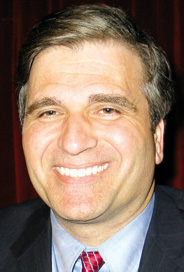
Girard Mayor James Melfi
 Photo
Photo
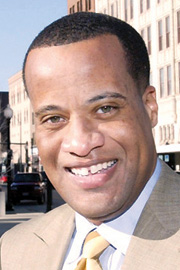
Youngstown Mayor Jay Williams
 Photo
Photo
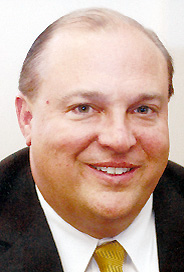
Youngstown finance director David Bozanich
By DAVID SKOLNICK
CITY HALL REPORTER
Though a final deal between Youngstown and Girard won’t be done today, officials in the cities say there’s no concern that V&M Star Steel will kill a potential $970 million expansion project.
Youngstown and Girard reached a tentative deal in meetings with V&M officials earlier this week after the company said it wanted a deal on land needed for its potential expansion immediately, or the company would look elsewhere.
The company’s officials are satisfied the two cities are making progress toward a written contract and aren’t concerned that a final deal isn’t signed, said Girard Mayor James Melfi, Youngstown Mayor Jay Williams and Youngstown Finance Director David Bozanich.
“V&M officials are reasonable,” Bozanich said. “We’ve made significant progress. The framework is in place. We have to get it wrapped up shortly.”
As a condition of the potential expansion, V&M officials insist that the land for the project be in Youngstown.
V&M officials have declined to discuss the potential project.
A final deal to transfer the land to Youngstown for the V&M proposal could take up to three months, Bozanich said.
Girard City Council has to approve legislation on the deal. Also, both cities have to approve the final agreement that would include transferring land from Girard to Youngstown.
County commissioners in Mahoning (Youngstown) and Trumbull (Girard) also have to approve the agreement.
Trumbull County Commissioners Dan Polivka and Frank Fuda and Mahoning County Commissioner John McNally IV say commissioners support the project and the land transfer as long as Youngstown and Girard support the deal.
Also, the acreage needed for the expansion project continues to change.
It was initially about 80 acres in Girard, but Melfi confirmed Tuesday that the amount was 192 acres.
Bozanich said about 160 acres of Girard’s land is now needed.
“There are a lot of ways to reconfigure this project,” Williams explained. “The fewer acres needed [from Girard] to get this done properly, the better. The goal wasn’t to grab as much land by the company. It was to be done in the most-efficient manner as possible.”
That figure could still change, Williams said.
Melfi is still upset that the boundaries of the cities are being changed for the project.
“The numbers keep changing, and it’s frustrating,” he said.
Melfi also said changing the boundary lines is “a nice way of saying, ‘It’s a land grab.’ It’s the same thing as annexation.”
The final agreement between the two cities will include language that splits a 2.75 percent corporate-profit tax from V&M as well as a 2.75 percent income-tax collection on employees at the potential expansion site.
Youngstown currently collects those taxes from the company’s Martin Luther King Jr. Boulevard location.
A key issue is figuring out how much of the 2.75 percent taxes for a potential new facility would create. The two cities are to share that new revenue.
Youngstown sent a proposal late Wednesday to Girard that provides the average tax incomes from V&M over the past few years.
“We’re looking for a long-term average,” Melfi said.
He pointed out that 2008 was V&M’s best year financially and this year is the company’s worst.
Officials in both cities refused to disclose the amounts.
Bozanich said that the expansion, should it occur, would generate more tax revenue for the cities than V&M’s current facility.
Melfi said he is very concerned that Girard is giving up the land needed for the V&M expansion and his city could end up with no tax revenue.
“If you think possession is nine-tenths of the law, there is concern” about tax sharing, Melfi said. “I would certainly hope with the legal minds on this very public project that it would be straightforward, but I’m concerned.”
The contract would be a “legally binding agreement,” and “there’s no way on Earth that” Youngstown and Girard wouldn’t split the tax, Williams said.
Failing to do so “goes to the credibility of the city,” he said.
“This is the biggest project in the last 20 years in this area,” Williams said. “If I have to, I’d deliver the check to Girard myself. It’s a binding document.”
Girard Law Director Mark Standohar and Youngstown Law Director Iris Torres Guglucello couldn’t be reached Thursday by The Vindicator to comment on the tax-revenue split.
An Ohio attorney general spokesman said the agency isn’t familiar enough with revenue from boundary-line changes to comment on the issue.
V&M won’t make a decision on expanding its local facility until the end of the year.
If the project is a go, construction would take about 18 months, Melfi said.
In the tentative deal, Girard would receive the majority of the income tax generated by construction workers building the new facility.
The estimated income-tax revenue is $5.5 million with Girard getting $3 million and Youngstown receiving $2.5 million.
If the revenue is different from the estimate, Girard would keep that 55 percent advantage over Youngstown in income tax.
Also, Youngstown has agreed to give $400,000 to Girard. That’s what it would cost Girard to install sewer lines to the V&M location.
Girard is to get $200,000 when the sewer installation starts, expected to be sometime next month, and the rest when the project is done.
Youngstown is doing preliminary work on the property it owns in Girard that would be used to house the potential V&M expansion, Bozanich said.
The city spent $5 million to purchase the property. V&M is to repay the city for those purchases sometime late next year.
The city plans to spend about $5 million from a $20 million federal stimulus package grant it received to clean up the environmentally contaminated land, Bozanich said.
It would use about $15 million of the grant to make the land level and usable for V&M, he said.
skolnick@vindy.com