 43
43

The Terleskys struggle to pay for ALS care
Related Stories
By Jessica Hardin
BOARDMAN
The day after her first outing in almost a year, Christine Terlesky slept.
Two hours with her former Boardman High School co-workers May 2 were exhausting, but “it was so worth it,” she said.
The next day she wrote on Facebook: “I have to fight for every word I speak, every breath I take. I fight to live each day. Yesterday, you made my fight a little easier. Those two hours with you made me forget for a little while.”
Many had not seen Christine in years. Recalling their reactions to her physical changes, she said, “They were really good about it.”
Not everyone is.
“I understand it’s a shock to a lot of people, but still, I mean, come on, I’m still living over here!” she exclaimed with exasperation. “You can’t do that to me.”
Upcoming
Chapter 3: May 26 - Managing, coping, caring — and fearing.
When people learn they have cancer, they are encouraged to fight.
When Christine received her diagnosis, she was told to prepare to die.
“I was brought up as a fighter,” she said.
Today, Christine aims her tenacious spirit toward political advocacy.
Via social media and in-person lobbying, Christine has confronted lawmakers. Her next goal is to get Medicare coverage for caregivers.
DAILY SCHEDULE
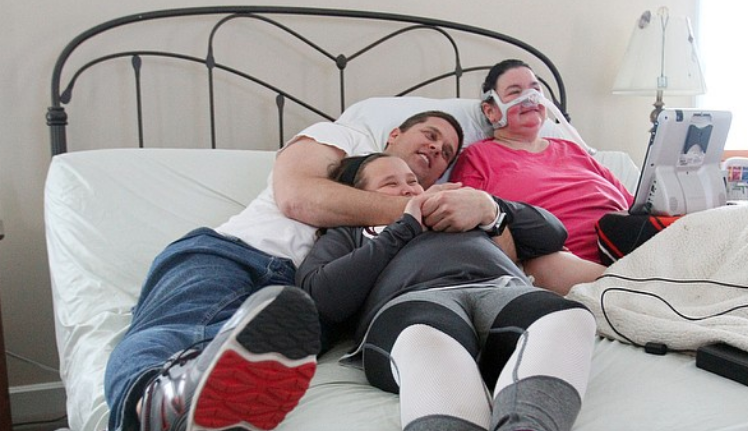
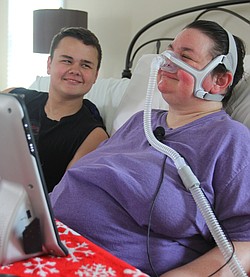
Christine’s survival relies on the sophisticated coordination of a team made up of family members and professional caregivers.
Brian’s parents Mary Lou and Ted Terlesky arrive at 6 a.m. every weekday morning to get 14-year-old Tyler and 10-year-old Emma off to school. They prepare breakfast, pack lunches, do laundry, run errands and maintain the house, which is remarkably tidy given the circumstances.
Ted watches for the bus from the kitchen window. When he sees it circling the adjacent neighborhood, Emma has about two minutes to get out the door. Then, Ted drives Tyler to school.
 Gallery
After working at McGuffey Elementary during the day, Christine’s mother Judy Moschella arrives in the evenings. Christine’s sisters, Nadine and Jolene, each take an evening a week to give their mom a break.
“It takes both families to take care of this family,” observed Ted.
In 2016, when Christine lost the ability to walk, the family started hiring caregivers for extra help. Today, caregivers are essential.
“Now I can’t be left alone,” she said.
They feed and bathe her and massage those muscles that can’t move on their own.
One of six caregivers arrives every weekday morning and works until Christine’s husband Brian returns from work. It’s cheaper to hire independent caregivers rather than use a company.
Ted is in charge of scheduling, and though he’d never say so, it’s a daunting task.
“They all have other jobs. They all have other families,” he said, noting a last-minute scheduling issue can be devastating.
“When someone calls off, it’s a bad day. I can’t eat ... can’t go to the bathroom. So we try to make sure someone’s always here,” Christine said.
EXPENSIVE BATTLE
Although home health care is essential to Christine’s survival, health insurance does not assist with the hefty cost.
Christine Terlesky ALS Series 2
 Video Set
Christine is on Medicare, and while Medicare includes a home health care benefit, the law requires that services provided be considered “skilled” care.
Medicare considers the support Christine needs “non-medical.”
Currently, caregivers provide assistance to Christine for about 25 hours per week. This service ends up costing the family nearly $30,000 a year.
“Put it this way, having ALS is expensive as hell,” Brian said.
Like other families faced with daunting health care costs, Christine’s family crowd funds expenses. There’s a fund at Huntington Bank called “Chip in for Chris.” Her family also started a GoFundMe page.
Budgeting for amyotrophic lateral sclerosis is challenging, because the arc of the illness is so unpredictable.
“But you don’t know how long I’m going to be. You can’t plan for it,” Christine said.
TRIP TO DC
If ALS-related expenses are hard for her family, Christine can’t imagine how others manage.
“What I kept thinking about was all those people who have nothing and nobody and what happens to them and how they’re cared for,” Christine said.
Christine made her first foray into advocacy on a trip to Washington, D.C., with the ALS Association in May 2014.
Each year, the lobbying group gathers people with ALS and their families to advocate for increased funding for research on the disease. She fondly remembers being part of a “platoon of wheelchairs” that descended upon the capital.
It was on that trip that Christine and her sisters met U.S. Rep. Tim Ryan of Howland, D-13th. What could have been a forgettable one-off conversation instead sparked a close friendship.
“We all went out to dinner and had the best time,” Ryan said. “We laughed the whole night.”
SOCIAL MEDIA
Christine’s group met with several politicians throughout the trip. Most were sensitive and responsive. When a former congressman appeared to ignore them, she blasted him in a Facebook post.
“I told him that he didn’t even have the decency to give a pat on the back to his own constituents. I was harsh, but I didn’t call him names or anything,” she said. Five years later, the incident still visibly riles her.
As she tells the story, his office called the ALS Association to tell them to “shut her up.”
“I guess they got thousands of phone calls,” she said, laughing.
When you have ALS, she explained, “you don’t care what you say to people.”
Her tenacity, which thrived on the basketball court and in the classroom, has found a new home on social media. She uses Facebook and Twitter to post political opinions and updates on her condition.
In a recent post, she speculated that she “must’ve been a real a-hole” in a past life to be punished with ALS in this one.
“I’d see her posts on social media and I would just giggle,” Ryan said. “I know what she’s going through, and yet she’s on social media fighting the fight.”
POLITICAL FRIENDS
At 6 a.m. April 4, Ryan texted Christine to tell her he planned to announce his presidential bid later that day.
That afternoon she was brainstorming mottos for him.
“I told Tim he could use me as a prop if he wants to. Roll me out there, Tim!” she said, the prospect lighting up her face.
After they met in 2014, Ryan arranged for Christine to meet then-candidate Hillary Clinton.
Tears streamed down the congressman’s face as he watched Christine talk to Clinton about her plight.
“It was one of those surreal moments. ... It was beautiful, really heartfelt. It was real,” Ryan said.
Clinton saw her at a rally after their one-on-one, and said, “There’s my teacher.”
Christine also met U.S. Sen. Sherrod Brown, D-Ohio, who invited her to a roundtable on Medicare at Mercy Health’s St. Elizabeth Youngstown Hospital. About a dozen advocates shared stories of their interactions with the American health care system.
While we live in a world that demands facts, it’s often personal stories that compel people to act, Brown said.
“She moved people with her story,” Brown said. “She had an impact, because people see what happens with ALS and when insurance companies deny coverage when we don’t write laws in the best, most precise way.”
NEXT STEPS
May is ALS Awareness Month. For the first time, the ALS Association is advocating for home health care.
In a survey, nearly three-quarters of respondents reported requiring assistance.
Ryan sees this plight as a social justice issue.
“People work really hard to take care of our parents and family members. They should have a living wage. It’s an important job. Having Medicare cover that is appropriate,” Ryan said.
On Facebook, Christine said she hesitates to give advice to people diagnosed with ALS.
“One thing I can say is that ALS is one of the cruelest diseases to exist. It will take everything from you. The most unluckiest get abandoned by their loved ones, they lose all their money, their houses. No one there for you and you can’t even scream, because ALS took that, too. Most are like me, trying to scrape by with a supportive but very tired family.
“ALS is unforgiving, there is no reprieve, no days off,” she said. “I just think it’s impossible to prepare for it.”
While it may be impossible to prepare for ALS, with every loss, ALS prepares you for the end.