 43
43

1 pistol's path covers 3 crimes, 9 years in Y'town
By JOE GORMAN
jgorman@vindy.com
YOUNGSTOWN
It’s a mystery that likely never will be solved, even though a man was convicted last month of murder.
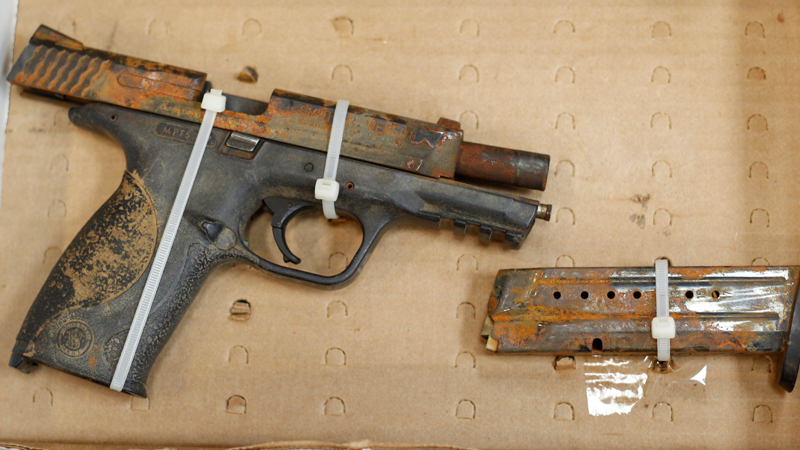
Police and prosecutors can’t figure out how a Smith & Wesson 9 mm M&P9 semiautomatic pistol that was legally purchased in 2008 ended up being involved in three crimes beginning in 2009, including the 2017 shooting death of a woman on the West Side.
They know it was made in 2007 and bought legally in 2008 by a man in Liberty Township from a store in Boardman – and it was never reported lost or stolen.
In 2009, it was used in what police described as a shootout on the South Side where possibly three weapons were fired. In January 2017, it was used to damage several cars in the parking lot of a Tyrell Avenue apartment complex.
On June 23, 2017, it was used to kill Rae’venne Faircloth-Thomas, 24, who was found with six gunshot wounds to the head in an SUV on
Oneta Street. On June 30, 2017, the gun was found by a fisherman in Mill Creek Park wrapped in a white Walmart bag.
Last month a jury in Mahoning County Common Pleas Court convicted Dashonti Baker, 26, of murder and being a felon in possession of a firearm for the death of Faircloth-Thomas. Police said she was killed because of a property dispute. He will be sentenced later.
Detective Sgt. Michael Lambert, the lead investigator on the murder case, said he was interested when tests showed the gun was linked to the homicide and two other crimes. He looked for the owner to see if he could figure out how the gun changed hands, but when he went to the home listed on records when the gun was purchased, someone else was living there. Lambert could not find the man and thought he hit a dead end until he saw his obituary sometime in August 2017.
For Lambert, an experienced homicide and robbery investigator, it is not uncommon to find out a gun used in one crime has also been used in others.
“It seems to me when it does happen, it’s connected to a bunch of crimes,” Lambert said.
Police Chief Robin Lees criminals get their hands on guns in several ways, and his department has just about seen them all. Baker is not allowed to have a gun because of a prior felony conviction, which is legally known as “having weapons under disability,” the disability being a criminal record prohibiting him from owning, possessing or being around a firearm.
One of the most common ways a person prohibited from getting a gun can get one is through a straw purchase, Lees said. He said in that instance, someone, usually a girlfriend who has a clean criminal record, goes to a gun store, passes a background check, buys a gun legally, then gives it or sells it to someone who is not
allowed to have it.
GUN SHARING
Often, people will barter a gun for drugs or some other kind of illegal commodity, Lees said. Guns are stolen and used in crimes also, Lees said. Sometimes, a gun will be passed around in a gang where resources are scarce.
“If you have a closely knit crew, other members of the group will use the gun,” Lees said.
He said it is not uncommon, for example, to see a 9
mm gun used in a crime and officers will collect two or three different types of
9 mm ammunition fired from the same gun. Sometimes bullets are hard to come by, Lees said.
The department does not keep specific statistics for the number of guns in the city that may have been reported lost or stolen, but it does keep track of how many guns it seizes, either because of criminal activity or other reasons, such as for safekeeping. In 2018, the department seized 200 guns, down from 402 in 2017.
From 2014-2018, the department seized 1,216 guns, including a high of 402 in 2017.
One statistic lacking, however, is the number of guns used in homicides. Chief of Detectives Capt. Brad Blackburn estimated that detectives find the murder weapon in less than half of their cases.
Blackburn cited several reasons why that number is low, such as the most obvious one, where suspects get rid of the gun. But sometimes they’ll keep a gun, especially if their own resources are scarce and they had trouble finding a gun.
Even after Baker’s conviction, a bit of mystery lingers.
Although prosecutors introduced the gun in the trial for jurors, they were never able to link it to Baker, who did test positive for gunshot residue the day of the murder. His DNA was not found on the gun, and there was no testimony from anyone who saw him with a gun.
The gun used to kill Faircloth-Thomas retails for $559 new on the Smith & Wesson website. It was first developed in 2005 by Smith & Wesson for the needs of military and law enforcement. It can hold a 17-round magazine as well as a round chambered to fire. It weighs 27.9 ounces. Its purpose, according to Smith & Wesson, is “home protection, recreational shooting and state compliance.”
2009 INCIDENT
The gun first appeared on the radar of Youngstown police Aug. 27, 2009. According to a report by then-Patrolman and now Detective Sgt. William Ward, he was called to Dorothy Avenue and Gibson Street to investigate a shootout between two people in the area of Lee Street and Gibson Avenue. A man inside his Dorothy Avenue home saw someone outside and then ducked when he heard a gunshot. There was a bullet hole in the south-facing wall, reports said.
Two women were walking on Gibson Street at the time of the shooting and ran to a Lee Street home to call police. In front of a home in the 500 block of Dorothy Avenue Ward found four .40-caliber shell casings, and another .40-shell casing in a field between two houses in the 600 block of Lee Street. A 9 mm casing was found, but the report does not say where that casing was recovered.
Ward reported that the shootout stemmed from an argument over a stolen ATV at a home on Dorothy.
The second time the gun was used that police know about was on Jan. 21, 2017, when officer Darrick Ball and two other officers were called about 11:30 p.m. for a report of gunfire on Tyrell Avenue. Three vehicles were damaged by gunfire, with windows shot out and hoods damaged. There, officers collected eight 9 mm shell casings and a .40-caliber shell casing.
The third time the gun was used in a crime was in the killing of Faircloth-Thomas . In her SUV, police found several 9 mm shell casings.
About a week after her death, on June 30, 2017, a fisherman found the gun in the water near the Artist Trail in Mill Creek Park. Park police called city police to ask if they had any open cases where a 9 mm gun may have been used because the gun did not appear to have been in the water for long. Lambert told them he had a recent homicide where a
9 mm was used, but he did not have the gun.
Officer Greg Miller of the city police crime lab was sent to retrieve the gun, which had an empty magazine that could have carried 17 rounds.
It was test fired and the bullets and casings were compared in the National Integrated Ballistic Information Network, run by the federal Bureau of Alcohol, Tobacco, Firearms and Explosives. ATF keeps a database of ballistics information collected all over the country. That’s when Lambert learned of the gun’s use in other crimes, including his homicide case.
WOMAN KILLED
When Faircloth-Thomas was killed, police found a .40-caliber handgun and
9 mm handgun in her SUV. Both guns were registered to her, and she had a concealed carry permit. They were never fired.
Lees said those who can’t have a gun but need one can often find one if they know who to ask. He said if they know people who break into cars or homes, they can put the word out that they need a gun. Recently, detectives arrested a man on a burglary charge and when they found where he stashed the goods he stole, they found a gun that had been stolen.
It is often easier for someone who hangs around with people engaged in criminal activity to get a gun if they have no legal way to get one, Lees said. But he also said if someone has a will, they most often are able to get their hands on a gun.
But no one will be able to get their hands on the gun that killed Faircloth-Thomas again. It will stay in evidence after appeals in the case are exhausted, and then it will be destroyed once a court order approving its destruction is obtained.
The gun will most likely be melted at Vallourec Star, where police for years have taken guns to be destroyed.