 43
43

Poland Historical Society unearths letters from local Civil War soldiers
By jessica hardin
jhardin@vindy,com
POLAND
Poland Civil War Letters
 Video
Video
The Poland Historical Society recently acquired a set of letters from tow Poland men who served in the Civil War.
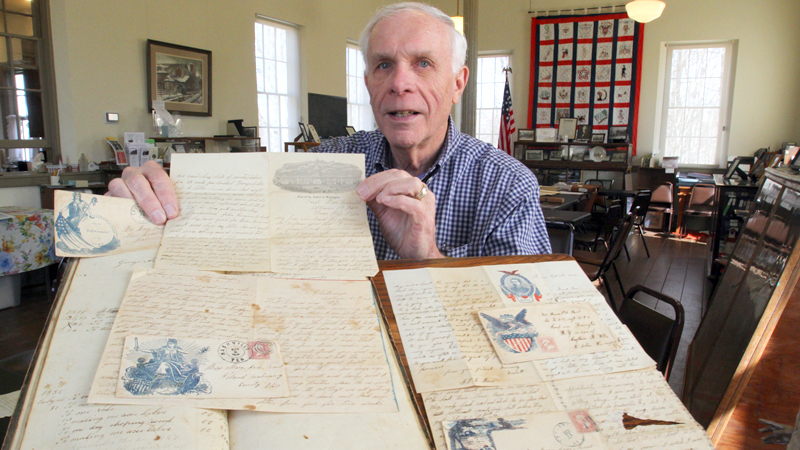
In the process of archiving items at the Little Red Schoolhouse on Struthers Road, Poland Historical Society secretary Dave Smith found a plastic box containing a bag of tiny envelopes.
Written in permanent marker on the bag was: “Donated in memory of Martin Kalal.”
“None of us have any idea who Martin Kalal is,” said Smith.
But upon further inspection, Smith learned that the letters were sent during the Civil War to and from James Nesbitt and Isaac P.C. Raub, Poland residents in Company H of the 105th Ohio Volunteer Infantry of the Union Army.
The two men were brothers-in-law. Shortly before departing for war, Raub married Nesbitt’s sister.
“The first letter is from Cleveland, when [Raub] first got there. ... He tells [his wife] that he trusts he will return from the war safe and sound. He says there’s a great deal of swearing and bad habits taking place in the camp. But he trusts in God that neither he nor any of the Poland men will join in,” Smith said.
The 105th infantry mustered in Cleveland in August 1862, traveled to Cincinnati by train and marched to Lexington and Louisville. An encounter with Confederate soldiers forced the group to retreat.
Nesbitt and Raub “were at the end of the line in the retreat. A lot of the food and water they foraged along the way was already taken. They had a very rough time getting back to Lexington,” Smith said.
Smith was struck by the loneliness evident in the letters and the deprivation the men described.
“You hope to find something really interesting, some big event that happened, but most of them are pretty routine. ... They played music, sang songs, told stories, reminisced just to pass the time. Despite that, at night they would, I’m sure, climb into their tents and miss being back here in Poland, Ohio,” Smith said.
Raub never did return. He got sick and died in a Chattanooga hospital Dec. 25, 1863. His brother-in-law went on to join General William Tecumseh Sherman’s March to the Sea.
“There were so many union soldiers going down there that they had to forage for food 20 miles out from where they were to get corn and whatever they could find,” Smith said.
Despite the campaign’s hardships, Nesbitt returned safely from war.
“He was quite a prominent citizen in Poland. He became the postmaster. He was also a contractor, and we think he had a lot to do with building the Poland Presbyterian Church in 1897,” Smith said.
His house still stands across from the Presbyterian church.
The dozens of letters make clear the importance of letter-writing to people at that time.
“Many of them, they couldn’t spell everything real well, but they must have been taught how to write a letter, because many of them at the beginning will say, ‘I take my pen in hand this afternoon to inform you that I am well and hope that these few lines find you enjoying the same blessings and all the rest of the family,’” said Smith.
Many of the letters written by the soldiers were on stationery embellished with artwork depicting battle scenes or poems.
“We’re still talking about [what to do with the letters]. There’s even a possibility of publishing a book with pictures of some of them in the book with the summaries included,” Smith said.
For now, they’ve been placed in archival, safe, acid-free plastic sheets and organized in a binder at the Little Red Schoolhouse.
“This process of finding these letters and unfolding them from these very small envelopes really gave me a sense of thrill of working with original primary documents from people over 150 years ago that talk about their lives, hardships, stories, families. And I think it’s important for the future to be able to preserve these so people 10, 20, 50 years from now will see some of the personal issues involved in these young men who went off to the Civil War, Smith said.