 43
43

Students serve spaghetti to fund trip to historic civil-rights sites
news@vindy.com
YOUNGSTOWN
Sarina Chatman attended a spaghetti dinner that gave high-school students an opportunity to raise money for a journey they will soon be taking, and she’s confident they will return with a plate filled with personal transformations.
“I’m hoping they will not only leave the South, but bring this back to their schools, parents and families,” the Youngstown State University senior said, referring to the lessons she hopes those going on the upcoming Sojourn to the Past civil-rights journey will learn and then incorporate in their lives.
Those include standing up to injustices, being more acutely aware of the corrosive effects of derogatory language, racism and marginalization on others and advocating on behalf of those being bullied or experiencing other difficulties, she noted.
Chatman, an interpersonal-communications major who traveled to many of the landmark civil-rights sites through the Deep South in 2012, added she hopes the immersive weeklong bus journey will provide them with a valuable education on people and events related to the civil-rights struggles of the 1950s and 1960s that are too often omitted from most history textbooks.
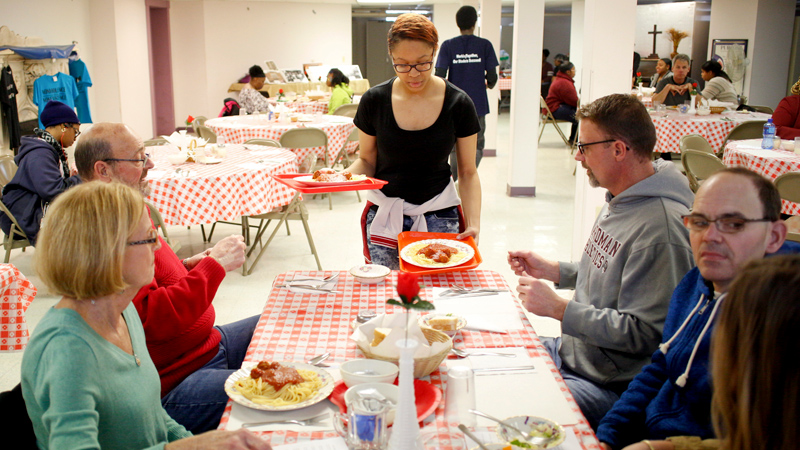
But before they fly to Atlanta to begin their journey later this month, the students are each required to raise $600 of the cost, something they got closer to achieving courtesy of a fundraiser dinner Sunday at Richard Brown Memorial United Methodist Church, 1205 Elm St., on the North Side.
Hosting the four-hour gathering was the Mahoning Valley Sojourn to the Past organization, which is affiliated with the 20-year-old Millbrae, Calif.-based STTP program.
Twelve students from Youngstown Early College as well as East, Chaney and Howland high schools will be among those taking the journey beginning March 29, noted Penny Wells, the organization’s executive director who also is conducting a series of weekly study classes to prepare them for the experience.
The program’s main mission is to empower participants to be more engaged citizens who promote social justice via the six principles of nonviolence espoused by Dr. Martin Luther King Jr.
The traveling hands-on American history experience uses the movement and people associated with it to conduct anti-racism work and provide lessons in human rights that directly tie in with and encourage participants to challenge and take an active stand against many modern societal ills. Those include bigotry, sexism, bullying, violence, hatred and discrimination, its mission statement says.
Students, teachers and others who take part meet and study with veterans of the civil-rights era, such as longtime Georgia congressman and civil-rights icon John Lewis, who suffered a skull fracture March 7, 1965, as about 600 marchers were attacked and beaten on the Edmund Pettus Bridge in Selma, Ala., a day known infamously as “Bloody Sunday.”
In addition, Lewis has been arrested about 45 times beginning in 1960 for what he often refers to as “getting into good trouble,” meaning engaging in nonviolent acts of civil disobedience that meant breaking segregation laws in the Jim Crow South, for example.
Among those eager to go are Bray’den Little, an Early College 10th-grader, who said she hopes to glean a deeper sense of the nation’s history.
“I’m hoping to get a better understanding of multiple things and come home with sort of a changed mindset,” Bray’den said while taking a brief break from serving dinners to attendees that consisted of spaghetti, bread and salads. “Many elderly people experienced a lot, and our generation is blinded to a lot of the stuff they experienced.”
Jenaya Conley, an Early College junior, said she expects to receive deeper knowledge about the civil-rights struggles and return home with a stronger commitment to speak up when she hears someone using derogatory language.
“I said I want to know more about [the movement] and why it’s not in history books,” said Jenaya, who also recalled that a lesson she heard about the Sept. 15, 1963, bombing of the 16th Street Baptist Church in Birmingham, Ala., greatly affected her.
Bray’den and Jenaya added that hearing a lesson last fall from Jeff Steinberg, STTP’s director and founder, also influenced their decision to go.
“I hope they learn the power of their own voice, that they will see how teenagers were able to step out and change this country … and they had the power to make a difference,” Wells explained about her hopes for those who will be leaving in a few weeks. “They just have to realize they have that power.”
“The trip inspired me to be a leader today and use my voice,” said Chatman, who added Sojourn to the Past’s teachings also have coalesced with her Christian beliefs in fairness and treating others with kindness. “I make myself available to people who are experiencing anything that’s caused them grief.”