 43
43

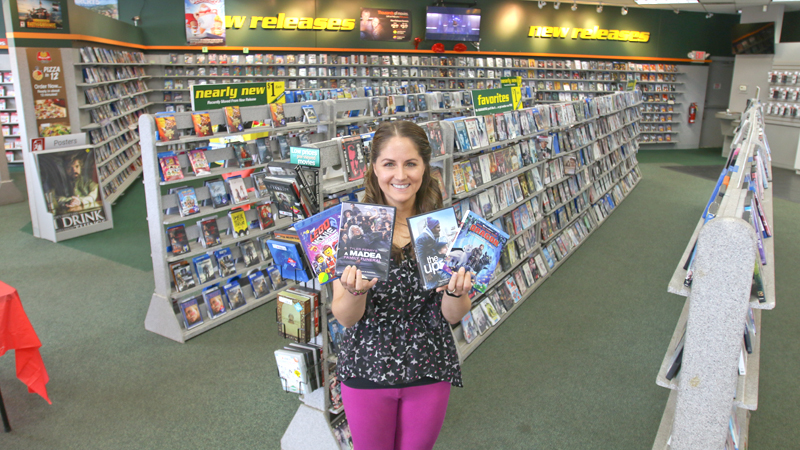
Family Video stores stay relevant in Valley
By JESSICA HARDIN
jhardin@vindy.com
BOARDMAN
To anyone with a Netflix password, the closure of the Family Video in Boardman on June 2 likely came as no surprise.
Of the 15,300 movie-rental shops open in 2007, about 86 percent were closed by 2017, USA Today reported.
But the closure of the Boardman store is not necessarily emblematic of the further crumbling of a bygone industry. Local Family Video District Manager Sarah Matola said the decision was made to fortify the area’s other Family Video stores.
Nearly 10 years after the bankruptcies of Blockbuster and Hollywood Video, four Family Video outposts remain: in Austintown, Girard, Hubbard and Struthers.
When asked why the stores persist, Matola said, “It’s family tradition.”
Kids who grew up on Friday night movie rentals are sharing the practice with their children.
According to the Illinois-based company’s website, Family Video operates more than 700 stores in 19 U.S. states and Canada. The stores are concentrated in the Midwest and rural areas.
While Netflix, Hulu and Amazon Prime have cornered the rental market on convenience, streaming services lack human interaction.
Matola and her 30 regional employees are movie buffs eager to provide rental recommendations.
Family Video’s physical rental competitor Redbox may seem to be everywhere, but it lacks Family Video’s selection, Matola said.
“We have more movies on our new-release wall than fits in their entire box,” she said.
The secret to staying relevant in an all-but-dead industry is baked into Family Video’s business model.
Matola often fields questions like, “Why is Blockbuster closed?”
“Blockbuster rented everywhere,” Matola said. “We decided to purchase property on busy corners. We knew even into the future if the business slowed down and we own that property, we could do whatever we wanted with it.”
Family Video has three sister companies – Marco’s Pizza, Digital Doc and StayFit-24 – that can be found adjacent to it stores. It also counts among tenants businesses such as Subway and Little Caesars.
When the shift from VHS tapes to DVDs allowed Family Video to take up less space in its buildings, “We were able to have other reasons for customers to come into our parking lots, make it more like a strip plaza,” said Matola.
Family Video’s creative approach to staying relevant took a new form with the gradual legalization of cannabidiol, or CBD, the nonpsychoactive compound found in hemp and cannabis. The product was introduced in stores in Michigan, Missouri and Pennsylvania.
Matola said customers can expect to find CBD in Family Video stores as it is legalized in more states.
“Instead of having to go to a vape shop, or something where families wouldn’t be comfortable going to purchase that, they can come in and they can talk to us,” Matola said. Employees are even trained on educating about CBD.
In the meantime, Matola will be strengthening her district’s stores by engaging with the community. Currently, the Report Card A program allows local students to bring their report cards to the stores and get free rentals for each “A.”
Matola, who has worked for the company 13 years, said the company’s focus on community engagement makes for a unique shopping experience. She knows her customers and has even hired people who were customers as children.
And that, more than any other reason, might be Family Video’s secret to its longevity.
“It really comes down to people,” Matola said.