 43
43

Ed Puskas: Phil was more than a football coach
 Photo
Photo
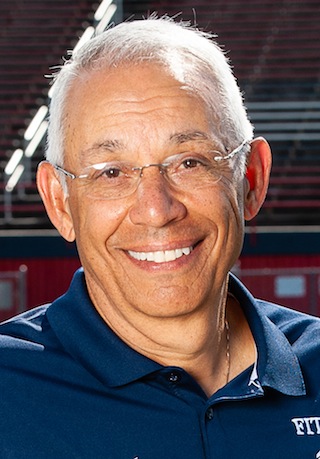
Phil Annarella
A lot of high school football coaches can run drills, call plays, motivate kids and break down film.
The most successful among them do all that and so much more. They build relationships with players that transcend what happens on Friday nights.
Their influence can last a lifetime because the best coaches don’t just coach football. They’re teachers and life coaches who can impact players long after they’ve suited up for the last time.
Austintown Fitch head coach Phil Annarella, who died last week at 70, was just such a coach and man.
Word of Annarella’s death spread quickly Saturday after he was found at his Niles home by a family member. Annarella, a widower who lived alone, had uncharacteristically missed several appointments last week, including a Special Olympics event Saturday at Fitch Falcon Stadium.
That’s what prompted Fitch officials to reach out to his family.
Full disclosure: I telephoned Annarella last week for a comment on the Ohio High School Athletic Association’s release of division assignments for the 2019 season. I left a voicemail and when Phil didn’t call back, I wrote the story and chalked it up to him perhaps being on vacation.
I should have known better. It was odd for Annarella not to answer his cell phone and certainly not to call back a few minutes later or perhaps the next day. That’s how he was.
No matter what else was happening, Annarella was a consummate professional in dealing with the press. He was almost always the first coach to submit preseason information and all-district nominations at the end of the year. He did so without being prompted for either. He was always willing to do whatever he could to help us do our jobs.
But the most important work Annarella did was for the kids in a lifetime of teaching and coaching. He impacted thousands of young lives in a career that included coaching stops at East Liverpool, The Rayen School, Warren Western Reserve, Warren Harding, Hickory, Niles and Fitch.
We’re often enamored with numbers in this business and Phil’s were impressive. He was 246-146-3 in 38 seasons as a head coach. He also worked nine more as an assistant.
Annarella spent the last 12 seasons of his career — and life — at Fitch. But perhaps his crowning achievement and strongest testament to his abilities came in 1990 in his first season at Warren Harding.
If you’re not from Warren or didn’t spend time there as a transplant, it might be difficult to understand what a maelstrom Annarella stepped into when he took over as the lone public-school head coach in Warren after the Western Reserve-Harding merger.
Warren — split into opposite sides by the meandering course of the Mahoning River — was a divided city, especially when it came to sports. Kids who had spent their entire lives as West Siders (Reserve) or East Siders (Harding) — you were either one or the other since the 1960s — were suddenly teammates.
The terms of the merger made Annarella, who had been 59-30-2 at WWR, the head coach of the consolidated program. Warren Harding was now the lone school, but the nickname and colors — Raiders and the gold and white — had belonged to Western Reserve. This was a potential disaster in the making.
Annarella was charged with making the forced marriage work. There was nothing in the playbook that covered such an arrangement, especially with kids and a town full of adults on both sides of the river who wanted no part of it.
But Annarella brought the players, and soon the city, together. The Raiders — led by future Ohio State linemen Korey Stringer and LeShun Daniels, running backs Anthony Butler and Myron Elzy, quarterbacks Chris Ensign and Chauncey Coleman and wide receivers Kendal Richardson, Omar Provitt and Tom Powell — went 14-0 and won a Division I state championship, beating Cincinnati Princeton 28-21 at the Akron Rubber Bowl.
Even now, almost 30 years later, Harding’s state title run remains an amazing and monumental accomplishment. It is the must-see high school football movie that has yet to be made.
But in a way, Annarella became a victim of that championship season. When the Raiders didn’t immediately duplicate the feat or become an annual playoff juggernaut, many of the same people who had cheered Annarella’s work began to pick it apart.
Harding fired him after the 1996 season (despite a 51-23 record) and replaced him with Gary Barber, who spent three seasons in Warren. Ironically, it wasn’t until 2001 that the Raiders returned to the playoffs under Thom McDaniels. It always seemed to me that Annarella and McDaniels were similar in their approaches to football and life. Both were stern, but fair disciplinarians who were able to convince players to buy into their vision of the game.
Annarella spent some time as a radio analyst and then returned to coaching with Hickory, then Niles and ultimately Fitch. He was successful at each stop, as he had been in all his previous jobs.
It wasn’t so much the Xs and Os that made Annarella the coach he was, although he had those down. What seemed to set him apart was his ability to unite kids in pursuit of a common goal and get them pointed in the right direction for life after football.
I’m not sure any Mahoning Valley head coach in any sport has done a finer job than Annarella did with that 1990 Harding team. The entire situation could have spun out of control in the hands of a less-skilled leader, but his steady guidance brought together players and fans who had been bitter rivals mere months earlier.
For that reason and many more, Phil Annarella will be missed.
Write Vindicator Sports Editor Ed Puskas at epuskas@vindy.com and follow him on Twitter, @EdPuskas_Vindy.