 43
43

State-of-the-art robot-assisted bariatric surgery in Mahoning Valley
Brought to you by MERCY HEALTH
The mission of Mercy Health has remained steadfast since the Sisters of the Humility of Mary began providing health care services more than 100 years ago. Mercy Health’s core values of compassion, excellence, human dignity, justice, sacredness of life and service are upheld at all of our care locations, blending pioneering technology and innovative equipment to provide the best care possible.
Visit mercy.com for more information or to find a doctor, location or specialty.
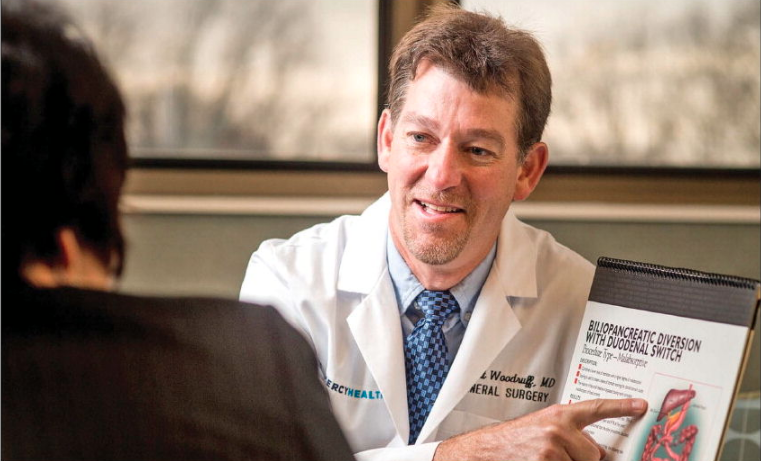
Dr. Robert Woodruff Jr. makes it clear to his weight-loss patients when describing the high-tech robot’s involvement in their bariatric surgery.
“I explain it’s just a tool that holds the instruments and makes it more stable; it doesn’t do the procedure,” he said. “The surgeon controls all the instruments’ movements. In the end, we get very little pushback.”
Bariatric surgery includes a variety of procedures performed on people with obesity. It typically involves removing portions of the stomach or re-routing the small intestine to a small stomach pouch.
Mercy Health-Youngstown is the only hospital in the Mahoning Valley performing robot-assisted weight-loss surgeries, and it has been doing them at St. Joseph Warren Hospital for five years.
In addition to Dr. Woodruff, the Mercy Health surgical weight-loss center’s clinical team includes Drs. Joseph Martin and Benjamin Biteman, both bariatric surgeons. Pre- and post-operation visits are at the Surgical Weight Loss Center in Youngstown.
“We’ve done many of the procedures on the robot and the rest laparoscopically,” Dr. Woodruff said. “We are continuously updating our robotics capabilities to ensure we are using the most up-to-date technology for our patients.”
With the robot, he says, it’s the same as the laparoscopic, or traditional procedure, but it adds 3D vision, a more stable camera and the surgeon is able to control all the instruments him or herself without assistance.
“These are very complicated procedures, so the better we can see, and the easier the technology makes the procedure for us, the better the outcome will be for the patient,” he said.
They’re complex, Dr. Woodruff said, because they’re very intricate.
“The robot holds the three instruments and a 3D camera,” he said. “I control the four arm movements to do the procedure. The instruments have wrists, which make sewing and manipulating tissue much easier than when I do it laparoscopically.”
Each procedure, whether done with or without the robot, takes about an hour.
“I definitely wouldn’t have imagined this technology being available when I was in medical school, but having grown-up playing video games, there are similarities in how you’re controlling something that you’re not literally holding onto, and how you’re looking at a screen when performing the task,” he said.
When consulting with the Mercy Health bariatric clinic, options for medical weight loss can include prescription medications or customized programs where the clinicians closely monitor patients’ progress and assess their progress toward better health. In many cases, patients who choose medical weight management report dramatically improved quality of life.
Candidates for surgical weight loss generally must be at least 18 years old with a history of attempts to lose weight through diet and exercise, and be 100 or more pounds overweight. A candidate could also qualify with serious weight-related problems such as diabetes, high blood pressure, sleep apnea or heart-related issues.
To learn more about Mercy Health-Youngstown’s surgical weight loss options, contact the clinic at 330-480-2866.