 43
43

2016-17 State Report Cards reveal Valley standouts
By AMANDA TONOLI
atonoli@vindy.com
YOUNGSTOWN
2016-2017 School Report Cards
 Document
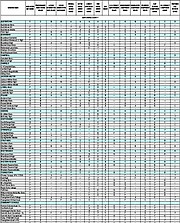
School report cards for Mahoning, Trumbull and Columbiana County Districts and Buildings - 2016 to 17.
Three local school districts stand out as the highest-graded in Mahoning and Trumbull counties, according to the 2016-17 State Report Card released Thursday by the Ohio Department of Education.
Of the 34 public school districts in the counties, only Maplewood Local Schools earned an A on the “Indicators Met” measure of the report card. This measure shows whether student performance on state tests met established thresholds.
The next-highest grade in that measure was a C earned by Canfield and Poland. The rest received D’s and F’s.
The report cards show districts’ and schools’ scores for six components in the 2016-17 school year. The components are Achievement, Progress, Gap Closing, Graduation Rate, K-3 Literacy and Prepared for Success. Within each component, the ODE has given letter grades for many individual measures.
Indicators Met is one of the measures within the six main components.
“In a highly competitive, quickly changing global economy where employers’ expectations are higher than ever, our students must be equipped with the knowledge and skills that will make them lifelong learners,” said Paolo DeMaria, state superintendent of public instruction, in a statement. “We’re seeing increases in achievement across the state.”
Kim Davis, the director of teaching and learning at the Mahoning County Education Service Center, previously told The Vindicator that a new, more rigourous standard for scoring has been used by the state to measure school district success. In 2016, the percentage of students showing proficiency needed for schools to earn a point differed from category to category. This year, the state requires 80 percent of students to achieve proficiency in all categories, regardless of topic.
Davis said this change fails to recognize improvements in the school districts. “If a district reported that 69 percent of students were proficient in reading in 2016 and reported this year that 79 percent of students were proficient, that’s a significant improvement, but it would still fall under the state’s new benchmarks,” she said. “Despite a majority of schools showing improvements across the board, many aren’t going to hit the new benchmark, and that will be reflected on the report cards.”
In the 2016-17 report card, there are no A grades for school districts in Mahoning and Trumbull counties in the “Performance Index” section, another of the measures within the six main components. The Performance Index measures the achievement of every student, not just whether they reach ‘proficient,’ according to the ODE.
Maplewood, Poland and Canfield are also the only districts to not receive D’s or F’s across the entire report card.
Maplewood, the district with the most A grades, earned eight A’s, five B’s and two C’s. A grade wasn’t assessed for one measure that didn’t apply.
Last year Maplewood received four A’s, five B’s, four C’s and one D. Grades last year weren’t assessed for two measures.
“We’re very pleased, because all of our schools were concerned with making changes on the types of test, and (for) what is not on the test issued by the state,” said Maplewood Superintendent Perry Nicholas.
Nicholas said all district officials are happy to maintain A’s in the previous year’s percentiles, and to add the additional four.
“We are very proud of students and faculty’s efforts,” Nicholas said.
Poland Superintendent David Janofa mirrored Nicholas’s sentiment
“We’re extremely happy,” he said. “We’ve got a tremendous staff and great kids.”
Poland got five A’s, five B’s and four C’s. Grades weren’t assessed for two measures.
The prior year, the districts got four A’s, three B’s, three C’s, and four D’s.
But, Janofa noted the challenges that come with changing benchmarks.
“The bar and the target is constantly changing from ODE,” he said. “Those are challenges that I personally, as a superintendent, look at and say, ‘Those are variables that everybody needs to understand when you’re looking at your overall scores.”
He added that Poland is one of only 60 school districts out of the 609 districts that were graded to receive an A, B or C in the Indicators Met category.
“When you only have 60 schools that got an A, B, or C, we might want to be a little critical of how our schools are being assessed,” he said.
Still, Janofa is proud. “Two years in a row, we’re in the top 9 percent of all districts in the state of Ohio regarding our state report card,” he said.
Canfield joins Poland in the top 9 percent with five A’s, seven B’s and four C’s, similar to last year’s five A’s, six B’s, and five C’s.
“We’re very fortunate to have outstanding families giving us the opportunity to educate their kids,” said Canfield Superintendent Alex Geordan.
The report card scores, however, are just test data, he added. “Test data is one statistic ... It’s not the end all be all. We have many means of measuring how our youngsters are doing. This is just one of them.”
Despite being just one of the many ways to measure students’ success, Geordan said the statistics are a benchmark and a means for them to see how they can continue to grow as a school district.
Austintown showed growth with five A’s, three B’s, five C’s, two D’s and one F. This an improvement of the district’s scores last year: three A’s, four B’s, one C, three D’s and five F’s.
Boardman also saw a slight improvement with three A’s, one B, five C’s, one D and six F’s. Last year the district earned two A’s, one B, five C’s, one D and seven F’s.
Youngstown City Schools had slight improvement, earning two B’s, one C, one D and 12 F’s. The district is under purview of Ohio House Bill 70, which put Chief Executive Officer Krish Mohip, overseen by a state-appointed academic-distress commission, in control of the district.
Within this year’s grades Youngstown schools earned its first-ever B in K-3 Literacy. “The K-3 Literacy component looks at how successful the school is at getting struggling readers on track to proficiency in third grade and beyond,” according to the ODE.
Last year the district received one B, two C’s, one D and 12 F’s.
“We really had a strong focus on primary grades for literacy with our First Grade Promise and a district-wide focus on purpose statements and exit slips,” Mohip explained. “It really helps teachers to, every day, teach with a purpose. It all goes back to proper planning.”
The First-Grade Promise is a system Mohip put in place last year to identify first-grade and kindergarten children who aren’t reading at grade level in order to provide the correct intervention.
In addition, the district also saw a 5.6 percent increase in five-year graduation rates.
“We want to attribute these successes to things put in place last school year and we are hopeful for 2018,” Mohip said. “Things are in place now and now it’s time to focus on perfecting all the things we put in place.”
Warren, the Valley’s other urban district, earned four C’s, three D’s and nine F’s. This is a slight improvement from last year’s three C’s, three D’s and 10 F’s.
Contributors: Staff writers Billy Ludt and Jordyn Grzelewski