 43
43

After boy's fall into Yellow Creek, educational signs go up
POLAND
A boy tumbled down a steep bank and into Yellow Creek nearly three years ago, suffering a serious bacterial infection.
On Tuesday, Mahoning County, village, township and school officials came together to mark the completion of a project that was prompted by that November 2014 episode.
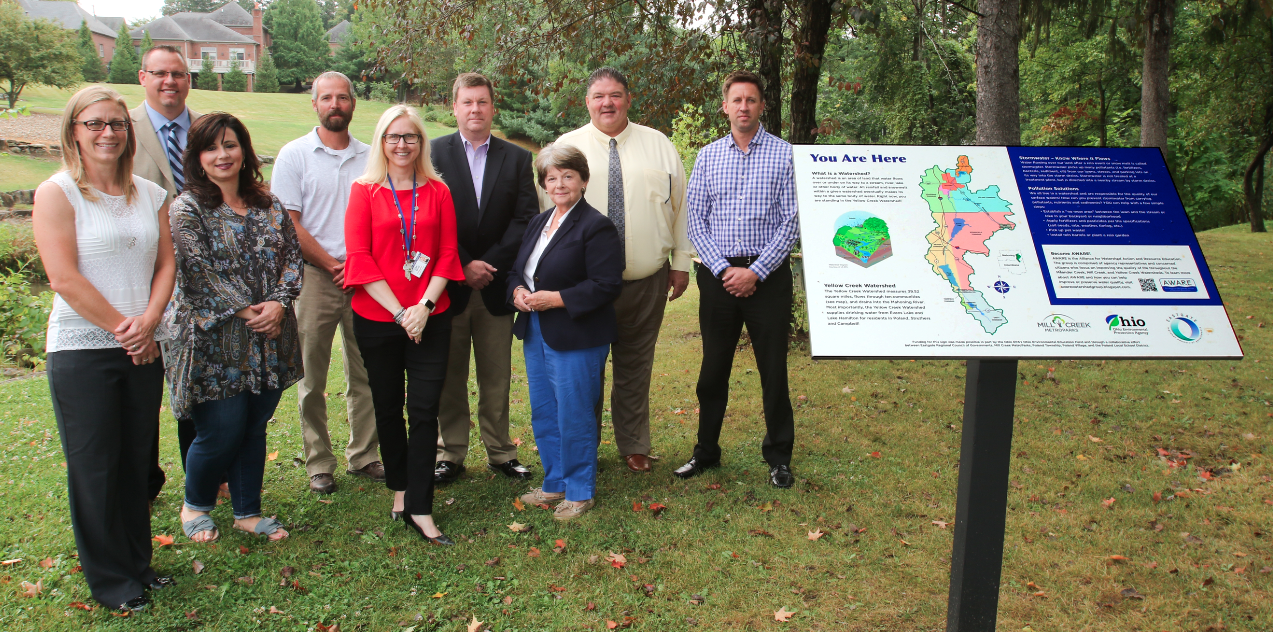
Eastgate Regional Council of Governments, the water-quality management agency for Mahoning and Trumbull counties, unveiled new educational signs about watersheds. The signs are placed at five locations: in front of Poland Seminary High School, in front of village hall, in the Hummingbird Hill neighborhood in the township, in the Poland Municipal Forest and in Yellow Creek Park in Struthers.
“It hit home with me that this is an opportunity to educate people about stormwater in general,” said Stephanie Dyer, Eastgate environmental program manager.
The signs depict the Yellow Creek watershed, a 39.52-square-mile area that flows through 10 communities, including Poland, and drains into the Mahoning River. The signs also explain that a watershed is “an area of land that water flows over or under on its way to a stream, river, lake or other body of water” and has information about stormwater and solutions to water pollution. The signs also feature a QR code that readers can scan with their phones to access the Alliance for Watershed Action and Resource Education’s website.
Installation of the signs is the culmination of about two years of discussions among local officials, prompted by a call to action from the grandmother of Cody Stacy, the boy who fell into the creek. In fall 2015, Barbara Stacy, a retired Poland teacher, began pushing township, village and school officials to do something about water quality. Stacy also pushed for water testing to be conducted in the creek. One round of testing soon after Cody’s accident found dangerously high levels of E. coli bacteria. Another, later round of testing found E. coli counts well below the threshold the Ohio Environmental Protection Agency considers to be a public-health hazard. It is typical for bodies of water to have elevated bacteria levels, for example, 24 to 48 hours after rainfall. The change in bacteria levels highlights a crucial fact, as Dyer said Tuesday: “Stormwater, when it runs over our surfaces, we know it picks up everything.”
Dyer noted the collaboration it took to get the signs in place. Mill Creek MetroParks offered graphic design services; and village, township, county and school officials worked with Dyer to make it happen. Also, high school technology teacher Pat Williams challenged his students to design a flier about water quality. The winning flier, designed by Olivia Morgan, will be made available in public places around the community.
As for Cody, now 15, his grandmother said he has permanent nerve damage in his right kneecap. The infected cut on that knee led to numerous attempts at vacuuming the infection out, three surgeries and a lot of physical therapy.
Although Stacy wanted to prevent kids from having access to the creek at all – a step experts cautioned against, saying the creek is a great place for learning – she said Tuesday she is happy local officials have done something about the issue.
“My goal was to keep kids out of there. But my second goal was to educate – so, I can say the second goal has been accomplished very well,” she said. “I just think it’s wonderful that everybody did what they had to do to keep our kids safe.”