 43
43

Jury quickly convicts Nasser Hamad of aggravated murder and attempted aggravated murder
By Ed Runyan
WARREN
The trial of Nasser Hamad, who is eligible for the death penalty, will enter the penalty phase as soon as Wednesday in Trumbull County Common Pleas Court.
Jurors now must decide whether the aggravating circumstances of killing two or more people outweighs the mitigating factors that Hamad’s defense team will present.
The jury in the aggravated-murder trial reached a lightning-fast verdict Monday afternoon, finding Hamad guilty on all counts, including the specifications that make him eligible for the death penalty.
The panel of six men and six women deliberated only about 11/2 hours before indicating it had reached a verdict.
That was remarkably fast for a trial with more than 30 witnesses over five days. Judge Ronald Rice also noted during instructions that the jury would have 27 verdict forms to review.
The judge spent about 11/2 hours before deliberations explaining the applicable Ohio laws to the jury.
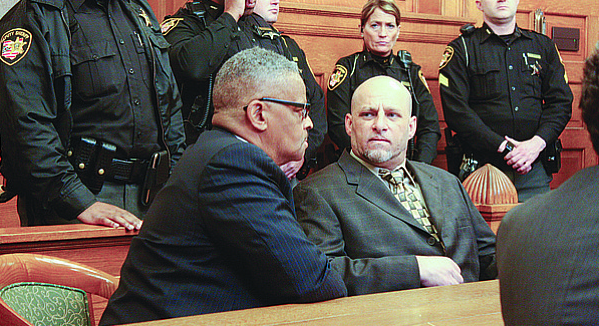
Hamad, 48, of Howland, sat still while the judge read the seven guilty verdicts, including two counts of aggravated murder and five counts of attempted aggravated murder.
The judge warned everyone in the courtroom that no outbursts or reactions would be tolerated, and everyone complied, despite the length of time it took to read the verdicts and the specifications attached to each charge.
Judge Rice said the trial will enter the penalty phase as soon as Wednesday, but David Doughten, one of Hamad’s attorneys, told the judge one of his witnesses will not be available until Nov. 6.
The judge said he would not wait that long, having told the attorneys during jury selection that jurors would have only a couple days off between the guilt/innocence phase and the penalty phase.
The jury concluded Monday that Hamad is guilty of killing Joshua Haber, 19, and Josh Williams, 20, and wounding April Trent-Vokes, 42, Bryce Hendrickson, 19, and John Shively, 17, in front of Hamad’s home on state Route 46 in Howland on Feb. 25.
By convicting him of aggravated murder, they found that he had purposely committed the killings and rejected Hamad’s self-defense argument.
The judge told jurors before deliberations that for a person to assert self-defense in Ohio, he or she must not be at fault in creating the situation that gives rise to the conflict, he or she must have a bonafide belief he or she is in imminent danger of death or great bodily harm and he or she must not have violated any duty to retreat.
Prosecutors have said the five went to Hamad’s house as part of a monthslong feud between Hamad and members of his girlfriend’s family. They’ve said the conflict began with a fight between Hamad and Shively that caused the three other males to get out of the van and join the fray.
After the fight was over, Hamad went into the house and got a gun, walked outside and started shooting at the five as they returned to the van, prosecutors said. After running out of bullets, Hamad returned to the house, got another ammunition clip, returned to the van and fired more shots.
Chris Becker, assistant prosecutor, said Hamad claimed he fired at the five because he feared they had a gun, but he shot Josh Haber just after Haber stood across from Hamad asking why he shot his mother, Trent-Vokes.
Haber gestured with his hands held out while saying this to Hamad, showing Hamad he had no weapon, so why did Hamad fire at him? Becker asked. “He executed Josh Haber,” Becker said.
The evidence showed that none of the five ever fired a gun at Hamad, Becker said. “If you had a gun in that van, you would have been shooting back,” Becker said.
And as for defense suggestions that Shively or Hendrickson may have had a gun but carried it from the scene when they ran away, Becker said that doesn’t make sense. If they would have had a gun, they would have used it, Becker said.
Defense attorney Robert Dixon told jurors during closing arguments that Hamad is a “family man,” businessman and a “hard-working man driving a backhoe.”
Dixon emphasized that Hamad’s actions in shooting the five people had to be evaluated based on what was “reasonable” in Hamad’s mind.
“He has a right to expect peace on his property,” Dixon said. “Every one of us has a right to expect that.”
If jurors would not have reached a verdict Monday, they would have been sequestered, which means they would have spent the night in a downtown hotel, and brought back to the courthouse this morning to continue deliberations.