 43
43

Facing deficit, Youngstown officials consider layoffs
YOUNGSTOWN
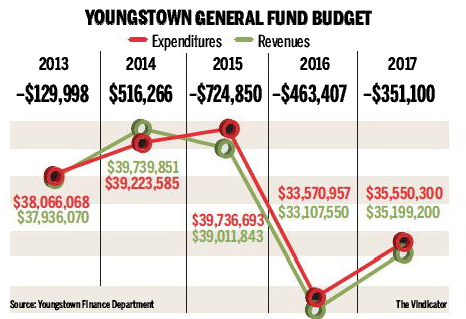
With the general fund facing a $2.5 million to $3 million deficit next year, the city is considering a number of options to make up the projected shortfall, including the reduction of employees through a possible buyout and even layoffs.
But city council members stressed Thursday that layoffs are – as Councilman Mike Ray, D-4th, said – “the last thing on the list. That’s the nuclear option. It’s the last option.”
The city, which has about 750 employees, loses about 10 a year through attrition, Finance Director David Bozanich said. So the city would lose about 20 between this year and 2018, he said.
It likely needs to shed as many as 40 employees by the end of next year, Bozanich said.
“We’ll look at attrition first and, if need be, have a buyout program and possible layoffs as a third possibility,” he said. “I don’t want to be an alarmist and say, ‘40 people are being laid off.’ But for 2018, we have a $2.5 million to $3 million deficit.”
The biggest savings through layoffs, Bozanich said, would be in the following departments: police, fire, courts, park, street and health. Each layoff would save the city about $70,000 a year, except the first year, when it would be $40,000 because of unemployment expenses.
The possibility of layoffs and the deficit doesn’t come as much of a surprise as Bozanich first publicly mentioned both in March when council was adopting the 2017 budget.
The city typically spends more general-fund money than it brings in and has gotten to the point where carryover dollars from previous years are virtually nonexistent.
The biggest general-fund expenses are employee salaries and benefits.
“If we can’t do attrition then we’ll have to do layoffs, but we have options,” Bozanich said Thursday.
A buyout incentive wouldn’t save the city any money during the first year primarily because of the cost of the incentive as well as severance payments to those departing employees for unused sick, vacation and other time, Bozanich said.
But after the first year, the city could save about $70,000 annually per employee, he said.
The city could see a 5 percent increase in its income-tax collections next year, which would resolve the problem significantly, said Bozanich. But he acknowledged that the city hasn’t seen an increase of that amount in about a decade.
The income-tax increase this year compared with 2016’s is about 1.75 percent greater, and the amount budgeted was a 2.5 percent increase, Bozanich said. The projected increase for 2018 compared with this year, he said, is only 1.5 percent.
Adding to the city’s financial problems is it will lose about $500,000 annually in rent for a building it leases in the Salt Springs Road Business Park to AT&T in May 2018.
Among the options to generate short-term revenue, Bozanich said, include finding a new tenant for the AT&T building or selling it and other city assets, and using money obtained through speed-camera fines for the general fund. The cameras bring in about $800,000 annually, he said. The police department uses that money to purchase equipment, primarily vehicles.
“In the short term, selling assets gets you through one year, but it’s not a long-term solution,” said Councilman T.J. Rodgers, D-2nd.
Bozanich later added: “You need long-term solutions to eliminate $2.5 million to $3 million, and that comes from personnel, whether it’s attrition or buyouts or layoffs.”