 43
43

Jury deadlocked in Hamad murder trial, but will resume deliberations today
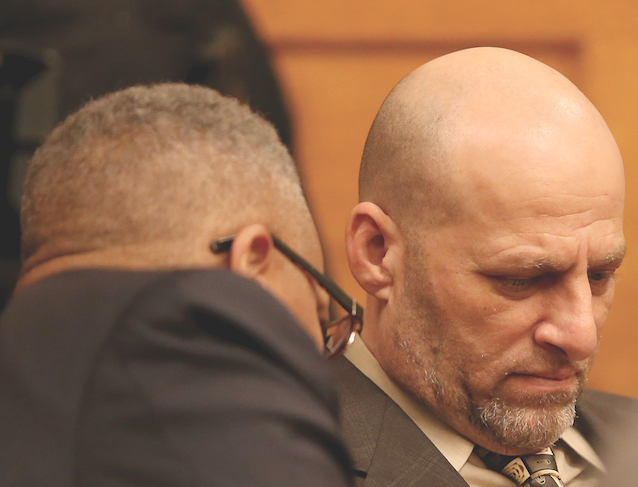
By Ed Runyan
WARREN
The jury in the Nasser Hamad aggravated-murder trial concluded it could not reach a decision on punishment for Hamad about 9 p.m. Tuesday and was sequestered at a local hotel overnight.
The jurors will resume deliberations at 9 a.m. today.
Judge Ronald Rice called the jurors and lawyers into the courtroom and allowed spectators and news media in the courtroom as he announced the deadlocked deliberations.
The judge said the jury of six men and six women would not be allowed to have their cellphones at the hotel but would be allowed to call their family from the hotel. As always, they were cautioned not to read any news media accounts or talk about the case to anyone, or allow anyone to talk about it in their presence.
The jury began to deliberate at 10:07 a.m. Tuesday. Subtracting two 15-minute breaks and a one-hour dinner, the group deliberated for about 91/2 hours. They ate lunch in the deliberation room.
That is a contrast with the decision that same jury made in the guilt/innocence phase Oct. 30, when they found Hamad, 48, of Howland, guilty on all counts – two counts of aggravated murder and six counts of attempted aggravated murder – in a little more than 11/2 hours.
Hamad killed Joshua Haber, 19, and Joshua Williams, 20, and injured April Trent-Vokes, 42, her son John Shively, 17, and Bryce Hendrickson, 19, Feb. 25 in a confrontation with the five in front of Hamad’s home on state Route 46 in Howland.
Jurors asked the judge several questions throughout the afternoon, but the content of the questions is not known.
If the jury becomes deadlocked and does not reach a decision, it is believed that Judge Rice can decide Hamad’s punishment, but he would only be allowed to pick one of the three life options available to the jury – life in prison without parole or life in prison with parole eligibility after 25 or 30 years.
Prosecutors and one of Hamad’s defense attorneys gave closing arguments in the case that lasted less than an hour when the trial began for the day at 9 a.m. Tuesday. Afterward, the judge gave jury instructions.
In his closing argument, Chris Becker, assistant prosecutor, downplayed the value of the mitigating evidence from Hamad’s family and work acquaintances Monday, saying: “What daughter or son doesn’t think their father is a good father?”
Then Becker said to put all of that testimony on one side of the justice scale and put the aggravating factors of killing two people and attempting to kill three others on the other side of the scale.
“Does any of that really shift the scale much?” Becker said of the praise heaped upon Hamad.
David Doughten, one of Hamad’s attorneys, said the death penalty is for “the worst of the worst” offenders, which he said Hamad is not. “I think we can agree that the death penalty is reserved for the worst of the worst,” Doughten said.
Doughten noted that Hamad had no criminal record before this incident.
“You should also consider mercy based on the evidence,” Doughten added.
Doughten said the Ohio Legislature has provided each juror with “incredible power. Each one of you has the ability to preserve a life. And based on the evidence from the case and in mitigation, this is a life worth preserving.”
Becker said Dr. James Reardon, the psychologist Hamad’s defense team is paying $12,000 and who diagnosed Hamad with post-traumatic stress disorder, appears to have some “bias in this case.”
“He wants to equate this defendant as having post-traumatic stress disorder with soldiers and battered women,” Becker said, adding that Reardon didn’t say much when asked if any soldiers in Iraq, Afghanistan, Germany or Japan ever “ran up to enemy lines” and taunted the enemy with remarks like the ones Hamad made toward the young males who came after him Feb. 25.