 43
43

First quarter casino tax revenue falls slightly
ohio
COLUMBUS
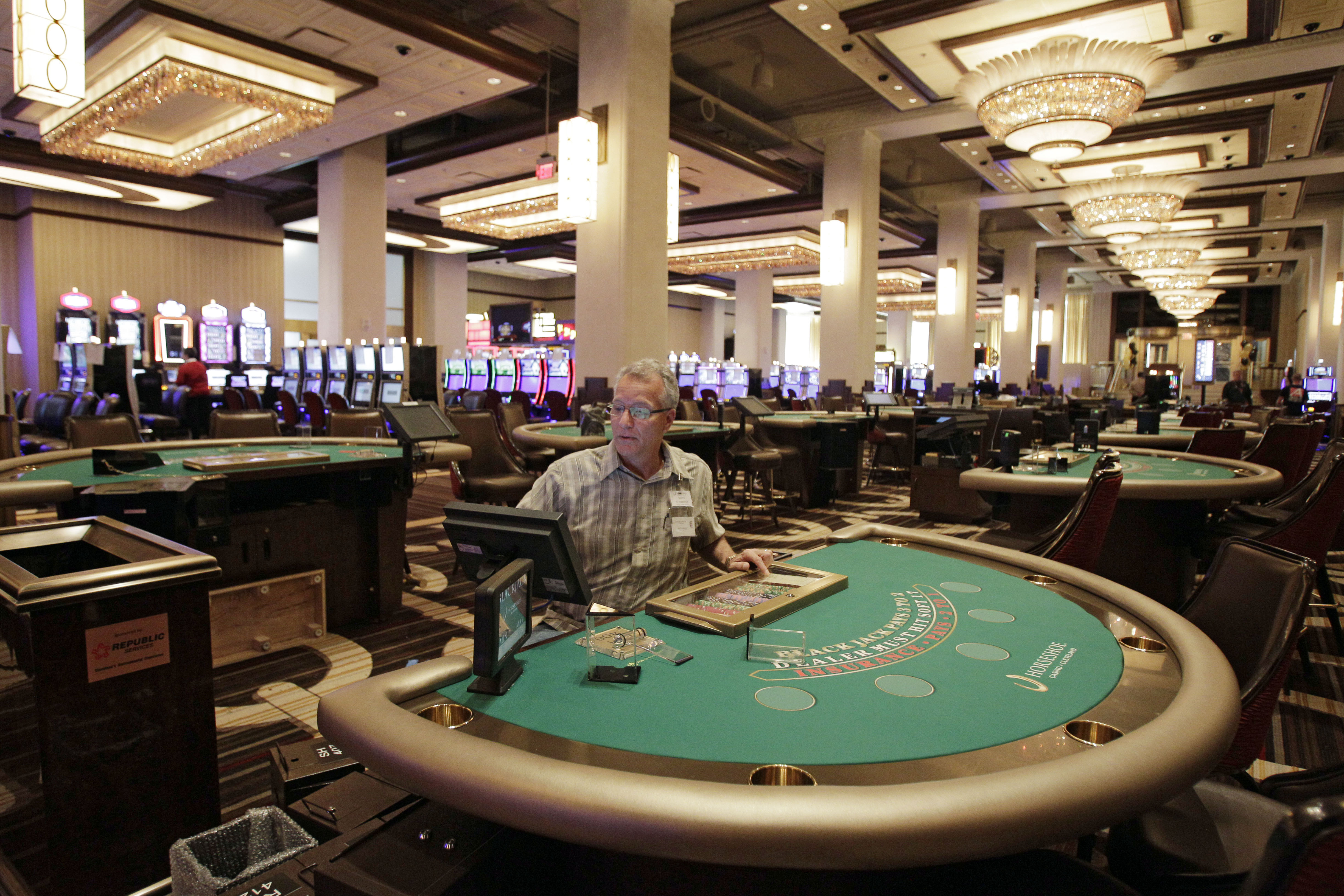
First-quarter casino tax revenues for Ohio’s counties and major cities, including Youngstown, have declined slightly from last year’s peak, according to the Ohio Department of Taxation.
These revenues come from a 33 percent tax on gross gambling revenues paid by the state’s four casinos, which are in Cleveland, Toledo, Columbus and Cincinnati.
First-quarter revenues for Youngstown and Mahoning County each totaled $357,390 in 2017, compared with $362,488 in the same quarter last year, $352,854 in 2015, $341,549 in 2014 and $326,893 in 2013.
In counties with a major city, the major city and county government share equally in the county’s casino tax revenue, which is distributed quarterly.
The casinos are facing competition from the state’s seven racinos, including Hollywood Gaming at Mahoning Valley Race Course in Austintown, noted Mahoning County Commissioner Carol Rimedio-Righetti.
The Austintown racino has an October-to-April live horse-racing season that helps generate first-quarter patronage there, she observed.
“There are a lot of people that are really interested in horse racing,” the commissioner said, noting that she has observed that the Austintown racino is “packed” with customers when the horses are racing.
“If they have one [a major gambling establishment] right in their own backyard, why should they drive to Cleveland or Pittsburgh?” Rimedio-Righetti asked.
“Competition from the racino sector is fierce,” said Alan Silver, assistant professor of restaurant, hotel and tourism at Ohio University.
“I see the racinos as suburban-area casinos, where players don’t have to drive far, pay for parking or have to worry too much about crime,” the professor added.
Many Ohio racinos have added “nongaming amenities” such as comedy clubs and microbreweries, Silver noted.
The commissioner said she thinks the first-quarter casino revenue drop would have been greater had it not been for the mild winter that facilitated long-distance travel to the casinos.
“Winter is always a factor with gambling. A mild winter makes it far easier to travel,” Silver said.
Although casino performance declined slightly in the entire first quarter of 2017, compared with the same quarter last year, March 2017 was the best performing month in the last three years for the casinos, said Jessica Franks, communications director for the Ohio Casino Control Commission, which regulates the casinos.
“I don’t know if it was the promotions that were being run or if it was just nice weather,” she said of the casinos’ strong March performance.
As far as the commission is aware, none of the Ohio casinos had any weather-related closings in the first quarter of 2017, Franks said.
The racinos have horse racing, and the casinos do not.
The casinos have table games, and the racinos do not.
Both the casinos and racinos have slot machines.
The casinos face competition from the Ohio racinos and from casinos and horse-racing tracks in surrounding states, Franks noted.
The Cleveland, Toledo and Columbus casinos opened in 2012, but the Cincinnati casino didn’t open until March 2013, making 2014 the first year all four casinos were open for the entire first quarter.
First-quarter casino tax revenues for Trumbull County were $627,197 for 2017, $636,975 for 2016, $620,889 in 2015, $602,987 in 2014 and $576,662 in 2013.
For Columbiana County, those first-quarter revenues were $322,214 this year, $327,649 last year, $319,821 in 2015, $309,298 in 2014 and $296,127 in 2013.
The Ohio racinos opened between June 1, 2012, when Scioto Downs in Columbus made its debut, and Sept. 17, 2014, when Hollywood Gaming at Mahoning Valley Race Course opened.
Recently released March figures showed a surge in the performance of the Ohio racinos, which collectively saw an 11 percent increase in slot-machine revenue from $78,614,917 last year to $87,545,661 this year.
The Ohio casinos showed a smaller revenue increase from $73,714,426 in March 2016 to $75,442,367 in March 2017.
The Austintown racino showed a 13.5 percent gain in March slot machine revenue from $8,893,141 in 2016 to $10,101,262 in 2017.