 43
43

Speakers share stories of civil-rights movement with Crestview students
By Sean Barron
COLUMBIANA
Civil rights speakers
 Gallery
Nearly all high-school students routinely take the essentials to class to prepare for tests and complete assignments, but on one morning, Janice W. Kelsey took a few unconventional items – and for a radically different reason.
“I remember waking up that morning, with all of my heart and soul, determined to get my freedom,” the Birmingham, Ala., woman recalled, referring to her decision to take part in the Birmingham Children’s Crusade, which began May 2, 1963 – also known as “D Day” – and consisted of a series of nonviolent demonstrations against segregation and other inequities.
For her efforts, Kelsey was arrested at 16 and spent four days in jail. That morning, she had brought to school a toothbrush and toothpaste, along with a bar of soap, knowing she would need the items while incarcerated.
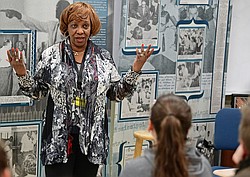
Kelsey and her brother, Alvin Wesley, shared their experiences in the civil-rights movement during a series of presentations they gave Thursday to Jackie Mercer’s English classes at Crestview High School.
On May 2, Kelsey, who spent 33 years in the Birmingham City Schools as a science teacher, guidance counselor and principal, joined thousands of children at the 16th Street Baptist Church to receive training in nonviolent social action.
Leading the effort was the Rev. James Bevel of the Southern Christian Leadership Conference, who also was an adviser to Dr. Martin Luther King Jr.
The Rev. Mr. Bevel pointed out to the young people numerous inequalities between blacks and whites in Birmingham, arguably one of the nation’s most segregated cities in which bombings in black neighborhoods were common but rarely investigated.
On the first day of demonstrations, an estimated 973 youngsters were arrested as they emerged from the church in groups of 50 toward downtown and were charged with marching without a permit. She added that using children was effective partly because, unlike many adults, they had nothing to lose economically.
Kelsey’s four days in jail included three in a 4-H Club dormitory at the Jefferson County Fairgrounds that had been converted to a makeshift jail near a segregated amusement park.
Wesley said he didn’t participate in the demonstrations initially because his focus was on being a quarterback for his school’s football team. He changed his mind, however, upon hearing rumors that many of the children were being treated poorly, including his sister, he explained.
For his part, Wesley spent five days in jail, he said, adding that being near the church today “still brings back memories. When I come through there, it’s like it happened yesterday.”
On the second day of demonstrations, the police and fire departments attacked the demonstrators in nearby Kelly Ingram Park with dogs and high-pressure fire hoses. They were under orders from Eugene “Bull” Connor, the city’s racist public-safety commissioner.
The violence was shown nationwide, causing outrage across the country and embarrassing the city, Kelsey continued.
Mercer said she met Kelsey and Wesley at a recent workshop and, after hearing both speak, decided to have them share their experiences with her students.
“Stand up for what’s right,” Kelsey advised Mercer’s students.
“You can make a difference. I was just one piece of the civil-rights movement that helped change Birmingham, the U.S. and the world. I’m proud to wear that badge of honor.”