 43
43

Valley families share struggles with multiple sclerosis
 Photo
Photo
YOUNGSTOWN
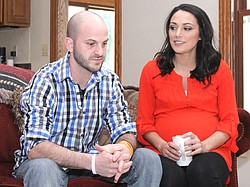
Nick Giangiordano was deployed in Iraq when his body went numb from the chest down.
“It was scary. I didn’t know if it was something I had done the night or the day before,” said Nick, 34, of New Middletown.
He was sent to Germany for testing, and got a diagnosis soon after.
For Kathy Villella, 65, of Canfield, it started with foot drop, an inability to lift the front part of the foot. It took eight years of doctor visits, unexplained symptoms, a spinal tap, MRI and other testing to get an answer.
For her daughter, Nikki Villella, 35, it took only a few weeks to find out why her hands and feet were tingling and why she had almost passed out at work.
Seven years passed between Stacey Shells, 46, of Canfield, temporarily losing sight in her right eye and her diagnosis.
Though they took different paths, all four are on a similar journey: They have multiple sclerosis.
Though symptoms of the central-
nervous system disease vary, the cause of MS is unknown, although it is believed to be triggered by an environmental factor in people with a genetic predisposition, according to the National MS Society.
Kathy, Nikki, Nick and Stacey hope to bring attention to the disease this week for MS Awareness Week.
All of them wanted to share this message: Just because MS symptoms aren’t always visible doesn’t mean they aren’t there. And if you have MS, don’t stop
living your life.
KATHY & NIKKI
Kathy shares her story from a reclining chair in her living room, daughters Nikki and Samantha sitting nearby.
Asked about her day-to-day life, her family says this is it. MS has robbed her of the ability to walk. She relies on her husband, Ed, for everything, from putting her in the shower, to dressing her, to driving her places.
With limited handicap accessibility in many places, it’s hard for them to travel. So Kathy is mostly at home in her chair.
“I had to retire from teaching. That’s the biggest and saddest part of my life, that I retired,” she said, breaking into tears. “I loved what I did.”
Kathy’s MS is progressive. She was diagnosed July 16, 2008, and retired June 5, 2013 after 32 years teaching for the Diocese of Youngstown.
Kathy’s situation was devastating enough for the close-knit family. Then, in 2014, Nikki was diagnosed.
“The only thing I knew about MS was what my mom has,” said Nikki.
Samantha vividly recalls Nikki sobbing on the couch, scared that no one would love her once they found out about her MS.
“That was the most horrible thing to see her like that,” Samantha said.
It turned out, however, that Nikki’s MS is relapsing-remitting, not the severe, progressive type that Kathy has. For her, not much has changed. She takes medication, gets an MRI twice a year, eats right and exercises.
And she has found love.
“She was scared to tell me,” said her boyfriend, Ryan Snyder. Her MS doesn’t scare him at all, though, because “she’s amazing and perfect.”
What Kathy wants others to take away from her story is that living with any kind of disability is immensely difficult.
“Because they can’t see that something is wrong with them, they don’t understand the disease or the severity,” added Samantha.
NICK AND ADRIENNE
Nick made it through 10 months of his 13-month deployment in Iraq, then was medically discharged from the Marine Corps in 2008.
“I was crushed – absolutely crushed,” he said. “I wouldn’t accept it. I couldn’t accept it.”
He has just recently come to terms with the reality of his disease, encouraged by his wife, Adrienne.
“She’s my rock – my absolute rock,” he said.
For years, Nick’s MS (which is relapsing-remitting) was terrifyingly predictable. Whenever the seasons changed, he would have a flare-up.
“The one night he said to me he was really tired, but he was afraid he was going to wake up and not be able to walk,” said Adrienne, recalling a March 2015 episode.
That’s exactly what happened.
“I had to carry him, physically, down the stairs and put him in the car,” she said. The couple also had two small children to think about. Their sons, Wyatt Stock and Vinny, are 5 and 2.
In September 2015, Nick had another relapse. He had vision problems, slurred speech and numbness on one side of his body.
“It was essentially a realization of my nightmare,” he said.
He felt “constant fear. Anxiety. Anger.”
He thought to himself, “What kind of husband am I going to be? What kind of father? If I can’t do things for them, what does that make me?”
These days, Nick is doing a lot better. After starting a new medication, he hasn’t had a relapse in more than a year. His outlook is better, too.
“Ten years from now, I picture myself running,” he said. “That’s the person I’m chasing to be. Whether I get there, I can’t tell you, but I’m still going to try.
“Because I have to.”
STACEY
Stacey Shells’ MS symptoms started when she was in her 20s. While she was on a trip, she got a bad sunburn and felt a strange sensation when she took a shower later that day.
“The water – it felt like ants were crawling on me,” she said. “I didn’t know this, but the sun exacerbates your multiple sclerosis.”
On the bus ride home, she lost sight in her right eye. An eye doctor told her that she likely had MS, but after a referral to a neurologist was inconclusive and her eyesight returned, Shells let it go.
Seven years later, stressed about an upcoming exam, Shells again lost her vision in one eye.
This time, when a neurologist again told her nothing was wrong, she went to the Cleveland Clinic. There, she got her answer: She had MS.
She was afraid at first but encouraged by what her doctor told her: “It’s not a death sentence. You can live a long, long life with multiple sclerosis.”
She lives her life with that attitude. Most days, she is exhausted. Getting up and getting ready each morning is a challenge. And the demands of her teaching job wear on her, but she pushes through.
“People get extremely tired with multiple sclerosis,” she said. “I’m not being lazy. Our bodies are at constant battle.”
Shells recently found out that she has breast cancer, too.
“My biggest fear is that this is going to flare up my MS. But we’re just going to say that’s not going to happen and move on through,” she said. “We have a thing that we say at church: Your problems are big, but God is bigger. God is bigger than my cancer, and my MS.”
And to those living with MS, she said: “Don’t stop living because you have MS. Do all you can, while you can.”