 43
43

Ash Wednesday services mark the beginning of Lent
Ash Wednesday
 Gallery
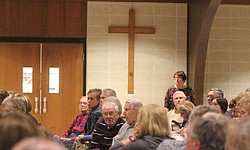
Ash Wednesday services were held at Western Reserve United Methodist Church in Canfield.
CANFIELD
A silent procession of ash-adorned worshippers filed out of Western Reserve United Methodist Church after the annual Ash Wednesday service.
The silence was by design. Instead of socializing on their way out, The Rev. Russ Adams instructed churchgoers to receive the ash and reflect on how they might grow spiritually over the next year.
Ash Wednesday marks the beginning of Lent, a 40-day period culminating with Holy Week and Easter, which is celebrated across all major Christian faiths and denominations. Lent is – outside its connection to the Christian faith – best known as a time when participants deny themselves some kind of pleasure for the duration of the period.
The Rev. Mr. Adams said Ash Wednesday and Lent are still largely celebrated solely for their spiritual qualities, as opposed to the hyper-commercialized Christmas and Easter holidays.
Rather than focusing on gift giving and receiving, Ash Wednesday and Lent are about denial and reflection.
Ash Wednesday services often end with worshippers receiving a black ash cross painted on their forehead or hand by a member of the clergy. The ash is symbolic in the Christian faith; it represents the humble beginning and end of life, and is often associated with mourning and repentance throughout the stories of the Bible.
Mr. Adams said the period of denial and reflection wasn’t meant for participants to feel self-loathing, but instead to act as a time of spiritual refocusing.
He asked the congregation to leave silently so the meaning of the tradition might not be lost in the bustle of life outside of the church walls.
“What’s the point in a tradition if we don’t take the time to understand its meaning?” Mr. Adams said. “Lent isn’t a second chance at a New Year’s resolution.”
Despite the solemn nature of the observance, Mr. Adams said Ash Wednesday has a particularly personal impact on him. About 100 people who entrust him to lead them in their spiritual lives lined up and allowed him to touch them on the hand or the face with a blackened finger tip.
“When you’re touching people on the face, it’s a very personal thing. I’ve buried some of these people’s parents, I’ve baptized their kids,” Mr. Adams said. “This is a lifelong journey that we take together.”