 43
43

Experts doubt Trump can deliver lost jobs
SEE ALSO: de SOUZA: Dems need a ‘decent’ Trump*
By DAVID SKOLNICK and KALEA HALL
news@vindy.com
YOUNGSTOWN
Trump says jobs coming back to Youngstown
 Video
Video
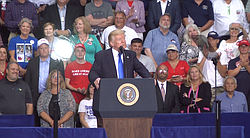
Speaking to a crowd of about 7,000 people at the Covelli Centre at a rally, President Donald Trump promised the Youngstown area would return to its steel-mill glory days. How realistic is it for the Mahoning Valley, which has lost about 35,000 primary metal jobs in the past 40 years, to have all of them return?
Speaking to a crowd of about 7,000 at a Covelli Centre rally last week, President Donald Trump promised the Youngstown area would return to its steel-mill glory days.
Trump said Tuesday: “I rode through your beautiful roads coming up from the airport, and I was looking at some of those big, once incredible job-producing factories, and my wife, Melania, said, ‘What happened?’ I said, ‘Those jobs have left Ohio.’
“They’re all coming back. They’re all coming back. Don’t move. Don’t sell your house. ... Do not sell it. We’re going to get those
values up. We’re going to get those jobs coming back, and we’re going to fill up those factories or rip them down and build brand new ones. It’s going to happen.”
How realistic is it for the Mahoning Valley, which has lost about 35,000 primary metal jobs in the past 40 years, to have all of them return?
Not very, according to interviews conducted by The Vindicator with manufacturing, business, government and steel-union officials.
THE COLLAPSE
September will mark 40 years since the beginning of the end of Youngstown’s steel titan days. On Sept. 19, 1977, Youngstown Sheet & Tube Co. announced it would close its Campbell Works, leaving about 5,000 workers without jobs. Then the company’s Brier Hill location shuttered and more area steel plants followed suit.
“I think there’s so much you could talk about maybe as to what happened,” said Donna DeBlasio, professor of history at Youngstown State University. “Everyone blamed everyone else.”
The factors that contributed to the hit on Youngstown’s biggest industry included not advancing with technology, trade and less steel being used. It was a steady downfall that hit hard.
“You had all kinds of other ancillary industries that were affected,” DeBlasio said. “I think people were just shocked. It was devastating.”
What survived are companies that specialize in making metal materials for various industries, but these companies aren’t the mega-plants that once were.
Instead of employing thousands, they employ hundreds.
Industry today, as the Mahoning Valley Manufacturers’ Coalition points out, is not what it was back then: It’s cleaner, it’s safer and more efficient.
“The manufacturers who exist here today are the ones who survived the downturn,” said Jessica Borza, executive director of the MVMC. “They are diversified, healthy, strong companies. They are in a position to grow.”
The MVMC’s mission is to grow the area workforce, so manufacturers can stay competitive in a global economy. Area manufacturers started the coalition six years ago. They became concerned about the lack of the skilled workforce needed to keep them going.
“Our whole purpose is to help manufacturers stay strong and grow, and there’s a lot of work to that,” Borza said. “We are hitting it from every angle. We feel like we have impacted a number of education and training programs to be more in line with what the manufacturers [need].”
A NEW ECONOMY
The Mahoning Valley is still a goods-producer, but it has become a service-based and more knowledge-intensive economy.
“That means that we require skills and education for the jobs that we have,” said Mekael Teshome, PNC Bank economist.
Since the 1970s, both the technology used in manufacturing and the workforce have changed.
“We can definitely create more of those jobs, but we can’t rewind the clock and become an economy where a majority of people are making things,” Teshome said. “The technology doesn’t allow for this massive creation.”
The workforce today is mismatched for the job requirements, and some workers have completely backed out of the workforce. Teshome noted that nationwide there are about 6 million jobs available and there are 7 million unemployed.
Also, the nature of manufacturing has changed. Not as many workers are needed to do the job today as were needed back in the 1970s.
“I think we are moving in a good direction,” Teshome said. “I do believe we will get better if we are able to adapt to the new realities ...we can still make things, but what that looks like is going to be different.”
BRINGING BACK
Bringing back the thousands of jobs lost in the Valley wouldn’t be an easy task.
Trump “gives the feeling that we can turn the light switch and reverse this ... the truth is that this is going to be a process,” said Jose Arroyo, business representative for the United Steel Workers.
Arroyo is a third-generation steelworker who now represents workers at plants throughout the Valley during contract negotiations.
Though Arroyo believes there’s opportunity to bring more manufacturing jobs to the area, he says the days of plants with thousands of workers have passed.
“I don’t believe that it can happen because we are in a capitalist system,” Arroyo said.
It would take investors willing to invest millions.
“Even though it’s no secret that the steelworkers endorsed Hillary Clinton, Trump is the elected president, and we are willing to work with him to bring jobs back,” Arroyo said.
Arroyo says the way to bring back jobs is to have an infrastructure bill that would support U.S. companies and to have trade reform that would even the playing field between American and foreign companies.
“Trade has devastated the steel industry,” Arroyo said. “The trade policy has to be crafted very carefully to make sure we aren’t causing manufacturing jobs to go overseas.”
Bob Messaros, president and chief executive officer of local tank-head producer Commercial Metal Forming, would like to know exactly what Trump’s plan is to bring back the lost jobs.
“This is the time where we need substance – not words – that we have heard over and over again,” Messaros said.
Messaros, who has worked in steel for 17 years, doesn’t see the massive steel mills coming back. The area no longer has the workforce to support massive plants, Messaros said.
“You have mini-mills,” he said of today’s plants. “Instead of being all things to all people they have carved out niches.”
CHANGING TIMES
U.S. Rep. Tim Ryan of Howland, D-13th, said all you have to do is look at Vallourec Star, one of the few steel success stories in the area that made one of the largest investments in the Valley, opening a second plant in Youngstown about five years ago.
“The fact we have a $1 billion steel mill and about 600 people that work there illustrates how disingenuous it is to say he’ll get all of those jobs back,” said Ryan. “We’ve had a lot of people tell us over the past 30, 40 years that they’ll wave a magic wand and get the steel mills back. With automation, new mills come with a very, very small number of steel jobs.”
He added: “Fifty, 60, 70 years ago, if Vallourec opened up, there would be 20,000 people working there. There are 600 there today.”
The Valley has diversified over the years with the development of high-tech manufacturing, Ryan said.
“It’s the [Youngstown Business] Incubator, additive manufacturing and it’s steel mills if you can get them,” he said. “You can’t rely on just one industry. We saw what happened with steel. That’s why we’re bringing back federal money for additive manufacturing so our area can become a hub. It’s one shovel at a time with economic development.”
Youngstown Finance Director David Bozanich also pointed to the increase in automation as a reason the steel industry cannot employ tens of thousands of area workers.
“The capital investment dynamics of the steel industry have changed significantly over the past 30 years,” he said. “To build a plant that would employ what an old mill had would take about $7.5 billion. That’s seven-and-a-half Vallourecs.”
Thomas Humphries, Youngstown/Warren Regional Chamber’s president and chief executive officer, said with the economic growth the nation has seen in the first six months of Trump’s presidency, “we have reason to be more optimistic now than we have in the past 15 years” that manufacturing jobs can return to the Valley.
The area’s primary metals industries, particularly aluminum extrusion, are growing, he said.
But Humphries acknowledges that bringing back all lost steel jobs from the past 40 years is a major challenge because of automation.
“That’s had the greatest impact” on manufacturing jobs along with companies moving offshore, he said.
When asked about Trump’s statement in Youngstown, U.S. Sen. Rob Portman, a Republican from the Cincinnati area, said: “We are bringing back steel jobs to Ohio” and will bring back more through a combination of fair-trade policies, regulatory relief, worker retraining and an infrastructure investment program.
“Yeah, we can bring back more steel jobs to Ohio,” Portman said without saying how many.
U.S. Sen. Sherrod Brown, a Cleveland Democrat, said he simply doesn’t believe anything Trump promises, including somehow revitalizing the steel industry.
“I don’t see anything he’s done to live up to [his] promises,” Brown said.