 43
43

CEO delivers results-oriented recovery plan
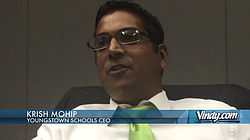
Krish Mohip discusses academic plan
 Video
Video
Youngstown Schools CEO Krish Mohip discusses his academic improvement plan that will be presented to the district’s Academic Distress Commission.
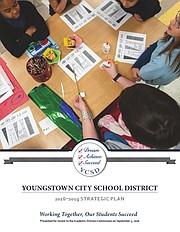
YCSD Strategic Plan
 Document
YOUNGSTOWN CITY SCHOOL DISTRICT 2016–2019 STRATEGIC PLAN
YOUNGSTOWN
Krish Mohip, Youngstown city schools chief executive officer, has delivered an ambitious, student-centered and results-oriented academic improvement plan to the district’s Academic Distress Commission, featuring specific goals and achievement timetables.
“We’re shifting to have an intensive focus on teaching and learning and giving our teachers and administrators the support they need to be successful,” Mohip said, summarizing his plan.
The commission will meet at 5 p.m. Sept. 20 at district headquarters to consider the plan to rescue the school district from the state of academic emergency it has been mired in since 2010.
Created by Ohio House Bill 70, known as the Youngstown Plan, the five-member commission appointed Mohip as the district’s CEO.
Mohip, a former teacher, principal and administrator in the Chicago public schools, started work here June 29.
Mohip’s plan is subject to commission approval, and the board of education will have an advisory role, Mohip said.
The plan is based on research findings concerning best educational practices and on comments from members of the Youngstown community, Mohip said.
“There’s going to be accountability,” Mohip said. “I want central office to answer to the schools. When schools have a need, we have to be able to respond to them and respond to them quickly,” he explained.
“We’re going to be doing a lot more professional development with our teachers. We’re going to be doing a lot of professional development with our principals,” he added.
“I’ve told my principals already that I expect teachers to get nonevaluative, coachable feedback once a week, and that’s a shift because, typically, that hasn’t been happening,” he said.
Some 5,300 students “are relying on the educators in this district, and I’m one of them, to do what’s best for them,” he said.
Mohip said he knows some people won’t favor some aspects of the plan.
“All my decisions will be student-based, and, when you make student-based decisions, it sometimes makes adults uncomfortable,” he observed. “I’m not here for anything else or anyone else but the children of this district.”
The plan’s goals are significantly improving all students’ academic achievement; ensuring “every student benefits from the individualized instruction, supportive culture and caring relationships” needed for academic success; engaging “parents, families and the community in meaningful experiences that impact students;” creating “a world-class [city schools] workforce focused on continuous improvement;” and operating “an effective and fiscally responsible school system.”
Dario Hunter, a member of the board of education, said the plan offers few revelations.
“The plan doesn’t concretely say how it’s going to achieve those goals. There’s a difference between goal-setting and strategy,” he noted.
However, he observed that: “A truly savvy strategist might not want to show all his cards at once” in the current political climate.
Hunter said he gives Mohip credit for having “the wherewithal to get the job done.”
He added that the plan’s community-engagement section does not mention the board of education, which he said “has really earned its growing irrelevance.”
Although there are “some excellent, student-oriented board members,” the board, as a whole, needs to “focus on the students, rather than on personal agendas,” he said.
“It’s nothing that I haven’t seen or heard or read before,” Jackie Adair, another school board member, said of the information in Mohip’s plan.
“It’s just a pretty common-sense approach to the problems that all of us should be very much aware of,” she added.
She disagrees with Mohip’s emphasis on providing medical and mental-health services in the schools. “As educators, we need to stay in our lane,” she added.
Basia Adamczak, 7th Ward councilwoman and chairwoman of council’s education committee, said she was “extremely pleased because it’s a very comprehensive plan that is trying to engage everyone” including parents, youth programs, churches and social service agencies.
Adamczak’s daughters attend third and fourth grade at Paul C. Bunn School.
“We are going to be accountable because we’re actually using metrics and data and setting yearly goals,” she said of the plan.
“I think he’s the right man in place to help turn around our school system. I’m honored that I’m able to help directly and be in the forefront of helping change the school system,” for the better, she said.
“I’m extremely optimistic,” she added.
Using the slogan, “Working Together, Our Students Succeed,” Mohip wrote that his plan “is a call to action for all involved, including district administrators, educators, parents and families and citizens.”
Among the specific goals to be met by the 2018-19 school year are:
Daily student attendance should rise from 91.2 percent to 96 percent.
The four-year high school graduation rate should go from 75 percent to 90 percent.
The percentage of seniors with a post-high school plan should go from 44.6 percent to 100 percent.
The percentage of revenue spent on teaching and learning should go from 63 percent to 70 percent.
All teachers should get weekly feedback in instructional best practices.
All students should get weekly progress reports.
Ninety percent of school buses should arrive safely and on time.
School buses passing their first Ohio State Highway Patrol inspection should go from zero to 100 percent.