 43
43

Trumbull commissioner again questions fairness of way county does business
By Ed Runyan
WARREN
Treatment Plant Dispute
 Document
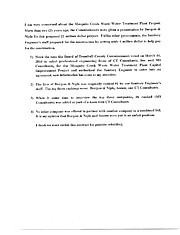
Trumbull County Commisioner Frank Fuda's statements and related documents regarding a capital improvement project and how it was handled by the Sanitary Engineer's staff.
Questioning County Business
 Video
Video
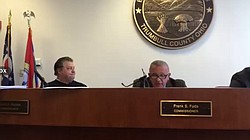
Trumbull County Commissioner, Frank Fuda, spoke out in a recent meeting questioning fairness in county business. He pointed out the selection of an engineering firm on a sewage-treatment plant upgrade.
Trumbull County Commissioner Frank Fuda is again questioning the fairness of how the county does business, this time regarding selection of an engineering firm for a $21 million upgrade to the sewage treatment plant in Howland.
Fuda said Wednesday that he is “very concerned” about the process that elevated a Youngstown engineering firm to the top position to get a contract despite poor ratings from three top supervisors at the county sanitary engineer’s office.
“I think we must revisit this contract for possible rebidding,” Fuda said.
Fuda has raised questions in recent months, accusing Commissioner Dan Polivka and several top county officials of being involved in unfair hiring and supervisory practices that he says interfere with efficient operation of county departments. Polivka also is the Trumbull County Democratic Party chairman.
Commissioners on March 16 selected CT Consultants Inc. and MS Consultants Inc., both of Youngstown, to design and administer an upgrade at the Mosquito Creek wastewater treatment plant off Anderson Avenue in Howland. The plan was for CT to do the engineering and MS to oversee construction.
The contract with CT and MS has not been finalized.
Fuda said he learned after the commissioners selected the two companies that some unusual things occurred that put CT and MS in a position to get the contract. He wonders now whether the process leaves the county vulnerable to additional legal action.
When the sanitary engineer’s office first began to evaluate nine engineering companies to determine which one to hire, the process was handled by three top supervisors in the sanitary engineering department, plus Gary Shaffer, deputy engineer at the county highway engineer’s office.
That group ranked Burgess and Niple of Painesville the top company for the job with a score of 381. The other scores were AECOM of Akron, 358; CT, 356; ARCADIS U.S. Inc. of Akron, 337; Stantc Consultant of Cleveland, 310; and MS Consultants, 307. Three other firms ranked below MS.
Sanitary engineers office managers involved in the scoring were Scott Verner, deputy sanitary engineer; Art Bain, wastewater treatment plant supervisor; and Bill Durst, wastewater collection superintendent.
According to a Sept. 23, 2016, memo written by Verner and James Brutz, an assistant county prosecutor, at the request of Fuda, the top three firms were asked in September 2015 to give presentations to the four evaluators. Verner, however, was advised the day before the presentation that MS Consultants, which was ranked sixth, would be joining with CT Consultants, which was ranked third, to present as a team.
Reached by phone Thursday, Verner said he could not comment on who informed him that MS was being added as part of a team with CT.
On Sept. 30, 2015, Verner wrote a letter to the commissioners recommending Burgess and Niple, but Randy Smith, head of the sanitary engineer’s office and highway engineer’s office, refused to allow Verner to send it, the memo says. Instead, Smith told Verner to revise his recommendation and indicate that county sanitary engineer employees “were biased against MS Consultants,” the memo says. Verner refused to write it.
The Vindicator acquired a copy of the Sept. 30, 2015, Verner letter, and it said Burgess and Niple carried out an initial report on the needs at the treatment plant in February 2015 and he was “very impressed with the company’s level of professionalism coupled with their technical ability” and other attributes.
A March 2, 2016, sanitary engineers letter to the commissioners says that Smith, Verner and Shaffer were now the evaluators of the engineering firms, and they were recommending the CT/MS team to receive the contract.
The Verner/Brutz memo says there are “no records of these new evaluations and ... score sheets in the files of the Trumbull County Sanitary Engineer’s Office.”
When Smith was asked whether he was the person who changed the commissioner recommendation from Burgess and Niple to CT and MS, he said it was more people than just him, but he did feel the sanitary engineers office managers had made poor decisions in the past and he wanted them to change their thinking.
Specifically, he felt that one company should not be hired to design a project and oversee construction, known as project administration. Smith’s philosophy, and the requirement on some state and federal projects, is that the two jobs go to different companies, Smith said.
Fuda says he is concerned that the rankings by the “sanitary engineers” – Verner, Bain and Durst – appear to have been overridden by Smith and that none of the other bidders was allowed to partner with another company the way CT and MS were.
“It is my opinion that Burgess and Niple [the company ranked first] and AECOM [the company ranked second] were put in an unfair position,” Fuda said.
“All of the sanitary engineers chose Burgess and Niple. That company should have gotten the job,” Fuda said. “These other people could file suit against us for more money,” Fuda said of the reason he thinks the contract should be rebid.
“We can’t afford lawsuit after lawsuit,” Fuda said. “It’s not us who’s paying. It’s the customer. If we cost $2.4 million more, that’s not fair.”
Fuda was referring to the $2.4 million Smith recently estimated the sanitary engineer’s office lost because of an arbitrators’ decision in August related to a lawsuit the county filed against Youngstown construction company Marucci and Gaffney. The suit related to the company’s work on the $10.6 million Kinsman sewer project.
The 20,000 customers in the county’s Metropolitan Sewer District will pay the extra millions associated with the arbitrators’ decision, Fuda said. The district serves about 75 percent of the county’s customers.
Smith said last week he didn’t know yet whether the entire $2.4 million from the Kinsman project falls on the sewer-district’s customers.
Smith said there are at least four examples of recent projects in which the people in charge of the sanitary engineer’s office, before he got there in the spring of 2015, chose to hire the same company for the design work and construction oversight – including the Kinsman and Vienna projects, which both involved litigation.
Smith said he’s seen a lot of bad decision making from staff members at the sanitary engineer’s office since he arrived. “I’m not going to rely on a staff that makes poor decisions,” he said.
“In 20 years in engineering, I’ve never had this number of challenges with consultants that I’ve seen in my short time in sanitary engineering,” he said.
When asked whether he thinks the change that was made to select CT and MS for the job instead of Burgess and Niple could give Burgess and Niple reason for legal action, he said: “I have no sense there is a legal issue.”