 43
43

They’ve been sucking juice from your plants for 17 years CICADAS
By Eric Barrett and Stephanie Hughes
OSU Extension educator and master gardener volunteer
Most of us are used to the singing of dog-day cicadas (mostly called locusts) here in the Valley.
During the long days of late summer each year, we hear their loud singing in the evening. It’s a sign fall is upon us.
This year, the sound will be louder and earlier.
It’s actually a different kind of cicada – periodical cicadas, Magicicada spp. The group that emerges this year is called Brood V. They are the longest-lived species of insect in North America.
These insects have been under the ground for the past 17 years. The life cycle of these cicadas is fascinating. They lay in the ground for those years sucking the juices out of roots of plants.
When the soil temperature is “just right,” these cicadas climb out of the soil, and climb about one foot up a tree and molt.
We estimate this date to be about mid-May based on this year’s weather.
You will first start to notice their emergence when you see the muddy exoskeletons on bark.
Adults live two to four weeks above ground and are gone by July.
While above ground, they feed on small twigs. They also sing – the males, not the females. The sound can be overwhelming in some areas.
The song of the males attracting females is a phenomenon unto itself. It can be heard a half-mile away, and only in the daytime. It is the loudest of all insects. They are attracted to lawnmowers and weed whackers, possibly the same sound range.
Female cicadas have a saw-like device at the end of the abdomen for cutting wood to deposit eggs.
Each female will lay between 400 and 600 eggs at a time in twigs, preferring trees and shrubs. She punctures the bark of the twig and makes a pocket, and inserts 24 to 28 eggs in two rows; then moving forward makes another pocket, aligning these in straight rows. They can look like a continuous slit 2 to 3 inches long.
Eggs hatch in six to seven weeks, and the white nymphs resembling an ant drop to the ground and burrow into the soil to feed for another 17 years.
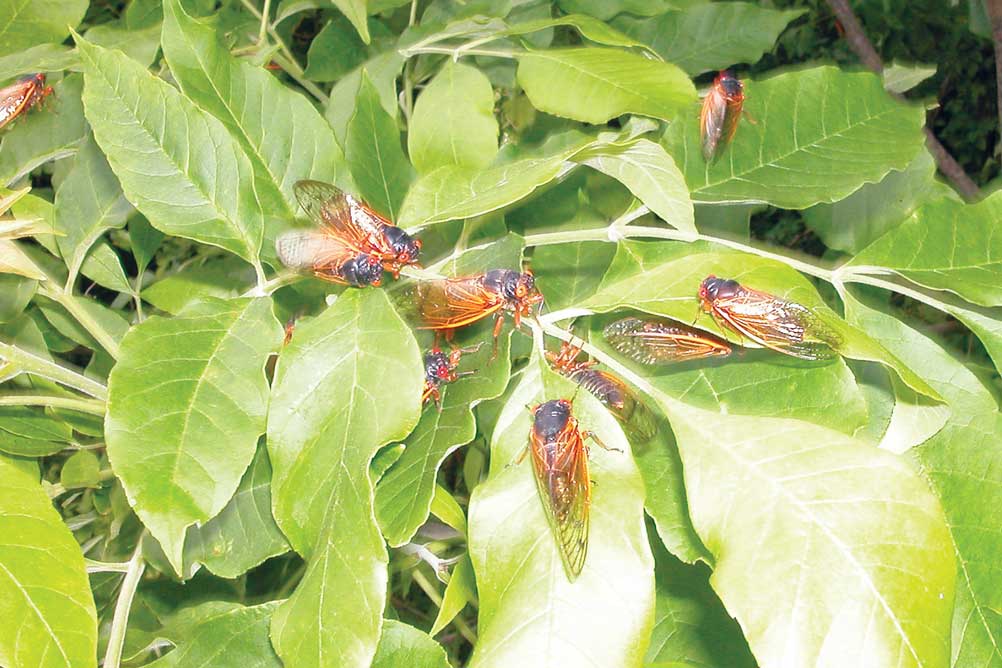
You will notice these cicadas are different from the annual dog-day cicadas by noticing their red eyes, orange wing-veins and legs and black body. Annual cicadas have green eyes, green wing-veins, and green to black bodies and legs.
Our OSU Extension factsheet states the more-favored trees for oviposition include maple, oak, hickory, beech, ash, dogwood, hawthorn, magnolia, willow, apple, peach, cherry and pear. Flowers, vines and shrubs include Rose of Sharon, rose, raspberry, grape, black-eyed Susan, hollies, spirea, rhododendron, viburnum, junipers and arborvitae.
We recommend the affected areas postpone planting young trees and shrubs. The map of the affected areas can be found at the link below. If small trees and shrubs need protection, use nylon netting or cheesecloth, starting when you first see exoskeletons on trees. Netting should cover all small branches and be tied together on the trunk.
We do not recommend using any chemicals on cicadas. They do not sting or bite and do not cause harm to humans. But if held too long they may become thirsty (they are sucking insects) and will “nip” in an effort to find drink.
The damage on trees is not noticed at first. With the browning and wilting of the ends of branches on trees, people often wonder if an affected tree is diseased. In actuality, the ends of branches were weakened by the female’s egg-laying. These branches break, but don’t fall off completely. This is called flagging.
Once nymphs drop back to the ground, they can damage tree roots as they suck the sap from them. Prolonged feeding by nymphs on a tree’s root system may reduce plant growth and fruit production.
The biggest thing to overcome during their emergence is fear. They will be loud, and arrive in large numbers in some areas. Your pets may eat cicadas, but the only worry is overeating. Keep pets inside if this is a concern. Many birds and fish eat them as they are a rich source of proteins, but there is no fear of endangering them. Turkeys love them.
This emergence affects only western Mahoning and Columbiana counties, along with just a strip along the western edge of Trumbull, but all of Portage – and about 40 percent of Ohio in general. The eastern two-thirds of the Mahoning Valley will not see their brood (Brood VIII) until 2019.
Take a few moments to enjoy this experience. It won’t last long … and it’s something you see only a few times in your lifetime.
For complete details on these insects, go to http://go.osu.edu/cicadafacts.
For maps of this year’s expected emergence, go to http://go.osu.edu/cicadamaps.