 43
43

You’ll always find these near their birthplace The TUFTED titmouse
By Nancy D. BRUNDAGE
Ohio Certified Volunteer Naturalist
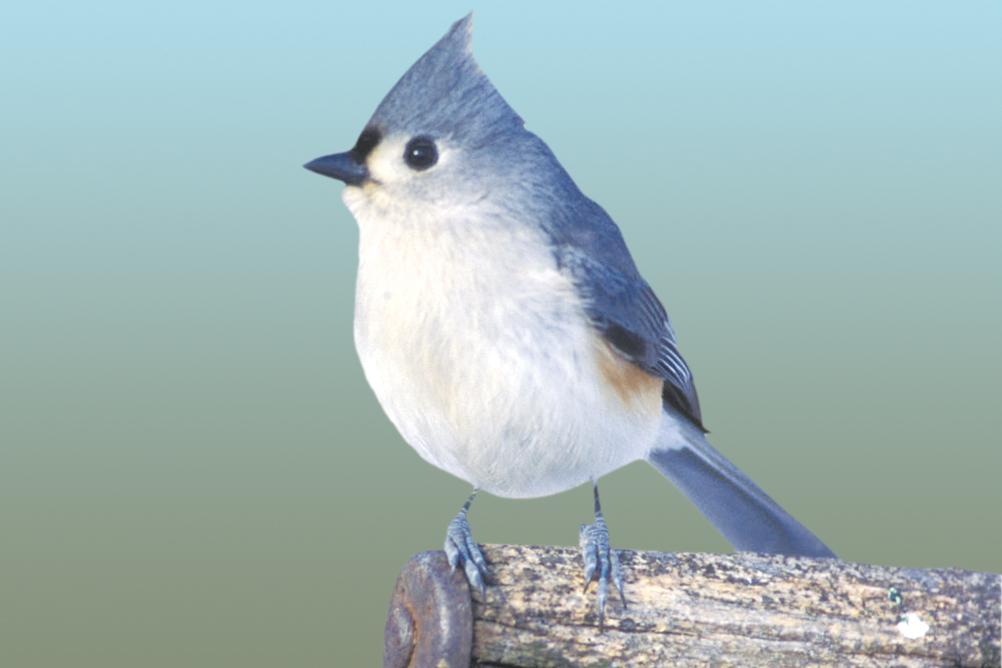
The tufted titmouse (Baeolophus bicolor) is my favorite bird. I love the large, inquisitive dark eyes and the perky-looking crest.
This bird has a length of 6.5 inches, a wingspan of 9.7 inches, and weighs just 0.8 ounce.
It has a short stout bill and feeds on insects and seeds.
It is the largest of the titmice family and also larger than a chickadee.
Their tails are short and fan-shaped.
There is a small pointed crest on the head.
The tufted titmouse is darker gray above and a pale gray underneath. Its flanks are orange, its forehead is black, it is pale around the eye and has a white eye ring. Juveniles are duller.
Titmice are common, widespread and live mainly in deciduous woods. They also can be found in urban shade trees and backyard feeders.
They usually are found in pairs or small groups.
Titmice often are associated with chickadees and white-breasted nuthatches.
The range for the tufted titmouse is from the east coast (Southern Maine, but excluding the tip of Florida) to Central Texas to Eastern Nebraska.
Tufted titmice live their entire lives near their place of birth.
Their nests are placed in a natural cavity, a birdhouse, or woodpecker hole. The nest is lined with bark, leaves, soft grass, moss, snakeskin, and bits of animal hair.
Titmice are monogamous and solitary nesters.
They lay four to eight eggs that are creamy white with brown speckles. The eggs are incubated 13-14 days by the female.
The sounds of the tufted titmouse in Ohio are low, clear whistles “peter, peter, peter,” usually two-syllabled.
Other sounds are “chup, chup, chup, chup” or a sharp high-pitched note.
The flight is a weak fluttering , short flight with shallow rapid wingbeats. A flittering flight has several quick wingbeats alternating with wings drawn to the side, then repeated.
Tufted titmice eat insects, various berries, seeds, spiders, snails and acorns. They also eat suet and sunflower seeds often at feeders.
They will forage in trees, sometimes upside down.
In the fall, the birds begin hiding seeds to use for the winter. Hiding places include bark crevices, needle clusters, knotted branches and other nooks and crannies near feeders. Under the siding of a house has also been a location.
These locations are called caches and the action of hiding is called caching.
Tufted titmice are only in areas where rainfall is greater than 24 inches per year, but they are more common if rainfall exceeds 32 inches per year.
The estimated global population of the tufted titmouse is 12 million.
There is a low environmental concern.
A Cherokee legend regards this bird as a “messenger.”
A group of titmice is known as a banditry and a dissimulation.
Chickadees and titmice are known for their friendly behavior. They seem to have little fear of people. I have had a titmouse as well as a chickadee take seed from my hand when Mill Creek MetroParks had its “Hand Feed The Chickadee” event.
For additional information on the tufted titmouse, go to http://go.osu.edu/tuftedtitmouse.