 43
43

These flashy backyard birds stay put and mate for life NORTHERN CARDINALS
By Marilyn McKinley
OSU certified volunteer naturalist
Spotting a cardinal is a welcome site during northern Ohio’s seemingly long winters and too-often drab landscape.
This bird is the northern cardinal – Cardinalis cardinalis.
That splash of red at the feeder or in the trees brings a needed splash of color.
The cardinal was named by the colonists who thought the male cardinal reminded them of a Catholic cardinal’s biretta.
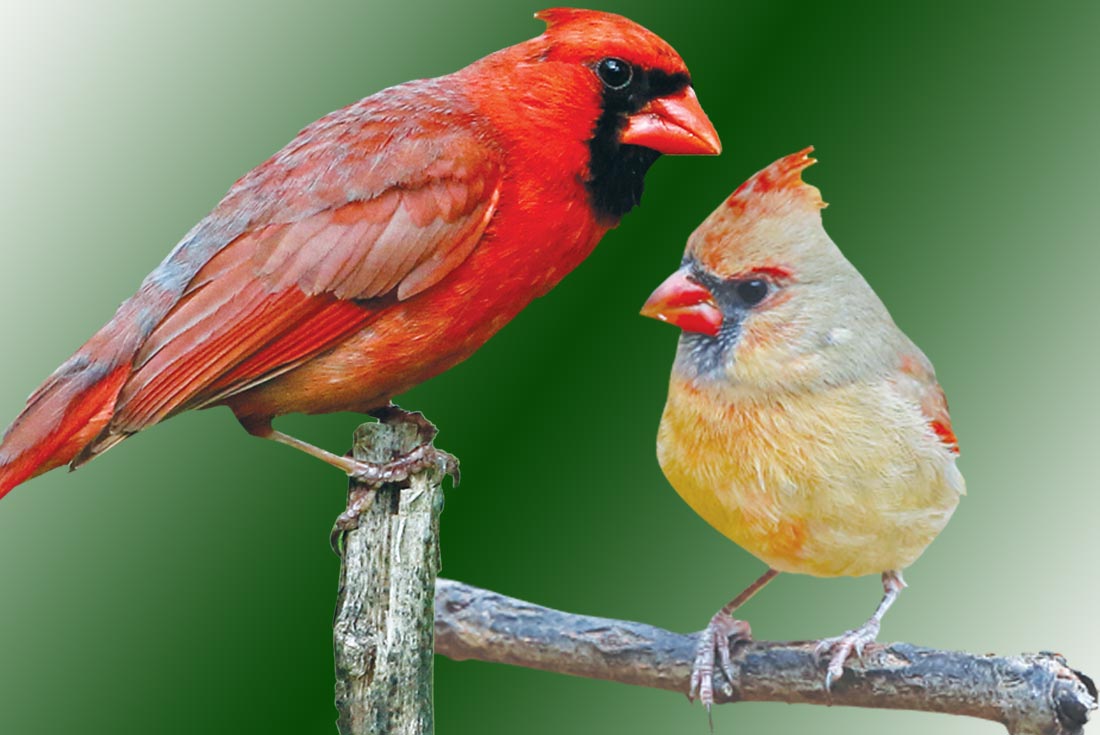
The male cardinal is a bright scarlet red, and is a bit larger than the female, with an average weight of 1.7 ounces and about 8 inches in length.
The female is a dull olive greenish brown with red wings and tail, with an average weight of 1.5 ounces and 7 inches long. Some say the female is more of a gray tone – maybe representing the scarlet and gray of the Ohio State Buckeyes.
Both adult males and females have bright red beaks and face masks.
Yet to mature males have some red feathers, often bald spots (not molting) which give them a mottled appearance.
The bill of the young cardinal is a dusky color.
Cardinals are territorial and mate for life.
They do not migrate.
The average life span in the wild is 3 years.
Populations remain stable with no threat for diminishing.
The cardinal is preyed upon by cats, hawks, fox and even snakes.
Cardinals are 90 percent seed-eaters.
They are fond of sunflower and safflower seeds. They occasionally will eat insects or fruit.
The behavior of birds and animals is always fascinating, and the cardinal is no exception.
They engage in “mate feeding.” The male will pick up a seed, hop over to the female and they touch beaks as she takes the food.
This is a common practice of backyard birds as a part of pair bonding.
It is thought that this act gives the female an idea of how well the male will provide food for their eventual young.
The female builds a cup-shaped nest of sticks, twigs, hair and sometimes, paper. The nest will be near a food and water source.
Cardinals prefer the nest to be 1-15 feet above the ground. They often build a nest in dense shrubs or vines.
The breeding season runs from March to September.
The female lays two to five eggs two to four times a year. The eggs are smooth and white with a greenish tint having blotches of brown or gray. The female incubates the eggs 12 to 13 days.
The male’s job is to feed and protect his mate.
When the eggs hatch, both parents feed the young.
The young leave the nest in about 10 days.
They are often unable to fly for the first two days after fledging.
Each season the pair will raise at least two broods.
You may notice the cardinals are the first birds to arrive at feeders in the morning and the last to feed at night.
They are territorial in their feeding habits.
Having more than one feeder in your yard may increase the number of birds in your yard.
To learn more about the northern cardinal, go to http://go.osu.edu/cardinal.