 43
43

Mill Creek MetroParks rings in quasquicentennial anniversary
 Video
Video
YOUNGSTOWN
What began as one man’s refuge from the hustle and bustle of a rapidly-industrializing city this year marks a significant milestone as a metropolitan park district that spans roughly 5,000 acres and provides recreational opportunities to thousands of people.
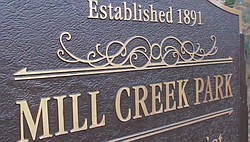
Mill Creek MetroParks, founded in 1891 by Youngstown lawyer Volney Rogers, is celebrating its 125th – or, quasquicentennial – anniversary in 2016. Throughout the year, the park will commemorate the occasion with special programming that begins today.
Visitors can take part in “Hunt & Hike” at Ford Nature Center, during which 25 items – which change each month – are hidden there for visitors to find. The park also will host monthly hikes around Mill Creek Gorge, in honor of Rogers. For detailed event information, visit www.millcreekmetroparks.org.
“What makes us important is we were the first park district in the state of Ohio,” said park naturalist Ray Novotny. “This community should be so proud and thankful that they have this historic park, celebrating this milestone.”
Today, the park district stretches across 12 municipalities, and encompasses 20 miles of roads, 21 acres of parking, 45 miles of hiking trails and 225,677 square feet of building structures. Its sites include a golf course, public garden, mill, recreation area, performing arts pavilion, lily pond, nature center, lakes, bikeway, farm, wildlife preserve and more.
The park now is looking improve some of its existing assets after winning approval of a renewal levy with additional millage for capital improvements.
Back when Rogers brought the park to life, however, it looked much different than it does today. Mill Creek Park formed on a few hundred acres around Mill Creek Gorge, which Rogers sought to preserve from impending industrial development. Formation of the park was approved by a vote in April 1891.
Rogers envisioned the park as a public-health resort at which city dwellers could escape the dirty, crowded conditions of the city’s urban center. Up until his death in 1919, he dedicated most of his time and energy to realization and protection of that vision.
“Not only is Volney Rogers remembered for his foresight in conceiving the idea of a park district, his lifelong interest in nature led him to supervise every aspect of the formation of park lands,” wrote Rogers biographer Bridgett M. Williams, as quoted on the park website. “He used his legal expertise to protect and define the park. As a citizen of the Mahoning Valley, he cherished the park on a daily basis.”
Novotny – like many others – describes Rogers as a visionary of his era.
“The only reason we have Mill Creek Park is because of Volney Rogers,” he said. “He took that core of the gorge, and grew it into the park we know today, adding so many facilities, roads, trails, lakes, etc.
“Since then, becoming a metropolitan park district, we’ve expanded even more, from the city and Boardman Township to all of Mahoning County, with close to 5,000 acres now that people can enjoy.”
Novotny, who has worked at the park for three decades, recalled ringing in the park’s 100th anniversary in 1991. He also thought back through the park’s history, noting some of its other milestones.
In its early years, the park notably acquired and preserved historic properties such as Lanterman’s Mill and Pioneer Pavilion. Lakes also were added to the park early on, with Lake Cohasset’s creation in 1897, Lake Glacier in 1906 and Lake Newport in 1928. The Lily Pond – which remains one of the park’s most-visited sites – came to be in 1896.
Over the decades, the park expanded, stretching into Boardman and to the city’s West side. In 1989, it became Mill Creek MetroParks after voters approved the conversion to a countywide park system.
The park’s history has not been without challenges. Last year was particularly challenging for the park, most notably after water-pollution issues caught the attention of the public, and local, state and federal officials after a massive fish kill in Lake Newport last summer and subsequent finding of elevated E. coli levels in the park’s lakes.
Park lakes – for the first time in their history – have been closed since summer; park officials plan to reopen them sometime this year.
The issue harkened back to a much-earlier challenge in Mill Creek Park’s history, when Volney Rogers fought tirelessly – and unsuccessfully – to prevent the city from constructing sewers in the park.
Despite its challenges, park officials believe Mill Creek MetroParks remains the area’s gem.
“I think our Mill Creek MetroParks is only going to get better,” said Novotny. “I think Volney Rogers maybe is watching.
“If he could see this, I think he’d give us his blessing. We’re carrying on his vision, all these years later.”