 43
43

What you need to know to stay safe Ticks and tick-borne disease
By Linda C. DOLAK
OSU master gardener volunteer
When identifying a tick, size may be of some help, but it’s not always reliable. Generally, adult males are smaller than females. Ticks that are engorged (filled with blood) are sometimes difficult to identify because the size and color are very much altered.
There are three tick species found in Ohio that are medically important because they are disease vectors (carriers). Ticks insert their barbed, harpoon-like mouths into their victim and suck blood.
The American dog tick is dark brown with whitish or yellowish markings. These are found in spring, in open fields or underbrush. They feed on mammals - white-footed mice, voles, chipmunks, raccoons, squirrels, dogs, cats and people. They wait on weeds until a suitable host brushes against them. They cling to fur or clothing and crawl to a place to attach. The female feeds for seven to 11 days before dropping to the ground and laying eggs. Adults are common from April through June. This tick transmits Rocky Mountain spotted fever, by injecting saliva into its “victim,” sometimes causing tick paralysis in dogs and humans. Quick recovery can result by properly removing the infected tick.
The black-legged or deer tick is fairly new to Ohio. Adult females are reddish brown with black heads and legs. These ticks usually use white-footed mice and white-tailed deer as hosts, but have been found on other mammals, birds and humans. The black-legged tick is a known carrier of Lyme disease, mostly transmitting in June and July. Tick bites which develop a red skin lesion should be checked. The lesion usually expands into a large bright red ring with a clear center that can be hot or itchy. Several days to months later, arthritis can develop. The ill person can also experience abnormalities of the heart and/or the nervous system. The number of adult blacklegged ticks spike in October each year.
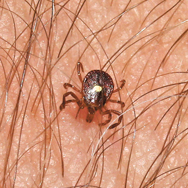
The Lone Star Tick prefers shaded grassy areas. This tick got its name from its original existence in Texas. However, the warmer weather coaxed it through Kentucky and into Ohio. The crazy wet spring we had influenced the ticks to “hold up” in large groups. When the warmer weather arrived, the ticks went wild. The Lone Star tick aggressively bites humans. The adult female can be identified by a white dot or “lone star” on the back. Its saliva can be irritating and usually causes redness and discomfort. It is the nymph and adult females that will most often bite humans and transmit disease, primarily human monocytic ehrlichiosis, a rash illness (STAR), and possibly, tularemia.
If you are going to be hiking in long grass and brush, wear light clothing so ticks can be easily seen, tuck pant legs into socks and wear long sleeves. If you do find a tick attached, remove it immediately by grasping it as close as possible to the host skin with tweezers. Avoid squeezing the abdomen. Gently, but firmly apply steady pressure until the tick is pulled out. You risk leaving the mouth parts in the skin by twisting or jerking the tick.
Using tape, alcohol, burning with a cigarette, or Vaseline to try to get the tick to back out does not work. Keeping the grass cut short and getting rid of vegetation on your property will greatly discourage infestation. DEET (20 percent to 30 percent) will protect for several hours. Be sure to check your clothing and body for ticks if you have been in areas where they may congregate. Especially check adults and children around the waist, under arms, inner legs, behind knees, and around the head, neck, and ears.
If you need to identify a tick, you can bring it to our clinic from 9 a.m. to noon Mondays and Thursdays through the end of October.