 43
43

Youngstown School Board plans appeal of judge’s ruling
By Denise Dick
YOUNGSTOWN
Youngstown City School District vs State of Ohio
 Document
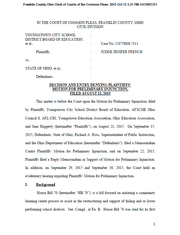
Decision and entry denying plaintiffs' motion for preliminary injunction filed August 21, 2015
The city school board plans to file an appeal to a judge’s decision that denied an injunction that would have stopped a CEO takeover of the school district.
“We’re going to try for an expedited appeal,” said Brenda Kimble, school board president. “The attorneys are going to start working on it” today.
Provisions of the so-called Youngstown Plan, approved by the state Legislature in late June, start taking effect Thursday.
The Youngstown school board and its employee unions filed a lawsuit in August to have the plan declared invalid and unconstitutional. They asked the judge for an injunction to stop the law from taking effect until the merits of the case are determined.
Judge Jenifer French of Franklin County Common Pleas Court on Tuesday denied that motion, saying that attorneys for the board and unions didn’t prove their arguments.
Kimble is upset about the ruling.
“Our attorneys stuck strictly to the law, and for Judge Jenifer French not to give us the injunction, I would say she’s part of their plan and not part of the solution,” she said.
The law dissolves the academic distress commission in place since 2010 and appoints a new one.
The new five-member commission includes three members appointed by the state superintendent of public instruction, one by the mayor and a teacher appointed by the school board.
Those appointments are expected by mid-November, and that commission will appoint a chief executive officer to manage and operate the school district.
The CEO, who will be paid by the state and need not have any education background, will have broad authority including the power to reopen contracts, hire and fire administrators and turn failing schools over to charter or other outside operators.
The CEO is expected to be appointed by year’s end.
Richard A. Ross, state superintendent of public instruction, issued a written statement in response to the ruling:
“Having been in education for more than 40 years, there is nothing worse than seeing our boys and girls trapped in failing schools without the opportunity to achieve their dreams. I look forward to continuing to work with districts, teachers, parents and communities to give students in struggling districts the best opportunity for success.”
Mayor John A. McNally said he’s leaning toward appointing himself to the commission.
“I have had a few folks send me letters of interest in the last couple of months,” he said. “I’m going to wait for official notification from the state superintendent, and then I have 30 days to make that appointment.”
Attorneys for the school board and unions argued the law didn’t go through the required three readings in the Legislature, it violates the Ohio Constitution because it eliminates all power of an elected school board, and it violates the U.S. and state constitutions’ equal-protection clauses because it eliminates all powers conferred by the electors in a school district on an elected school board.
The judge rejected all those arguments.
She found that the legislation was considered on three different days in each house and that the amendment that created the plan didn’t “vitally” alter the original legislation.
“More specifically, the court finds that [the law] clearly maintained a ‘common purpose’ from its introduction through its enactment,” the judge’s ruling says.
Both versions of the legislation focused on “restructuring and improving failing or lower performing school districts and both versions of the bill” addressed “performance standards,” she wrote.
Judge French also addressed allegations that the plan was crafted in secret.
“While these closed-door meetings may function to undermine the public’s confidence in this portion of the legislative process, it is not unconstitutional,” she wrote.
The plan was developed over a course of several months in meetings among Ross and members of ODE staff; Tom Humphries, president and CEO of the Youngstown/Warren Regional Chamber; Laura Meeks, former president of Eastern Gateway Community College; Jim Tressel, president of Youngstown State University; Herb Washington, president of HLW Fast Track; retired Judge Robert Douglas of Youngstown Municipal Court; Connie Hathorn, former city schools superintendent; Bishop George V. Murry of the Catholic Diocese of Youngstown, and Nick Santucci of the chamber.
Judge French said the state constitution provides the electorate the right to vote on its school boards’ composition “and does not provide any substantive rights as to the power and authority that those school boards will exercise.”
Although the attorneys for the school board and unions contended that irreparable harm would be caused if the injunction weren’t granted, the judge viewed it differently.
Attorneys for the education department “presented evidence that the Youngstown City School District is in dire need of help and change,” the ruling said. The state’s attorneys also “presented evidence that the district has received poor performance ratings for the past decade and that approximately 1 percent of the graduating student population is ‘college ready,’” the ruling said.
The state also presented evidence that the public “has an interest in having schools that are effective and that are properly educating students,” the judge wrote.
The Ohio Education Association, the union that represents 121,000 teachers and other education employees in Ohio, is one of the parties to the lawsuit.
In a written statement, Becky Higgins, OEA president, said the “decision will not deter us from continuing to find ways to give voice to the parents, educators and community in Youngstown who were silenced by the state takeover and who have a vital role to play in shaping the future of Youngstown’s public schools so that students have high-quality education they deserve.”
State Sen. Joe Schiavoni of Boardman, D-33rd, and state Rep. Michele Lepore-Hagan of Youngstown, D-58th, both issued statements noting their disappointment.
“There are serious legal issues at stake here, including the right of Ohioans to testify in public hearings on important pieces of legislation,” Schiavoni said. “The citizens of this state were denied that opportunity when the so-called Youngstown Plan was drawn up behind closed doors and added to House Bill 70 at the last minute. I am hopeful that the school district’s arguments will prevail at trial.”
Both lawmakers conducted meetings throughout the summer, talking to various groups and individuals from the community to develop an alternative plan.
Schiavoni plans to introduce that alternative legislation soon.
Lepore-Hagan said in her statement that city residents have a right to testify on laws that radically reshape public education “and I remain hopeful that the court will ultimately decide that the so-called Youngstown Plan – crafted behind closed doors and rushed through the Legislature – violated these rights.”
But not everyone is upset about the ruling.
“The court’s decision [Tuesday] is a strong step forward for kids in failing schools across our state,” Joe Andrews, Gov. John Kasich’s spokesman, said in an email. “Ohio’s old system for helping failing schools wasn’t working, and by breaking away from the status quo that has held our kids back, we can we make sure all students get the opportunities they deserve to reach their full potential.”