 43
43

RHUBARB
By Peggy Griffith
OSU Extension master gardener volunteer
If a plant could suffer from an identity crisis, it would have to be rhubarb (Rheum rhabarbarum).
It’s a perennial vegetable that grows best in cool climates.
Rhubarb often gets mistaken for a shrub because it has large, smooth, heart-shaped leaves with small white flowers and grows to heights of 2-4 feet.
It also gets mistaken as fruit due to its tangy taste best used in pies, cakes and jams.
Rhubarb originated in China for medicinal use 2,000 to 5,000 years ago, showing how hardy it can be.
But the English were the first to try it as food in the 17th century. They mistakenly thought it was chard and ate only the leaves.
This turned out to be a big mistake as the leaves of the plants are poisonous and can cause nausea, cramps and sometimes death.
Due to its bad rep, it was 200 years before the Europeans discovered that the stalks were actually the edible part and brought it to America in the 1800s.
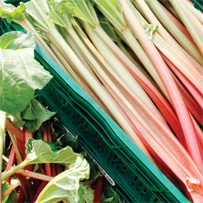
Today, rhubarb comes in many types and is classified as “red,” “green” and “speckled.”
Canada Red produces long stalks that are red inside and out and are juicy, tender and sweet. Crimson Red, aka Crimson Wine, produces tall, plump, bright-red stalks. MacDonald produces tender stalks and is also bright-red in color. Valentine has broad, deep-red stalks that retain their color when used for cooking. Finally, Victoria is the one I have seen the most and has light-green stalks of excellent quality and flavor.
Rhubarb’s leaves appear in the spring when the temperature reaches above 40 degrees.
Even though it prefers fertile, well-drained soil, it will grow within most soils that have a Southern exposure.
If planting in a garden with other crops, plant them on one side or at the end of the garden so it won’t interfere with other plants.
Rhubarb can be planted either in the spring or fall as long as it is still in its dormant stage. It is best planted as crowns, not seeded.
When planting rhubarb, remember it requires 1 square yard of space per plant so it has adequate growth. It requires fertilization only once a year using compost, well-aged manure or fertilizer with a 5-20-20 ratio.
When flowers appear, remove flowering stalks so nutrients can reach the stalk (unless you are growing it for an ornamental flower bed).
During the first year, do not harvest and only harvest a few stalks the second year. At three years, you can harvest from May to June and stop harvesting only when the stalks become thin.
Each mature plant will produce 4-12 pounds of stalks annually.
Also, we never harvest more than one-third to one-half of the plant’s stalks so enough foliage is preserved to protect the plant’s crown.
After the last harvest at the end of June, let the plants grow until the frost comes and places them back into the dormant stage. Once the ground freezes, cover plants with straw and leave until spring.
The stalks can be diced and stored in the refrigerator for two to four weeks and in the freezer for up to six months.
Rhubarb is virtually pest-free. Rhubarb curculio, a snout beetle about three-fourth inches in length, will sometimes attack.
Crown rot is sometimes seen. The easiest way to prevent crown rot is to buy your rhubarb crown from a reputable nursery.
With very little care on your part, rhubarb will continue to give plenty of tasty harvests for many years to come.
To learn more, go to: http://go.osu.edu/rhubarbplant.