 43
43

Volney Rogers was correct: Sewers polluted Mill Creek
By Jordyn Grzelewski | jgrzelewski@vindy.com
Last of a two-part series
The Best of Volney's Words
 Video
Video
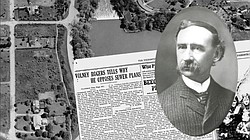
One hundred years ago, on August 11th, 1915, Volney Rogers made an impassioned plea to stop the installation of sewers throughout Mill Creek Park.
Volney Rogers Speaks
 Podcast Episode
On August 11, 1915, Volney Rogers, spoke his opposition to the proposed sewer project that would run through Mill Creek Park. In the pages of …
YOUNGSTOWN
The fight to protect Mill Creek Park from the intrusion of sewer lines pitted Volney Rogers, the park’s founder, against the most-powerful pillar of Youngstown society at that time: the steel industry.
After the federal government in 1915 seized control of the Mahoning River – a water supply vital to the mills – until the city could come up with a plan to install a better sewer system, city officials hastily cobbled together a plan.
Bridgett Williams-Searle, a Rogers biographer who wrote a book about him while she was a graduate student at Youngstown State University, paints a picture of Youngstown at that time as a city with a bustling industrial core, but confronting issues that come with rapid urbanization.
“Youngstown’s mills operated at full tilt to meet wartime demands, and hired extra help to man added shifts. Patriotic fervor ran high in the city, almost as high as labor unrest,” she wrote.
“With wartime production breaking records each month, it seemed that Youngstown would forever attract new workers and their families. The Vindicator predicted that Youngstown’s population would reach 150,000 by 1920. Few who watched crowds debarking at the downtown depot doubted the paper’s prophecy.”
City residents streamed into the suburbs as new residents moved in to take their place, according to Williams-Searle. Jobs were easy to come by, but city dwellers faced other issues.
“Crude sewage disposal systems did little to filter waste before being dumped directly into the Mahoning River. Residents still complained of the quality of water because the filtration plant, which had been damaged in a flood in 1913, had received only the repairs necessary to return it to service,” Williams-Searle wrote. “Customers could vouch that sewers presently in use were poorly designed and not large enough to handle ground water and waste at the same time. Moreover, seepage from porous clay pipes turned the earth above these lines into malodorous swamps.”
Rogers recognized the need for upgraded sewage facilities, but opposed the design that would take pipes through the park.
He fought a long, solitary battle to prevent the city’s plan from coming to fruition, but ultimately lost. Construction began in 1919.
For the next 50 years, steel manufacturing remained the backbone of the local economy.
Then, in the 1970s, the house of cards collapsed.
What remained, in a city that to this day is dealing with the devastating poverty and blight that followed the collapse of the local steel industry, was what’s been called a “Green Cathedral” and the gem of this area: Mill Creek Park.
On July 10, for the first time in the 125 years of Mill Creek’s existence as a park, its waters were closed to all public use — fishing, boating, kayaks, canoes and more.
The park’s staff closed lakes Glacier, Newport and Cohasset until further notice due to elevated E. coli levels caused primarily by overflows from the city’s sewer system. Regardless, scores of Mahoning Valley residents continue to use the park for hiking, biking, nature programs, live entertainment and much more.
It is those people who will end up paying the price to stop contamination of park water, an outcome Rogers predicted a century ago in a two-page spread in The Youngstown Vindicator published Aug. 11, 1915.
The proposed plan to end sewage overflows into the park – slated to be complete in 2033 – carries a $47 million price tag. This is in addition to $100 million for other upgrades to the city’s sewer system.
The plan, as it now stands, is to pay for the project by increasing rates for city sewer customers.
WAS ROGERS RIGHT?
Rogers, in great detail and corroborated by experts, predicted 100 years ago a number of damaging outcomes for the park should the city proceed with its sewer plan.
His specific predictions, experts say, were mixed in terms of accuracy; his broader conclusion about the damaging effect to the park, they seem to agree, however, was spot-on.
“As an attorney, and as an intelligent man, he knew what he was talking about,” said Bill Lawson, executive director of the Mahoning Valley Historical Society.
“He saw the dangers immediately in 1915 in terms of undermining water quality ... and unfortunately, his prophecy came to be, because within a couple of years of the system being installed ... because of pollution and bacteria levels ... they had to stop using them [the lakes] for swimming,” said Lawson.
Rogers predicted that sewage would overflow into the park.
“During heavy rainfalls or high water from melting snows, water from the high hills would rush quickly down in the sewer to the low ground along the lake, back-fill with such a pressure that sewage would be forced from the sewer into the lake and probably overflow at the manholes at the surface,” he wrote. “In view of the fact that Lake Glacier is but a short distance above the city water intake, and that the ice on Lake Glacier is cut in large quantities for domestic consumption, it would be an unpardonable wrong to contaminate the waters of Lake Glacier with sewage.”
Additionally, he believed the sewer system would lower the lake’s water level.
“If water tight sewers cannot be built and maintained elsewhere is it likely that they will be built and maintained in Youngstown?” he asked.
Aaron Young and Steve Avery, executive director and planning and natural resources director for the park, respectively, say that, as far as they can tell, lake water seeping into pipes has not been an issue over the years.
Another concern of Rogers’ was that the pipes would pollute and dry up the park’s springs.
“The opportunity of the people of a city such as Youngstown now is, and such as it gives promise of being in the future to visit a beautiful park forever, and be forever denied the privilege of drinking the pure cool waters of Nature’s springs that were rightfully theirs, to me is unthinkable,” he wrote.
Young and Avery say it’s unlikely there was a direct connection between the construction of the sewer and the springs’ drying out.
They pointed to other impacts not mentioned by Rogers in the August 1915 article. For one, construction tore up the park, damaging anything in the path of the sewer lines – and those pipes will someday be replaced.
“It’s going to be a much bigger pipe ... so therefore the effects are even greater,” Avery said. “Those were impacts back then, and will be in the future when it’s replaced.”
There also have been breaks in the lines over the years, Avery said. Plus, “there are several locations where the smell is always there. You wouldn’t have the smell if we didn’t have the sewers,” he said.
‘AHEAD OF HIS TIME’
Although many in that era accused Rogers of being anti-progress, experts today say he was forward-thinking and progressive.
“That’s something that a lot of people don’t know about Volney Rogers. He was not just interested in preserving the scenic beauty; he was really interested in public health,” said Rick Shale, a former park board commissioner, longtime park volunteer and co-author of a book about the park. “I think he was 50 to 100 years ahead of his time.”
Through his involvement with the park over the years, Shale saw the pollution issue come up again and again.
“This is an ongoing disaster story. Every few years something happens to get it going again – and this time it was the fish kill,” he said. “If that hadn’t happened, there would have been nothing to call attention to a problem that has been going on for decades.”
Sitting at a campus coffee shop, Shale pondered what Rogers would think if he were alive today.
“I think he would take no pleasure in the current crisis. He would be heartsick at the idea that the park’s lakes are polluted, but ... I don’t think he’d say it out loud. But I can imagine him saying privately to himself, ‘I told you so. I told you what would happen,’” he said.
“One hundred years later, it’s all come true.”