 43
43

100 years ago, Volney Rogers decried Mill Creek sewers
RELATED: Rogers fought sewer encroachment on park
By JORDYN GRZELEWSKI
jgrzelewski@vindy.com
YOUNGSTOWN
 Gallery
The Best of Volney's Words
 Video
Video
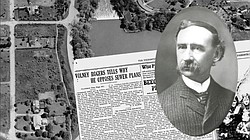
One hundred years ago, on August 11th, 1915, Volney Rogers made an impassioned plea to stop the installation of sewers throughout Mill Creek Park.
Volney Rogers Speaks
 Podcast Episode
On August 11, 1915, Volney Rogers, spoke his opposition to the proposed sewer project that would run through Mill Creek Park. In the pages of …
One hundred years ago, The Youngstown Vindicator gave Volney
Rogers – the founder of Mill Creek MetroParks – two entire newspaper pages
to lay out his staunch opposition to the construc-
tion of sewers through the park.
The Aug. 11, 1915, article — when read today — reads like a prophecy in light of recent sewage overflows that, on July 10 for the first time ever, closed all of the park’s waterways for public use.
“It is one of the eternal principles of right and wrong that every one shall so use his own land as not to injure his neighbor, and it follows that every one shall take care of his own sewage, so that he shall not harm others,” wrote Rogers, a lawyer by trade, who in his role as park board commissioner, was a passionate advocate for protection of the park as a “public health resort,” as he had envisioned it since he founded it in 1891.
“It follows for these reasons that under no circumstances should sewers be located in public parks near springs, lakes, or streams, and if possible they should not be built within the park limits. At best it is bringing city conditions into public parks, and city conditions are the very things the tired city dweller wishes to avoid.
“The idea of bringing all the sewage for about six and one-fourth square miles, now in the city, and as much more later perhaps from Boardman to the center of as valuable a park as our Youngstown Mill Creek park, as a sanitary proposition, is so abhorrent and so destructive to the highest benefits that the people are entitled to enjoy, that I am sure those who suggest this plan do not do so understandingly,” wrote Rogers, 68 at the time.
Bridgett Williams-Searle, a Rogers biographer, wrote that by that time Rogers’ “hand had begun to tremble slightly when signing documents and other papers. Sometimes his bones ached. He walked with a slower step and saw with a dimmer eye.”
Despite any ailments, however, Rogers fervently pushed on with his attempts to stop the city from building a sewer system through the park.
Despite Rogers’ impassioned pleas, including a lengthy legal battle with the city that went all the way to the Ohio Supreme Court – the city moved forward with the plan. Construction began in 1919.
Rogers, dejected, left Youngstown planning to travel the world. He instead died Dec. 3, 1919, in Colorado after a battle with pneumonia.
Today, the community is paying the price for the battle Rogers lost with the city.
On July 10, Mill Creek MetroParks announced it would close its lakes to the public until further notice after tests found elevated levels of E. coli in the water. A massive fish kill in Lake Newport in June after a rainstorm prompted testing.
The presence of high levels of E. coli bacteria was primarily the result of overflows from the city’s combined storm and sanitary sewer system into the park’s bodies of water, the Ohio Environmental Protection Agency concluded.
YOUNGSTOWN CIRCA 1915
Youngstown at the time was a flourishing industrial city in the midst of a population boom. As the United States geared up to enter World War I, there was no shortage of manufacturing jobs.
“It was a very quickly growing and expanding city with a very vibrant steel industry. There was a lot of money being made,” said Bill Lawson, executive director of The Mahoning Valley Historical Society.
“At the same time ... the city had a lot of trouble with growing pains – having adequate housing for people, adequate sanitation,” he said. “There was a lot of water-borne disease that came through the area because of contamination of the water.”
On top of complaints from residents, the city was under pressure from the U.S. government. Concerned by the massive amounts of industrial waste and raw sewage being dumped into the Mahoning River, the federal government seized control of the river – cutting off a water supply needed by what Lawson dubs the “main cog” in the local economy: the steel industry.
“The city’s back was pretty much against the wall,” he said. If steel making was to continue, the city would have to build a sewer system.
Short on funds and time, city officials – namely city engineer F.M. Lillie – “drew the straightest, cheapest course they could devise,” wrote Williams-Searle.
That line was drawn through Mill Creek Park.
ROGERS’ PREDICTIONS
Rogers’ opposition to the sewer plan – laid out in the Vindicator – came down to a few predictions and beliefs that the design was poorly planned and that it was wrong to damage public property in the name of private interests.
“Mr. Rogers’ idea during the many years he has been at the head of Mill Creek park, has been to give the people of Youngstown who cannot afford to go away during the summer, a health resort here at home, with pure air, pure water, and all opportunities for enjoyment,” the Vindicator wrote. “The proposed sewer, he finds, will destroy the springs in the park, cause sewage to back up into Lake Glacier, lower the level of and perhaps drain Lake Glacier and Bear Creek, and do other damage that cannot now be foreseen.”
The park in 1915, experts say, was much like the Mill Creek Park visitors enjoy today, although Lake Newport had not yet been created.
Park lakes are man-made — Lake Cohasset was created in 1897, and Lake Glacier in 1906. Lake Newport was added in 1928.
Rogers envisioned the park as a refuge from the dirty, crowded streets of the city. Administration of that vision consumed him.
“For the rest of his life, until he left for his fateful around-the-world journey in 1919, he devoted almost all of his time to improvements to the park,” said Lawson.
Williams-Searle writes that park employees complained about Rogers’ interference in any and all park matters but “just as quickly praised his total dedication and total commitment.”
A primary concern of his was that the sewer system would lower water levels. He cited expert testimony that sewer pipes not only leak, but take in water.
“You will see by this that for bathing, boating and beauty, it is absolutely necessary to conserve all the water for these beneficial park benefits during these months, and in addition if the water were drawn down in a substantial degree, the question of mud banks drying in the sun would not only be ugly but unhealthful,” he wrote.
At that time, visitors to the park often drank from springs. Rogers was concerned they would not be able to do so if a sewer were added.
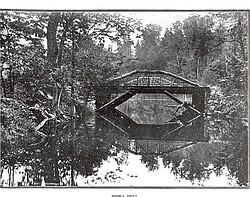
“Nearby is the old Lanterman Mill, used for a bath house, refreshments and shelter. This spring furnished large quantities of pure drinking water to thousands of thirsty people, and the large number of people who will in the future visit this romantic place and drink the waters of this spring would be impossible to estimate,” he wrote. “The pleasure and delight of going to this rock, for a pure cool drink of water, with a grand vista of a deep rocky gorge, a rushing stream, a deep pool, a magnificent waterfall, mosses, ferns and evergreens adorning rocks, cliffs and hill sides, is to an appreciative person beyond description, and the ideas of placing a sewer where it would pollute a spring so valuable is so abhorrent that I cannot believe that such a suggestion was made knowingly.”
He ended his Vindicator column with a plea: “In conclusion I wish to say that I have no personal feeling in this matter whatever. I am trying to the best of my ability to do what I believe to be for the best interests of all the people of Youngstown at present and to come. To help keep men, women and children well, hearty, strong and happy, ought to be the mission of our parks. To do this they must be given pure air, pure water and opportunities for rest and enjoyment with beautiful surroundings; and the best sanitary conditions possible. This is absolutely impossible if our parks are to become general receptacles for sewers that drain large areas.
“Thanking you for your patience in listening to this paper, and earnestly hoping that Mill Creek park may be saved to the people of Youngstown without being invaded by sewers, I am most sincerely yours, Volney Rogers.”
“THE GREAT SEWER BATTLE”
When Rogers received a copy of the plan, he was horrified. His response was immediate.
“He called his commissioners together, and started writing letters,” Lawson said.
It was around that time that Rogers got the Vindicator to give him two full pages. His appeal in the newspaper was one of many weapons he used in the fight – what Williams-Searle says came to be known as “The Great Sewer Battle” – that eventually took Rogers to the Ohio Supreme Court.
When expert testimony and impassioned pleas failed to halt the plans, the board of park commissioners sued the city.
For Rogers, it was an all-consuming battle for nearly four years.
“He led the fight for the park district, and he took a lot of abuse – in the newspapers and probably in public,” Lawson said. “In those 31⁄2 years, he surpassed his 70th birthday. His health was starting to fail, because he was so obsessed and focused on this case.”
On June 14, 1916, Judge C.M. Wilkins of Mahoning County Common Pleas Court ruled in favor of the city. Rogers appealed, prolonging a fight that had begun to take its toll on him.
“He felt the weight of his 70 years with every step. His eyesight, strained from poring over law books for some ruling that could aid his case, began to fail. ... Rogers no longer pretended to have an interest in anything but the preservation of Mill Creek Park,” Williams-Searle wrote.
In 1919, he suffered the final defeat: the Ohio Supreme Court announced a decision in favor of the city.
Rogers reportedly wept.
He left Youngstown shortly thereafter, never to return.
Little did he know that in the ensuing century, his predictions would be realized.
The story of contamination of the park from the sewer system had just begun.
(In Monday’s Vindy, read where Volney was right and wrong in his predictions of the sewer’s impact on the park.)