 43
43

Mahoning County's bonus bonanza
By PETER H. MILLIKEN
milliken@vindy.com
YOUNGSTOWN
The salaries of some highly compensated Mahoning County employees have been padded with a new trend: a bonanza of bonuses ranging from hundreds of dollars to the $5,000 lump sum paid last year to Randall Muth, county children services executive director.
Bonus Bonanza
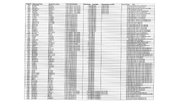
 Document
A collection of the recent hike in bonuses given to county employees.
More than 250 lump-sum bonuses totaling $165,400 have been awarded to 181 Mahoning County employees in nine departments over the past five years,
according to a payroll spreadsheet supplied in response to a Vindicator public records request.
The newspaper sought all bonuses not tied to a labor con-tract ratification.
In fact, the county response reveals bonuses have achieved a newfound popularity. The number of bonuses awarded was just seven in 2010, but it has mushroomed to 139 thus far in 2015.
The bestowing of bonuses accelerated with awards so far this year to all 112 juvenile court employees, a select group of 14 members of the auditor’s office staff, and some other smaller groups of county employees.
PROSECUTOR LIVID
County Prosecutor Paul J. Gains said he is displeased with bonus payments to county government workers.
“I’m very angry about it. ... It came as a big surprise to me, and I think it’s wrong” to give bonuses to county workers, he said.
“In 18 years, I’ve never heard of bonuses” for county workers, said Gains, who was first elected prosecutor in 1996.
“They’re inappropriate because I have yet to see why any of these people merited a bonus,” he said. “A bonus is for exemplary work. ... What could they do that’s so extraordinary?”
After a Vindicator inquiry to him, Gains said the sole employee in his office to receive a bonus, George Briach, a $62,228-a-year assistant county prosecutor who works with the county auditor’s office on county board of tax appeals cases, is refunding to the county the $500 bonus he received this year.
Gains said Carol McFall, the county’s former chief deputy auditor, who approved Briach’s bonus, lacked the authority to do so. Briach’s bonus was listed as both a training and cost-of-living bonus. He previously was an employee of the auditor’s office.
Gains said all of his other assistant prosecutors undergo Ohio Supreme Court-mandated training and receive no bonuses for it.
JUVENILE COURT
By far the largest bonus outlay consisted of $48,636 collectively awarded this year to the 112 juvenile court employees.
They were the first bonuses awarded by that court since Tarise Wolfe, who was listed as a $30,186-a-year driver, received bonuses of $350 each in 2010 and 2011, according to the county spreadsheet.
Among the top juvenile court bonuses awarded this year were: $2,066 for Jason Lanzo, the $68,876-a-year detention director; $1,833 for Kelly Melvin-Campbell, a $36,651 intake officer; $1,475 for Juanita Marsico, a $29,493 mediation coordinator; $1,348 for Ronald Chambers, a $44,586 program director; and $930 for Magistrate Anthony D’Apolito, the $93,021 court administrator.
All juvenile court employees got a lump-sum payment of 1 percent of their salaries, and selected employees received bonuses in addition to that based on exemplary job performance, educational achievement or increased job responsibilities, D’Apolito explained.
The 1 percent lump sum was paid on the basis that the Public Employees Retirement System might raise the employee contribution to PERS from 10 to 11 percent of salary, although D’Apolito acknowledged that he wasn’t aware of any declared intention by PERS to raise that percentage.
The employees already had received salary increases to compensate for the switch from the county’s paying their PERS share to their paying their own share, he said.
D’Apolito objected to the 1 percent lump sums being characterized as bonuses because the 1 percent was not awarded based on job performance.
The Jan. 9 awards were approved by Judge Theresa Dellick after court officials consulted with the county commissioners and Budget Director Audrey Tillis, D’Apolito said.
“It would not have been done if it would hurt the county at all,” D’Apolito said of the awarding of lump sums to court employees.
Passage of the 0.75 percent sales tax in November — which took effect Wednesday — was not a factor in the decision to make the lump-sum awards, he said. All lump sums fit within the court’s budget, he added.
Such lump-sum payments were not made to juvenile court employees between 2011 and 2015 “because of the economic situation” in the post-recession period, he said.
MENTAL HEALTH BOARD
At the mental health board, among the 1 percent bonuses paid Jan. 9 were: $784 for William Carbonell, the $79,977-a-year director of programs and planning; $750 for Howard Merritt, the $76,500 finance director; $760 for Toni Notaro, the $77,576 administrative director; and $526 for Michele Petrello, the $53,627 administrative assistant.
Duane Piccirilli, the $112,000-a-year director of the county mental health and recovery board, who did not get a bonus, said the timing of the bonuses had nothing to do with the Feb. 23 merger of the county mental health and alcohol and drug addiction services boards to form the new mental health and recovery board.
Piccirilli said he believed it “would be more cost-effective” to pay the one-time lump sums, which were approved in the budget of the former mental health board, than to incur the permanent cost of a pay raise and associated benefits.
RECYCLING
In the recycling division this year, Lou Vega, the $72,352-a-year director, got a $1,447 bonus; James Jerek, the $58,596 business manager, got a $1,172 bonus; and Mary Gresh, the $47,012 division coordinator, got a $940 bonus.
In a statement on behalf of the county commissioners, Tillis said the payments the commissioners gave the recycling employees were not bonuses, but should be characterized as one-time payments to equalize their compensation to that of their professional peers.
“These stipends do not run in perpetuity and do not affect future budgets,” she said.
The recycling division, which is funded by landfill dumping fees, contains the only group of employees covered by The Vindicator’s public records request who are under the commissioners’ appointing authority, Tillis said.
BOARD OF HEALTH
At the board of health, bonuses appeared only in 2014 and 2015.
Patricia Sweeney, whose regular annual salary as county health commissioner is $99,008, received a $1,980 bonus this year.
Nine other county board of health employees received bonuses last year, ranging from $600 for Michele Olin, an hourly procurement specialist, to $1,502 for Diana Colaianni, the $75,088 recently retired nursing director.
The board of health approved lump-sum payments of 2 percent of salary for members of American Federation of State, County and Municipal Employees Local 3759 in a new union contract last year, as well as for nonunion staff, including the commissioner, Sweeney said.
Even though the county payroll department handles its payroll, Sweeney said board of health workers are not county employees; they are employees of the Mahoning County General Health District.
CHILDREN SERVICES
At the county children services, Muth’s $5,000 bonus was not subject to contributions toward his Ohio Public Employee Retirement System benefits. Muth’s regular annual salary is $95,000, and a $5,000 annual bonus is included in his three-year contract, which expires in July 2016.
Muth, who became children services director in July 2013, said his bonus stems from his doubling as a lawyer for the agency after the 2013 retirement and nonreplacement of an agency lawyer.
Muth said bonuses were awarded to staff, instead of raises, because of the uncertainty of whether the agency’s 1.85-mill, five-year real-estate tax levy would pass last November. The levy passed with 63 percent of the vote.
“We would like to have raised the base salaries, but that was just not fiscally responsible” given the uncertainty, Muth explained.
Besides Muth, four other children services workers received bonuses of $1,000 or more last year, two of them receiving training bonuses of $1,000 each for completing continuing professional education.
SCIORTINO’s GENEROSITY
Among the most generous bonus payers here was former county Auditor Michael V. Sciortino, who bestowed $28,110 in bonuses on 14 of his nonunion employees on Feb. 20, 2015, just before a three-judge panel suspended him Feb. 23 based on allegations against him in the Oakhill Renaissance Place criminal-conspiracy case.
Those bonuses ranged from $1,250 to $2,730 and are not subject to PERS contributions. They were listed as cost-of-living increases.
McFall, whose final regular annual salary was $92,500, received the $2,730 cost-of-living bonus this year, after she had received training bonuses of $1,000 each in 2013 and 2014.
Newly elected Auditor Ralph T. Meacham fired McFall on March 4 because she redacted bonus information from a personnel action request form she provided in response to an earlier Vindicator public records request.
VETERANS SERVICE COMMISSION
At the veterans service commission, 13 employees received bonuses within the past five years, with individual awards ranging from $275 to $660.
Employees there ranged from one to four such awards over the past five years.
Moses Murphy, a $62,587-a-year service officer there, received four separate bonuses during the past five years, totaling $1,764.
Before 2013, commission employees got varying annual bonuses based on their salaries, but in 2012, the five-member veterans service commission voted to give all employees a $300 annual bonus.
“The veterans service commissioners felt that a $300 bonus to their employees was well-deserved for their endeavors and hard work,” said Susan Skrzynski, commission director.
In 2013, the commission provided its own financial assistance to more than 500 veterans, transported more than 1,600 veterans to medical appointments in Cleveland and procured about $41 million in U.S. Department of Veterans Affairs claims awards for veterans and their families, she said.
THE BUDGET CONTEXT
Although a few of the county’s 1,741 employees benefited, the total dollar value of the bonuses, paid out of the county’s general fund and many other county funds, depending on the department, isn’t significant in the context of the county’s total spending.
The 2015 general-fund budget for operation of the central administrative functions of county government is $33.6 million.
Tillis said the lump sums the county pays should not be viewed in the same context as bonuses paid by a private business.
Where the county’s spreadsheet explains the lump sums, the most common description is “training bonus.”
Other lump sums are listed as cost-of-living adjustments or wage-equity adjustments to equalize compensation to the workers’ professional peers.
From a budgetary perspective, paying a one-time lump sum is cheaper than giving an employee a permanent pay raise, Tillis explained.
“It is a way of recognizing that, at this point in time, we were not able to give permanent increases, but still recognize that costs [of living] have gone up,” she said.
The inflation rate as measured by the Consumer Price Index was 1.5 percent in 2013 and 1.6 percent in 2014.
The payment of lump sums to county employees is not unique to Mahoning County, Tillis said, noting that lump sums were paid to Portage County employees when she was budget director there before she took her current job.
“We actually did lump-sum payments when we couldn’t afford to do the raises,” she said of her Portage County experience.