 43
43

Austintown room calms students
 Photo
Photo
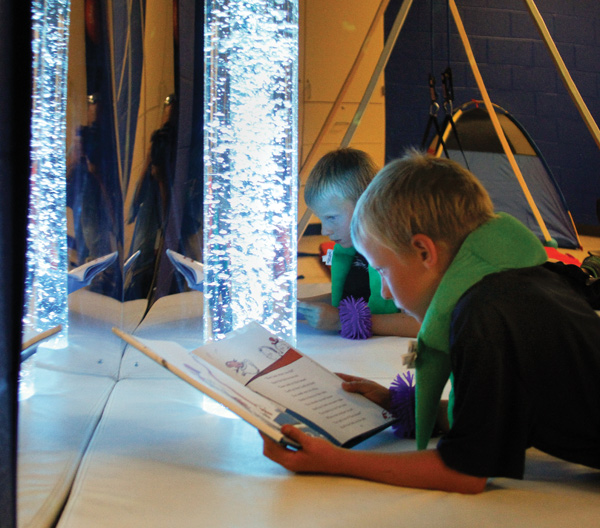
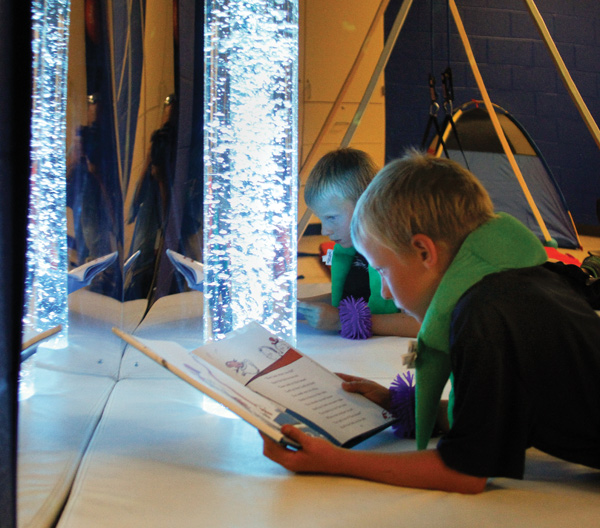
Colorful lights that change help to soothe Nolan Mickey as he reads a book in the sensory room in Austintown Elementary School. The room was not originally in the plans for the new building, district officials said, but once the space was available, the district bought equipment and opened it this school year.
By ROBERT CONNELLY
rconnelly@vindy.com
AUSTINTOWN
School officials unveiled the district’s new sensory room Thursday during an open house.
A sensory room offers a place for students to go during classes to either calm down or move around to help them learn better or become more engaged during learning. The room is in the kindergarten wing of Austintown Elementary School, 245 Idaho Road.
The walls are painted dark blue, and the windows currently have black covers on them. Becky Morris, director of special education for the district, said motorized blinds will be installed for the option to change the lighting in the room.
The room is 600 square feet, and the district spent $27,000 on equipment for the room through a federal Medicaid reimbursement program. The room was not paid for by general-fund money or special-education funds, Morris said. That is because the room is for all students, not just ones in special education.
“We really wanted to make sure that it was for all kids — not just kids with disabilities — but all kids that they can really gain from this room,” Morris said.
A spokesperson with the Mahoning County Educational Service Center couldn’t comment on whether this was the first sensory room in the county, but Maureen Hough, occupational therapist for Austintown schools employed through the MCESC, said, “Some districts have parts and pieces [of a sensory room] within classroom settings, but to have it this broad and have this much equipment” is new, she said.
During the open house, a few students enjoyed using the equipment. There was a trampoline with a stand to hold onto, a wide multipurpose swing and beanbag chairs, among other items. If the lights are turned off in the room, it switches to a black light and a projector displays an aquarium image on a whiteboard while overhead lights dance on the walls.
Many of the special-education workers who will be using the room are employed through the MCESC, such as physical and occupational therapists.
JoAnn Nori, assistant certified occupational therapist through MCESC, said the room can accommodate seven to eight students at maximum. Three to four students at once would be more common, district officials said.
“It’s learning with movement, and it makes learning a lot of fun,” Morris said of the room.
The process of selecting equipment for the room was done during the last school year, and the room wasn’t in the original plans of the new school, Morris and Superintendent Vincent Colaluca said.
“When we thought about what equipment should go in there, we tried to think of a variety of different things that would address many needs, so whether a child needed more movement or more visual input, more auditory [input] ... we tried to incorporate all different senses when we picked the equipment,” Hough said.
Colaluca added, “We knew that we had a space that we could possibly make into a sensory room. ... It just made sense to us to give the kids an opportunity to have an area where they can go and de-sensorize themselves from the stimulations that are in a normal classroom of 20, 25 kids.”