 43
43

YSU history expert gives insight into Russian conflict
 Photo
Photo
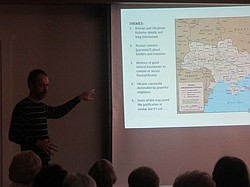
Neighbors | Tim Cleveland.Dr. Brian Bonhomme spoke about Russia's paranoia about its borders and invasions during his talk about the situation between Russia, Ukraine and Crimea at the Boardman library.
 Photo
Photo
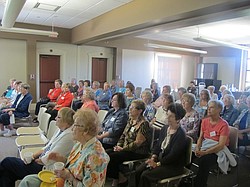
Neighbors | Tim Cleveland.A large crowd filled the meeting room at the Boardman library to hear the talk by Youngstown State University history professor Dr. Brian Bonhomme.
 Photo
Photo
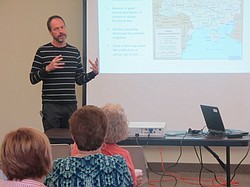
Neighbors | Tim Cleveland.Dr. Brian Bonhomme gave a talk at the Boardman library about the history of Russia, Ukraine and Crimea. He began his talk by going back 1,500 years in the region's history.
By TIM CLEVELAND
On Sept. 8, a large capacity crowd filled the meeting room at the Boardman library to hear a talk by Dr. Brian Bonhomme about the history between Russia, Ukraine and Crimea, plus the current state of the region.
Bonhomme has been a history professor at Youngstown State University for the past 10 years. Originally from the United Kingdom, he has been in the United States since 1987. He has earned a PhD. and has extensively studies Russian and eastern European history.
“They asked me to talk about Russia and Ukraine and what’s been going on there in the last few months with Crimea and the breakaway regions east of Ukraine,” Bonhomme said.
He has written two books - “Russian Exploration, from Siberia to Space: A History” and “Forests, Peasants and Revolutionaries: Forest Conservation and Organization in Soviet Russia, 1917-1929,” as well as numerous articles about Russia.
Bonhomme discussed what got him interested in Russian history.
“My wife [Yelena],” he said. “My wife was born and raised in Belarus, and that’s basically how I got interested in Russian affairs and eastern European affairs.”
The talk lasted about 50 minutes, with about 45 minutes devoted to his talk and the rest of the time for a question and answer session.
Bonhomme said he would give an extensive history of the region in his talk.
“I’m a historian so I’m going to start 1,500 years ago and do a long kind of build up for it,” he said. “Some of the things I’m going to emphasize today is how closely connected the history of Ukraine and Russia is. For the last 23 years, since the collapse of the Soviet Union, Russia has been one country and Ukraine has been another country, but their histories are so mixed up. There’s a very long background to the problems that are going on today. I’m going to emphasize the intertwined nature of Russian and Ukrainian history and try and get a little bit of sense of both the Ukrainian and Russian perspectives on what’s going on.”
He said he thinks the United States needs to be more self-aware in its responses to what’s been going on in the region while also being clearer in its position.
“I think the U.S. needs to do two things,” he said. “I think the U.S. needs to be aware of how these situations appear from the point of view of Russia and other countries, and secondly I think America needs to be much clearer when it draws red lines. It needs to take away any ambiguity. It needs to make it very clear that NATO states will be defended and it needs to take away any uncertainty that could encourage Russia to interfere in NATO states’ affairs.”
Bonhomme said he believes the conflict will come to a conclusion with a compromise on all sides.
“I do think the situation is going to be resolved,” he said. “I think probably that solution is already taking shape. I think it’s probably going to end up with Russia getting some of what it wants. I don’t think Crimea is going to go back to Ukraine. I suspect that Luhansk and these breakaway republics are probably going to end with with some form of autonomy. I think the real key on a global scale is to contain this to Ukraine because there’s a lot of other places in eastern Europe where there are Russian minority populations and some of those places are in NATO, such as Estonia. I think a solution has to be worked out that contains this situation to Ukraine and does not allow it to spread to NATO states.”