 43
43

Area communities decide whether to take ODOT's ballooned salt price
 Photo
Photo
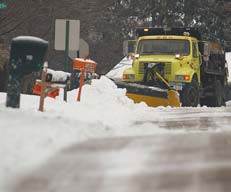
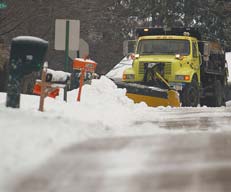
With rising salt prices, local governments are looking at ways to treat roads this winter while keeping costs down.
Staff report
YOUNGSTOWN
Winter driving won’t be the same this season because there won’t be as much road-treatment material to spread around.
“The consequences are that drivers need to understand that it’s not going to look like it has in the past as far as clear, wet roads. We just don’t have the resources and funding to do that,” warns Mahoning County Engineer Patrick T. Ginnetti.
Although the Ohio Department of Transportation was able to lower its rock-salt bid price, Mahoning Valley communities are taking different approaches to the coming ice and snow.
Just months ago, salt prices through the state were between $146 and $148 per ton in Mahoning County. That price was recently reduced by ODOT to $105.25. The deadline for accepting ODOT’s price is today.
ODOT’s Steve Faulkner explained that once initial high bids were rejected by early September, “we had to find if there was another option for salt. What ODOT did was we actually went back out to the market.”
The state found Indiana-based Midwest Salt Co., Faulkner said, and bought 171,600 tons at $105.25 a ton. “We’re able to have that shipped in via barge to the ports of Toledo and Ashtabula for those communities that joined with us,” Faulkner said.
Local governments
Austintown decided to buy 3,000 tons at the $105.25 rate, Administrator Mike Dockry said. Last year, the township ordered 3,750 and the rate through ODOT purchasing was about $27 per ton.
“We would prefer to do just salt. We started out just doing salt [last year], but it became apparent before the end of the year that with the frequency of us going out, we would run out,” he explained. This year, some options include “after they plow, they won’t be salting the entire road. They may just be salting the intersections.”
Similarly, Canfield Township also opted to take ODOT’s price and ordered 1,300 tons — it usually orders between 1,300 and 1,800 tons and paid about $27 per ton a year ago.
“That is all that the township can do at this time,” Administrator Keith Rogers said.
He explained his crews don’t mix salt with any other treatment because they don’t have the equipment for their vehicles. “That would cost about $10,000 per truck ... and obviously we don’t have that kind of money to outfit five trucks,” he said.
Any local government purchasing salt through ODOT will have to pick it up using its own vehicles.
Youngstown has a contract for $37.89 a ton with Cargill Inc., with a depot near Cleveland. The city plans to purchase enough salt at the current price to last through the winter, said Finance Director David Bozanich.
The city purchased 14,000 tons last winter and had 2,000 tons remaining. Also, the city purchased an additional 3,000 tons about two months ago that is stored in its salt dome, which is now at near-full capacity. The city is looking for other places to house the additional salt, Bozanich said.
Canfield city Manager Joe Warino isn’t deciding what to do until today. The city has 700 tons in storage, the max capacity, from ODOT’s summer fill-up. That’s also enough for a normal winter, but the city went through 1,200 tons last winter.
He’s deciding on how much to buy, maybe ordering 700 more tons. “Do I gamble and split the difference? Today it’s the best deal,” he said of ODOT’s $105.25.
Struthers plans to purchase 400 tons from the state. Mayor Terry Stocker said the city ordered 600 tons last winter and has 200 tons left over from last year.
Campbell committed to 400 tons from ODOT. Judith Clement, city administrator, said the city was down to 10 tons. As a safety precaution, Campbell already purchased 45 tons from Lowe’s Home Improvement in Boardman in case of early snowfall at $125 a ton. Last winter, VanSuch said the city purchased 420 tons for $27 per ton.
Lowellville plans to purchase 125 tons from the state, and Bill Meehan, village administrator, said the village tends to use 175 tons per year. “We’re a lot smaller than most communities,” Meehan said. It also mixes slag and salt.
Boardman decided to purchase 500 tons from ODOT, said road Superintendent Larry Wilson. Wilson said the township has about 4,500 tons in storage that it purchased at $42 per ton.
Poland Township opted to buy 300 tons from ODOT and has about 600 tons in storage.
Poland Village has no plans to purchase salt and awaits a quote from Morton Salt, said Russell Beatty Jr., streets commissioner and police chief. Beatty said the village has about 40 tons in storage from last year and will mix it with treated limestone.
Liberty Township has enough salt left from last year to get through a mild-to-moderate winter. It has, however, notified ODOT that it will purchase up to 1,200 tons at the $105.25 price if needed.
MAHONING COUNTY
Mahoning County has not gone with ODOT’s price. It has 3,500 tons in stock; of that, 2,000 tons were purchased during ODOT’s summer fill-up at a rate of $42 a ton. The county used 13,000 tons last year and typically purchases between 8,000 and 11,000 tons.
Commissioners approved the purchase of up to $100,000 for both brine-treated slag and an ice-control accelerator made from sugar beets and molasses from K-Tech Specialty Coatings Inc. of Ashley, Ind., at $1.44 per gallon. The brine-treated slag comes from Gennaro Pavers Inc. of Lowellville at a rate of $13.50 per ton if the county picks it up, or $19.50 per ton if delivered.
“We will be able to stretch our salt supply by adding slag and BEET HEET. There is no way I can predict if we will need to purchase more salt unless the meteorologists can guarantee their weather prediction is 100 percent accurate 100 percent of the time,” Ginnetti said.
TRUMBULL COUNTY
Engineer Randy Smith plans to begin using beet juice and brine to augment salt. His office plans to buy 2,000 additional tons of salt at $105.25 per ton through the state to add to the 7,000 tons now in storage.
That will give the county 6,000 tons for its trucks to use and 3,000 tons for its partner townships and village. That is about 75 percent of what the county used last year. The partner townships and villages can add to the county’s order at the state price, Smith said.
Hubbard, for example, will buy through the county consortium, paying $105.50 a ton. It plans to purchase 650 tons, the same as last year.
Trumbull County also plans to use beet juice, brine and grit. The office has installed a 6,000-gallon tank to hold the beet juice. Smith’s office also will have two brine tanks available to place in the back of plows to use for road pre-treatment. The two brine tanks and beet tank will cost the county about $40,000.
In Warren, Frank Tempesta, operations superintendent, says the city hopes to keep its costs comparable to last winter by buying only half as much salt and adding brine and beet juice.
The city had about 800 tons left and ordered 1,200 more tons at $42 per ton earlier this year. The city used 4,000 tons last year.
Roadway grit such as sand and ash will be mixed in more liberally than in the past, Tempesta added. Grit is priced at $18.10 per ton.