 43
43

Retired local veteran gives speech on women in the military
 Photo
Photo
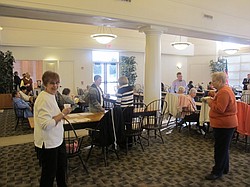
Neighbors | Tim Cleveland.The attendees of retired Air Force Chief Master Sgt. Lori Stone's talk about women in the military mingled together before the event at the Austintown library.
 Photo
Photo
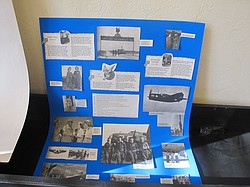
Neighbors | Tim Cleveland.Retired Air Force Chief Master Sgt. Lori Stone brought a poster that featured the history of women in the military as part of her presentation at the Austintown library.
 Photo
Photo
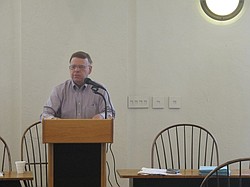
Neighbors | Tim Cleveland.Friends of the Austintown library vice president Doug Wilcox introduced retired Air Force Chief Master Sgt. Lori Stone before her presentation about women in the military.
 Photo
Photo
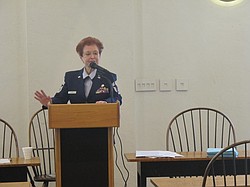
Neighbors | Tim Cleveland.Retired Air Force Chief Master Sgt. Lori Stone gave a presentation at the Austintown library about the history of women in the military.
By TIM CLEVELAND
On Oct. 27, retired Air Force Chief Master Sgt. Lori Stone gave a 40-minute presentation at the Austintown library about the history of women in the military as well as information about the local VA clinics, as she has volunteered at the Youngstown clinic since 2007 overseeing the volunteers at the various area clinics.
“I’ll be speaking about mainly the history of women in the Air Force and tie that in with the history of women in the military since it started,” she said. “I started in [August] 1965 and retired in [June] 2006, so there’s been a lot of changes in that time. I thought I’d reflect in how females actually did get started in the Air Force and how I was able to grow because of those pioneers.”
Stone said the history of women in the modern military started in 1939 when a women wrote First Lady Eleanor Roosevelt and said that female pilots would be very useful. In 1940 another women wrote Chief of Air Corps Hap Arnold saying the same thing. Stone said the Army Nurse Corps was founded in 1903 and was the only way women would be recognized for their service despite 30,000 women having served in World War I.
Stone said she wanted to service in the military from a very young age.
“I was always going to do that,” she said. “When I was in elementary school I started studying history and I believed I was going to go into the military, then. In 1965 when I graduated from [Austintown] Fitch [High School], my mother signed for me to go into the Air Force because at that time I was 18 and women were not legal until 21. A man could sign to go into the military [at age 18] but a woman couldn’t.
“My mother signed for me. It was the biggest fight my mother and father ever had. He was a World War II vet, so he didn’t want me being a part of that because he saw too much when he was overseas. But my mother knew that was my dream.”
Stone originally served from 1966-68 but was discharged because she got pregnant at a time when the rule was a woman could get married but not have kids. Being stationed in the Philippines, she came back home to Ohio. After a divorce in 1974, she enlisted in the Reserves. Stone used the GI Bill to earn a political science degree from Youngstown State University. After working in personnel originally, she applied for and got the position of maintenance training technician, becoming the first ever female in Air Force to do so.
Stone said a change she’s seen among women in the military during her service has been that they’ve become more competitive with men.
“I think females are forgetting that you shouldn’t do it because you’re trying to out-do a man,” she said. “I’m seeing that. You do it because you’re a professional. That’s what I think we really need to concentrate on, what you’re capable of doing. I never wanted to turn a wrench. I enjoyed education, I enjoyed personnel. You take your strength, regardless of you’re male or female.”
Recently there have been media reports of veterans not getting the care they need at VA clinics. Stone said veterans are receiving the best possible care at area clinics.
“I think every case is unique,” she said. “I know down at Youngstown, I see the best care being given. I see the care the doctors and nurses are giving. They take care of people. I think it’s each individual clinic. One thing that they’re not taking into consideration is the big hospitals are where a lot of retirees are moving to, so I think the expansion is just greater than they had anticipated as far as people taking advantage of the VA services.”
Stone said she loves volunteering at the VA clinic and has no plans to stop.
“I love volunteering,” she said. “It makes me feel better and I’m with fellow vets and their families.”