 43
43

Future of manufacturing discussed at YSU forum
 Photo
Photo
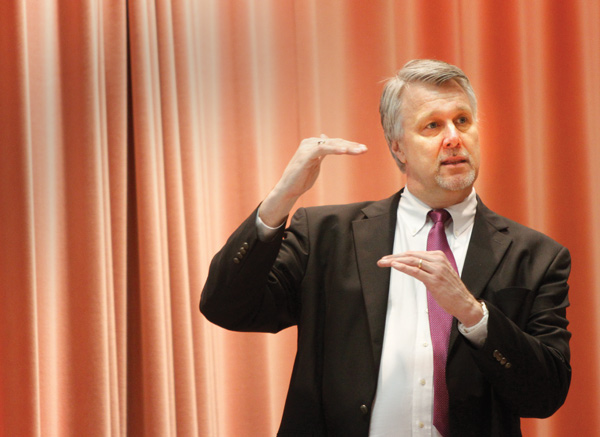
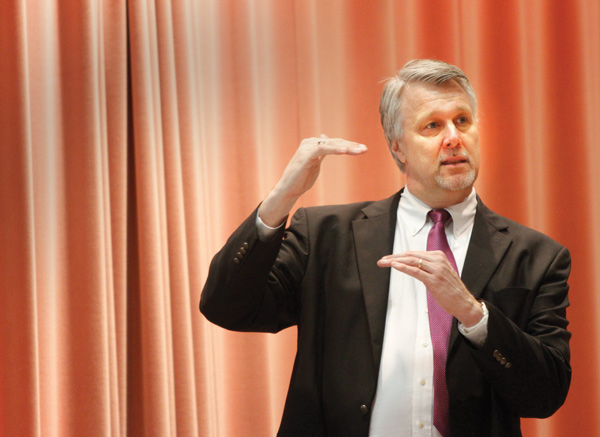
Mark Johnson, director of the advanced-manufacturing office at the U.S. Department of Energy, addresses participants Monday at a Sustainable Energy Forum at Youngstown State University.
By Kalea Hall
YOUNGSTOWN
The Youngstown area has seen its share of ups and downs.
“If you could come into Youngstown and then look at where we are today, don’t tell me you can’t transform” this community, said U.S. Rep. Tim Ryan of Howland, D-13th, speaking Monday at the Youngstown State University Sustainable Energy Forum. “The ultimate settlement is to not put all your eggs in one basket.”
The forum, inside Kilcawley Center, focused on technology that could lead to a savings of energy in the manufacturing industry. It included a speech from Mark Johnson, director of the advanced-manufacturing office for the U.S. Department of Energy; a panel to discuss the benefits of NASA Glenn Research Center in Brookpark; a panel on three-dimensional printing and additive manufacturing; and a panel on research exchange.
Ryan discussed the need for private and public entities to work together to develop and draw investment from those developments. “I think we have a lot of exciting things going on here,” he said.
Johnson discussed advanced manufacturing and clean-energy technology: Manufacturing “is making stuff,” he said. The “advanced” part is adding technology to help make the product.
“It is key to understand energy if you are going to understand manufacturing,” he told the crowd.
Part of that is knowing about additive manufacturing or three-dimensional printing and its benefits and challenges.
“You can cut the cycle for making tooling by additive manufacturing,” Johnson said. “This is the next wave in tool innovation.”
Additive manufacturing is the process of taking a three-dimensional solid object of virtually any shape from a digital model through a process in which layers of material are laid down in various shapes.
One of the benefits that Mike Hripko, America Makes deputy director of workforce and education outreach, mentioned in his segment is that additive manufacturing could reduce energy costs by 50 percent and reduce material costs by 90 percent compared to traditional manufacturing.
“It’s a technology we really have to take advantage of as quickly as we can,” Hripko said.
Some of the challenges with additive manufacturing include lower build rate and batch process, the build envelope can be limited, the number of materials available for printing is limited and there are multiple technologies, each with its own capabilities and limitations.
Discussed in a second forum on the NASA Glenn Research Center were the possibilities that companies have in working with the research center.
They can “be more competitive with other regions of the country, as well as the world and to get a better return on the government research and development investment,” said Joe Shaw, ventures and partnerships director of the research center.
Shaw mentioned there are no relationships formed with any companies in Columbiana County, and the center would like to continue working with companies throughout the Valley through NASA’s road show.
“If you have a product and you are trying to bring a product to the marketplace and you have problem, if we have the capability to help close that gap, whatever that gap is, that’s what we do using our subject-matter expertise,” Shaw said.
Barb Ewing, chief operating officer for the Youngstown Business Incubator, was on the NASA panel to discuss the need for the region to discuss new ways of manufacturing by using programs such as NASA’s to help.
“If we are going to change our trajectory in advanced manufacturing, that is going to require to get every player in the game,” Ewing said. “We have got to force, push, prod companies who aren’t thinking about how they can do things better.”
The Sustainable Energy Forum at YSU continues from 8 a.m. to 1:30 p.m. today . The main topic of discussion will be opportunities in natural gas.