 43
43

Berlin Center sisters up their intensity in Canfield Fair prep
 Photo
Photo
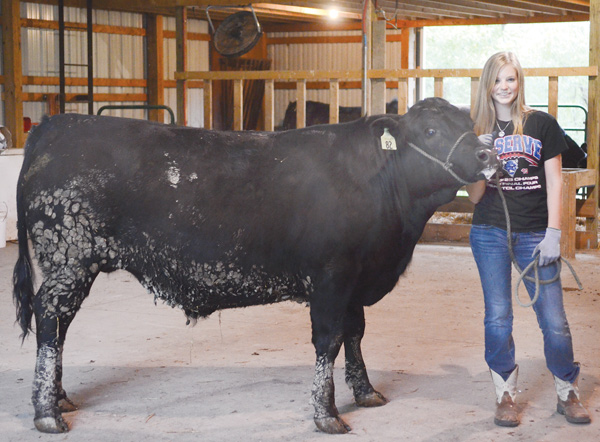
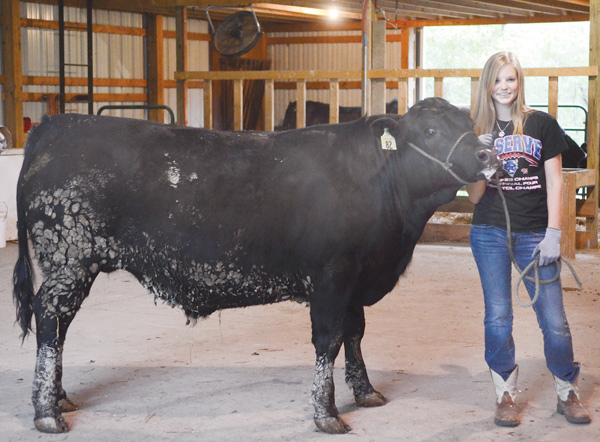
Abby Hemphill, 17, of Berlin Center is preparing for the 168th Canfield Fair. Her sister Emily, 11, also will participate.
By EMMALEE C. TORISK
BERLIN CENTER
Next week, once school has let out for the summer, preparation for the 168th Canfield Fair will begin in full force for sisters Abby and Emily Hemphill.
But that’s not to say the 17-year-old and 11-year-old, respectively, weren’t busy during the long, cold winter, when only three steers named Larry, Curly and Moe — the girls’ entries in the 4-H Club’s market steer category, and through the Jackson-Milton Livestock Club — occupied a barn on their Mock Road property.
Since the mid-October lottery that brought the steers to the Hemphill residence, the animals have become halter-broken, or more accustomed to being led. They’ve also become more familiar with the girls, who are solely responsible for their food, walks and cleanup every day.
And, perhaps most noticeably, they’ve each gone from about 500 pounds to more than 1,000, gaining approximately 3 pounds a day, thanks to their daily diet of about 25 pounds of feed, a home recipe made mostly of corn.
“They’ve grown very well for us over the winter,” said Wendy Hemphill, Abby and Emily’s mother, who, like her husband, Gary Hemphill, joined 4-H at 8 years old. She added that the couple didn’t have to do much prodding to get their daughters involved with the youth organization that promotes practical and hands-on learning, however.
For Abby, a soon-to-be senior at Western Reserve High School, this year will be her sixth as a member of 4-H, and she plans to enter two market steers — Curly and Moe — along with one market swine into the Canfield Fair.
Emily, who is nearing her sixth-grade year at Western Reserve, will enter Larry, a market steer; one market swine and two market feeders. She’ll pick up her market feeders from a local breeder in mid-June, when the steers will each weigh about 200 pounds, and raise them to be between 500 and 600 pounds by late August, when the fair begins. This year’s fair runs Aug. 27 through Sept. 1.
Other farmers will finish raising the market feeders.
On April 28, the sisters acquired four pigs — which they’ve named Charlie, Tiny, Brick and Wilbur — and have been working to get them fair ready. They’ve been teaching them to sit, for example, said Abby, who added that they’re sometimes rewarded with a special treat: marshmallows.
Their typical food, though, is commercial feed, and they can eat whenever they’re hungry. When they each reach about 150 pounds, which should happen in the first or second week of July, their twice-daily meals are individualized “according to how they look,” or whether they need to gain or lose weight, Wendy said.
Again, the amount of time the girls devote to feeding and walking and cleaning up their livestock will only increase come June 10, their last day of school.
“It will be longer, more-intense hours,” Gary said.
The work is worth it to the sisters, though, and not only because of what Emily fondly refers to as “the money part.”
At the fair, both girls will show their livestock in two categories. In showmanship, they’ll be judged on how well they present themselves and work with the animal. In market, the animal will be judged overall. From the latter category comes the order in which the animals will be auctioned off; the best go first.
“You walk up into a huge pile of sawdust, and there are buyers all around in the coliseum,” Abby said. “You get everything it sells for.”
The average selling price last year for pigs and steers was between $2 and $2.50 per pound, she explained, adding that bidders can be businesses, organizations or individuals. Most of the money the girls earn goes into their college funds, or to purchase the next year’s animals.
Abby even used some of her earnings to buy a car, but said she can’t help crying when the time to say goodbye approaches.
“I love working with my animals and the time I have with them,” she said. “It helps when you get the check at the end, but it’s bad.”
The Hemphills agreed that the fair itself is hectic and crazy, with hardly a free moment. Most days begin before the sun comes up or shortly afterward, and it’s not unusual for them to stretch until midnight or later. The family often trudges to their camper parked on the fairgrounds late at night, only to head back to the barns a few hours later.
Still, they love it anyway, and 4-H — which covers “many aspects of life,” not just livestock, Gary said — is something they’d recommend to anyone. There’s a project for everything, and for everyone.
It’s also OK to start small, maybe with just one pig like Abby did. Wendy added that her daughters have learned to manage their money, using some of their auction earnings to invest in better-quality animals, feed and equipment for the next year. The projects also have fostered responsibility.
“Gary and I are not in the barn unless the kids are here,” Wendy said. “We tell them, ‘The harder you work, the better the outcome.’”