 43
43

Henna art goes to author’s head
 Photo
Photo
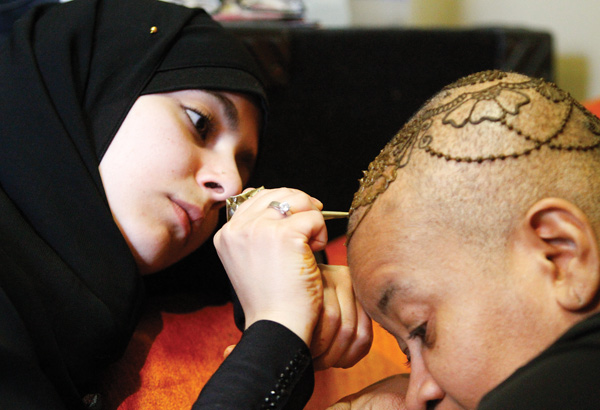
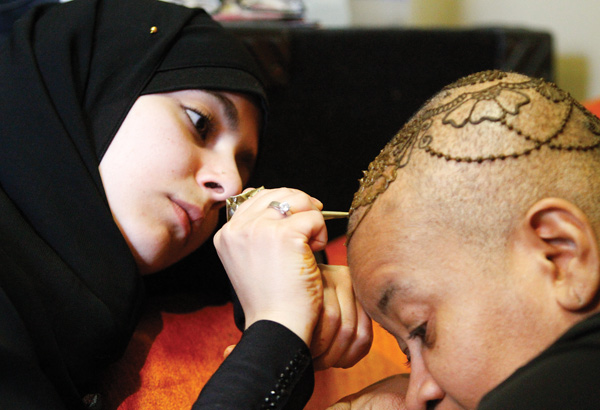
Lamia Alfares, a local Henna artist, draws a Henna crown on the head of Monaca Beasley-Martin at the Calvin Center in Youngstown. Beasley-Martin has alopecia, a condition in which a person is allergic to his or her own hair and becomes bald.
By ROBERT CONNELLY
YOUNGSTOWN
Facebook connected two local artists for a special crown.
Youngstown residents Monica Beasley-Martin, a local author with alopecia, and Lamia Alfares, a Henna artist, were put in contact by mutual friends through social media.
Henna is art that is drawn on someone’s body. Beasley-Martin has alopecia, a condition in which a person is allergic to his or her hair and becomes bald.
She wanted Henna art on her head to show “that bald is beautiful and how can I do that if I’m trying to cover up the baldness I have,” she said.
She also wanted to do something special for the release of her children’s book, “Bald is Beautiful, Too,” to raise awareness in children of the disease. She is having a book-signing and release at the Calvin Center in the Rust Belt Theater, 755 Mahoning Ave., at 7:15 p.m. June 15.
The book was inspired by Beasley-Martin’s own journey with alopecia. She said she wanted to raise awareness in children and “to help explain to the other children ... build up esteem of children.”
Alfares and Beasley-Martin were able to get together Friday for the Henna crown. Alfares prefers a comb style while others use stencils or a syringe in a design for religious or health purposes.
The art has a special implication in Alfares’ religion, Islam, as every bride gets it during a two-day pre-wedding ritual called Khutba. Alfares’ cousin, Randa Hamayel, will receive Henna art during her upcoming wedding.
The most-popular places where people, mostly females, get Henna are on their hands and feet. Alfares said males are only allowed Henna in their hair or on the palms of their hands during a wedding ceremony.
Alfares said she liked to draw and became interested in Henna after a wedding overseas when she bought two combs two years ago. She does all of her work free-hand.
The process takes about 20 to 30 minutes for a Henna crown — though a more-intricate design can take longer.
The actual liquid for Henna art comes from a plant, and Alfares said she grows her own plants for artwork.
It takes 48 hours for the design to take shape on the skin. It turns into an orange color and then slowly fades away. Alfares said she does 10 to 15 treatments a month, but sees more clients during the summer for prom and weddings.
“It’s very important to me because it has a huge religious meaning,” she said. lfares operates “Henna by Lamia” by Facebook and Instagram pages in Youngstown as well as by word of mouth.