 43
43

Does race matter? Panel tries to answer

 Photo
Photo
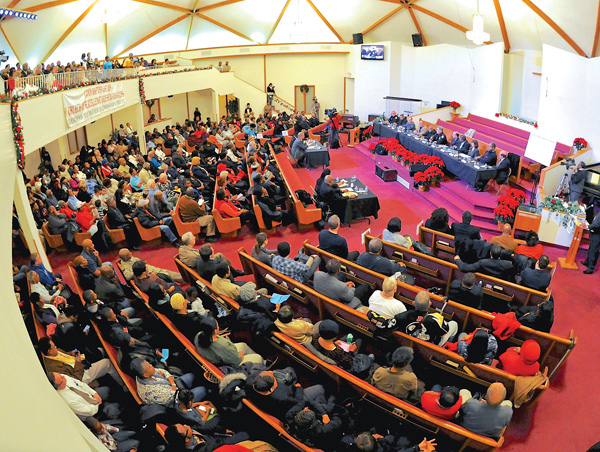
A full house listens to a community panel during a forum on race relations Monday evening at Union Baptist Church. The forum, “Does Race Matter?”, was sponsored by the church and the Mahoning Valley Organizing Collaborative.
YOUNGSTOWN
The Mahoning Valley definitely needs help when it comes to race relations, a panel of 11 community leaders has agreed.
It needs help in the city and in the suburbs. It needs help with police and citizen interactions, especially when it comes to young people.
It needs help when it comes to training people to fill the jobs that are here while employers go begging.
It’s going to take everyone working together to help the city overcome the problems racial division creates, said the Rev. Mr. Michael Harrison Sr., pastor of Union Baptist Church where a forum called “Does Race Matter” that featured the panel drew about 400 people Monday evening.
The panel included Boardman Police Chief Jack Nichols; The Rev. Mr. Kenneth Donaldson, pastor of Rising Star Baptist Church; Mark Munroe, chairman of the Mahoning County Republican Party; The Rev. Al Yanno, Metro Assembly of God Church; Ben McGee, Youngstown State University Department of Education; Youngstown Police Chief Robin Lees; Youngstown Mayor John McNally; Jamael Tito Brown, vice chairman of the Mahoning County Democratic Party; Atty. Patricia Wagner, chairwoman of YSU Department of Criminal Justice and Forensic Science; William Blake, director of YSU Office of Student Diversity Programs; and Tom Humphries, director of the Youngstown/Warren Regional Chamber of Commerce.
Moderating were 21 WFMJ-TV news anchor Bob Black and the Rev. Mr. Chris McKee of Tabernacle Baptist Church.
The panel started out by answering a general question: What is your take on race relations in the Valley?
“They’re fractured,” said the Rev. Mr. Donaldson.
Why? “We get imprints as young people,” explained McGee, telling a story about how his college roommate had his mind made up about black people before he’d ever met one.
“They become opinions, then beliefs, then actions, McGee said.”
“There’s room for improvement, or we would not be here,” said Lees, with McNally adding that “we still have a tremendous amount of work to do.”
Brown and Wagner said bias exists, and that has to be acknowledged.
“It’s what I live every day,” Brown said. “If I don’t have that [college] degree in my hand when walking down the street, there’s a difference in how people look at me.”
“Race doesn’t make any difference under rule of law, said Wagner. “But we relate to people who look and act like us, and we misunderstand those who don’t.”
Blake said that as young people hear about people their age getting killed by police around the country, they are just fearful of coming into contact with people in authority.
“We need to communicate better,” Nichols said. “Each one of us that wears a badge needs to be better communicators, to not escalate, to de-escalate, to slow down and to listen. Teaching the officers to do that can be quite a challenge.”
Others said that it’s the role of families and churches to help young people build trust among races.
Lees said he is taking some steps to help build trust in the community. He said he is sending officers to Block Watch meetings, is investigating using body cameras, and is trying to recruit minorities.
Both he and Nichols said they don’t believe the recent shootings of two police officers in New York will cause officers here to overreact.
“There will be heightened vigilance,” Lees said. “Will there be an overreaction? I don’t think so. I hope not.”
“Their reactions will be the same,” said Nichols. “They’re very well-trained. Are young black males in danger? No, definitely not.”
The forum was sponsored by the church and the Mahoning Valley Organizing Collaborative.