 43
43

Dogs, Valley handlers learn ropes this week at police dog school
 Photo
Photo
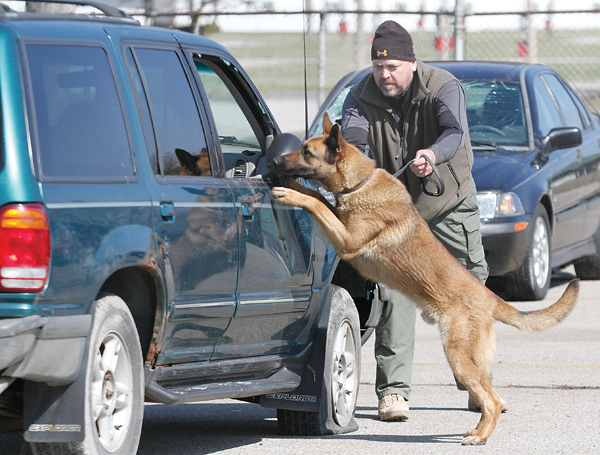
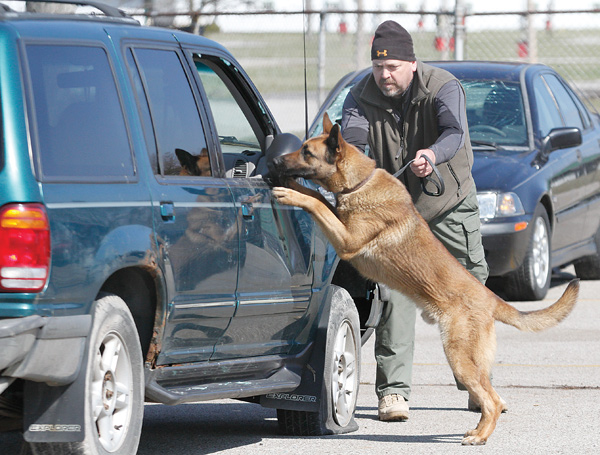
Roger Stafford of the Cortland, N.Y., police department puts his dog, Lummer, through an exercise on how to search a vehicle Wednesday at the Canfield Fairgrounds as part of a school for police dogs and their handlers sponsored by the Mahoning County Sheriff ’s Office and Shallow Creek Kennels. Below, Sumo, a police dog for Boardman police, gets ready to do a search at the event.
By Joe Gorman
YOUNGSTOWN
Police officers are used to the unexpected, even when their partner is a dog.
This week, they have been preparing for those moments as about 50 departments from the region participated in a police-dog training exercise. It was sponsored by the Mahoning County Sheriff’s Office and Shallow Creek Kennels in Sharpsville, Pa., which has trained a majority of the police dogs used in the area.
The training was spread out over several sites beginning Tuesday and ending today. Dogs and their handlers practiced such scenarios as building-searches, tracking people, traffic stops and drug searches. Much of the training for vehicle searches was done at the Canfield Fairgrounds.
Sgt. Larry McLaughlin of the MCSO said this week’s training is based on various situations dogs and their handlers will run into on the streets. He also was taking part in the training with his dog, Mercy, a Belgian Malinois, a breed that is very popular among police-dog handlers.
McLaughlin said he has been in law enforcement 15 years and has worked narcotics investigations for 11 years, the last four with Mercy. He said he would not his trade his time with her for anything.
“That’s the most rewarding and best experience you can have in law enforcement,” McLaughlin said.
Boardman police officer Daryn Tallman also was on hand with his dog, Sumo, a Dutch Shepherd, with whom he has partnered since August 2011. Before that, he was teamed with Yuma, another Belgian Malinois, for eight years, but Yuma had to be euthanized about two weeks ago because of illness, Tallman said.
Tallman said there is not much difference between the two dogs he has worked with, and he likes the training because it teaches him and his partner to be ready for different situations. Some of the situations practiced this week involving traffic stops will have suspects running away or being compliant for part of the time or resisting arrest in other ways — all to help train the dog for various situations.
“You never know what [suspects] are going to do,” Tallman said. “We have to be prepared as dog handlers.”
McLaughlin said dogs let their handlers know in different ways when they have found drugs or other contraband. Some dogs, such as McLaughlin’s, are passive, and sit when they find something. Others, such as Deputy Jeff Saluga’s dog, Lars, are aggressive and either scratch or bite what they find.
Other times, dogs will “alert,” or will give an untrained response when they encounter something during a search they are not looking for.
One of the training techniques used this week was “conflicts,” or planting various scents in vehicles that had drugs in them, such as vinegar or food, to get the dogs used to those smells, McLaughlin said. He said after awhile, those scents will become so familiar for the dog that they will ignore them during a search and concentrate on what they are supposed to be sniffing for.
John Drannon of Shallow Creek Kennels said the hardest part about training dogs and their handlers isn’t training the dog — it’s training the handler.
Breeds that are police dogs, Drannon said, are very task-oriented; they like working and being busy, and they like pleasing their handler. He said what is hard is getting the handler in sync with the dog.
“The dogs learn very quickly,” Drannon said.
Tallman said the hardest tasks to perform with the dog are building-searches or tracking. He said building-searches are hard because of the many nooks and crevices someone or something could hide in and when tracking, scents often disappear or blend in with other scents, plus people always are curious and distract the dog.
The dogs are rewarded with a chew toy, often a foam stick, for their work, and oftentimes the toy is saved and only used when the dog is working, not in its off hours.
Tallman said the dogs have one goal in mind when they are working: to get the toy.
“Their drive is so high to find that, they will pass up food to get that toy,” Tallman said.
Helping the MCSO with the training this week were the Liberty, Poland, Struthers, Boardman, Beaver, Canfield, Springfield and Youngstown police departments as well as the state Bureau of Criminal Investigation.