 43
43

With Nokia acquisition, Microsoft tries to catch up
 Photo
Photo
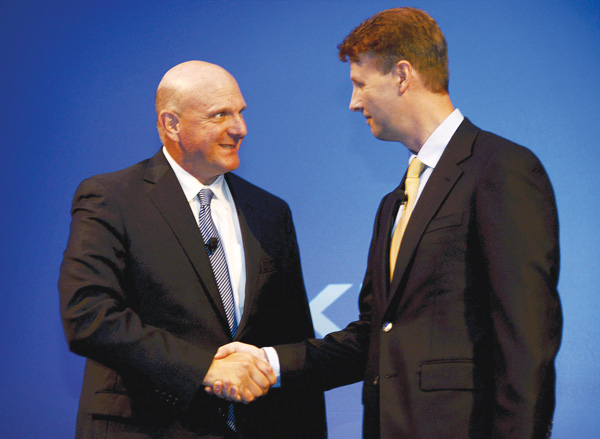
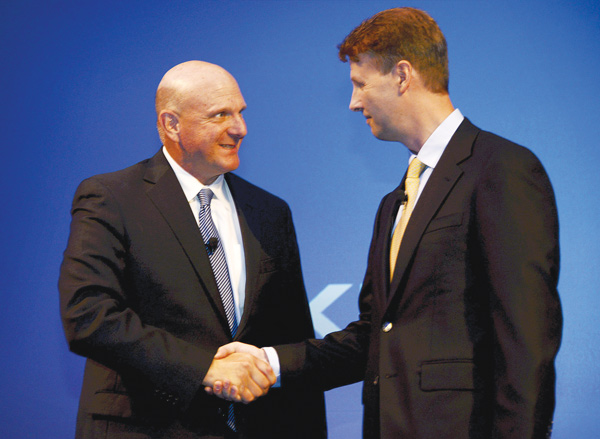
Microsoft CEO Steve Ballmer, left, shakes hands with Nokia’s Chairman of the Board Risto Siilasmaa during the press conference of the Finnish mobile manufacturer Nokia. U.S. giant Microsoft is set to buy Nokia’s mobile-phone business and patents.
Associated Press
SAN FRANCISCO
Microsoft’s acquisition of Nokia’s troubled smartphone business represents a daring $7.2 billion attempt by the software giant and a once-influential cellphone maker to catch up with the mobile computing revolution that threatens to leave them in the technological dust.
The deal announced late Monday offers both companies a chance to make up for lost time with a strategy to meld their software and hardware into a cohesive package like rival Apple has done. But there are many reasons to question whether the copycat approach will pay off.
Unlike Apple, Microsoft Corp. makes most of its money from software for personal computers — a still-profitable franchise that has been crumbling as smartphones and tablets supplant laptop and desktop machines. By some estimates, more than two-thirds of the computing devices being sold are either smartphones or tablets, and there are few signs that trend will change during the next decade.
To complicate Microsoft’s transition, the Redmond, Wash., company is being led by a lame duck. Microsoft CEO Steve Ballmer, who negotiated the Nokia deal, recently announced plans to retire within the next year in a tacit admission that the company needs a different leader to blaze new trails.
The managerial limbo raises even more doubts about whether Microsoft will be able to turn Nokia’s phones into more effective weapons in a mobile-computing battle against devices powered by Google Inc.’s Android software and Apple Inc.’s iPhone and iPad.
“It’s a three-horse race, and Microsoft knows it needs to come up with a more well-defined plan for mobile devices to catch up,” said Darren Hayes, a computer science professor at Pace University in New York. “This was an essential acquisition.”
The Nokia deal didn’t go over well with investors who have become weary of Microsoft’s largely fruitless efforts to evolve into something more than a PC-dependent company.
Microsoft’s stock shed $1.52, or 4.6 percent, to close Tuesday at $31.88. Nokia Corp.’s shares surged $1.22, or 31 percent, to finish at $5.12.
Nokia, a Finnish company, has seen its cellphone business unravel since Apple revolutionized the way people use handsets with the 2007 introduction of the iPhone.