 43
43

Worthy of remembering
 Photo
Photo
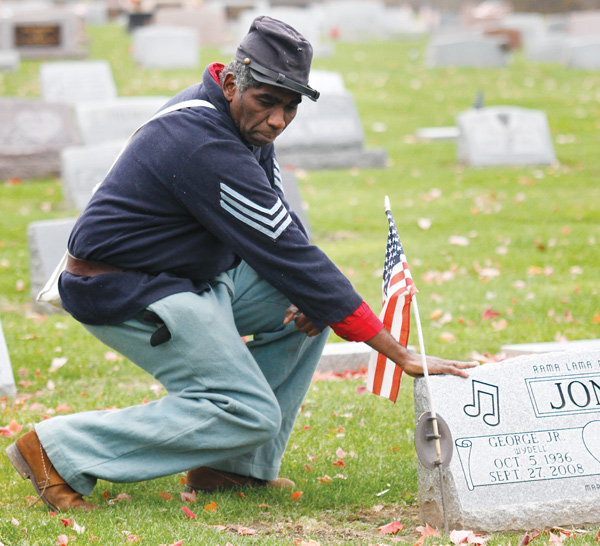
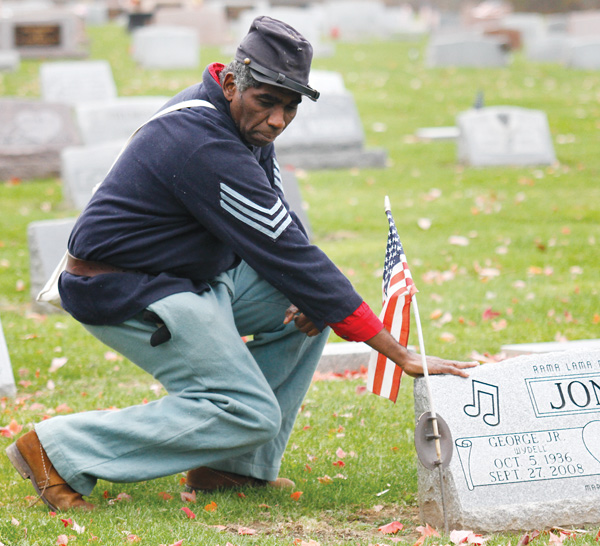
Steffon Jones, a local historian, places his hand on his father’s headstone. George W. Jones Jr., known for his singing talent, served three years in the Air Force during the 1950s.
By Sean Barron
YOUNGSTOWN
You might say two things about George W. Jones Jr.’s three years in the Air Force: His career soared, and he uplifted others with his voice.
“In 1954, my dad joined the service and they found out he had a talent for singing,” said Jones’ son, Steffon W. Jones, a local historian. “He performed for soldiers and on planes singing.”
That was one of several recollections the younger Jones had for his father, who was one of seven soldiers honored during Sunday’s 15th annual Forgotten Heroes program at Tod Cemetery, 2200 Belmont Ave. on the North Side.
Steffon Jones helped lead the 90-minute walking tour and series of discussions, which recognized seven men and women who served in several wars and contributed to life in the Mahoning Valley.
George Jones, who ran track and played baseball and football, soon found his niche in music. He became leader of The Edsels, a five-member doo-wop group popular in the late 1950s and early 1960s whose signature song was “Rama Lama Ding Dong,” which the elder Jones wrote.
“We called our house ‘a house of happiness’ because that’s where everybody got together and played music,” Steffon Jones said, fighting back tears.
George Jones also performed with singer Ray Charles, but beyond his singing prowess, he was a devoted family man who loved God before Jones died Sept. 27, 2008, at age 71, Steffon Jones explained.
The younger Jones also honored his late brother, Maurice J. Love Jr., who was in the Army and served in Kuwait during the first Gulf War.
Love was taciturn about his war experiences, telling family members and others only that his duties included driving a supply truck at night with its lights off, Jones recalled.
“He was quite a young man I enjoyed as a brother,” Jones continued, adding that Love was in the service six or seven years before his death in August 2010.
The others honored for their service to the country were Dr. Herbert Louis Armstrong, Samuel Weil, Madge J. Addeo, Samuel Clark and George Tod.
Armstrong, a 1938 South High School graduate, was an Army drill sergeant during World War II in the Pacific Theater. After being honorably discharged as a staff sergeant in 1946, he graduated from Youngstown College with a degree in business administration in 1949, Jones noted.
Nevertheless, Jones said, Armstrong was turned down for a teaching position because of the racial climate of the time, so he re-enrolled at Youngstown College, earned his bachelor’s degree in education and began what proved to be a highly successful 39-year career in that field until his retirement in 1986 as principal of Hillman Elementary School.
In addition, Armstrong served on numerous boards and was the recipient of many awards, Jones said.
Tod, who moved to the family’s Brier Hill farm at age 3, served as 1st lieutenant, 19th Ohio Company B, known as “Tod’s pets,” noted David Frank, a local Civil War re-enactor.
Tod, who also studied law and served three months in the Army, became part of the creation of the Youngstown Sheet & Tube Co. and the Brier Hill Works, which provided employment for many returning veterans, Frank explained.
Little is known about Addeo, who came to the area from her native Mississippi, enlisted in the Women’s Army Corps in 1945 and became a teacher, attendees were told.
Weil was a Confederate soldier who felt the call to serve his country and fought in the Civil War, including the Battles of Antietam and Gettysburg, noted Ron Johnson, a re-enactor.
After the war, Weil moved to Titusville, Pa., then arrived in 1874 in Youngstown, where he became a mercantile businessman and helped organize the Dollar Savings & Trust Co., Johnson said.
Clark, who came to Youngstown in 1891, fought in the Spanish-American War as part of the 5th Volunteer Company, Infantry Company F. Afterward, he was a peddler before his 1925 death, another presenter noted.
“These men [and woman] deserve not to be forgotten,” Frank said about the seven.