 43
43

Hubbard man recalls Korean War
 Photo
Photo
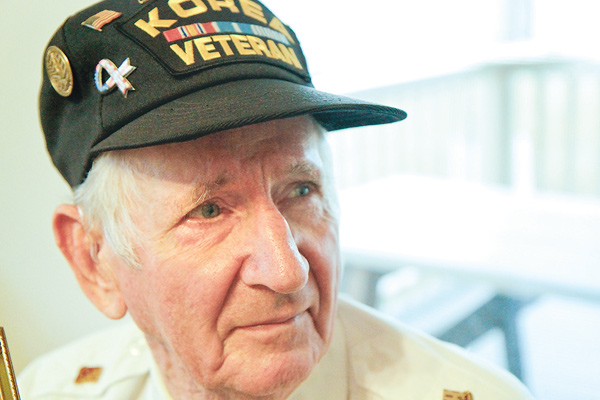
Korean War veteran Wilbert “Al” Alfred Walker of Hubbard returned to South Korea recently after more than six decades.
HUBBARD
Wilbert “Al” Alfred Walker of Hubbard has been to South Korea twice.
On his first trip, Walker, 85, and about 540 other members of the Army’s Task Force Smith were flown in from Japan and landed at Buson. They were taken by train July 5, 1950, to Osan, tasked with delaying the North Korean Army’s drive south until more troops could be deployed to Korea.
The Battle of Osan was the first engagement between the United States and North Korean forces in the Korean War.
Walker’s next visit to Korea, nearly 63 years after the Battle of Osan, was under much happier circumstances.
He and his wife, Martha, were invited to the grand opening of the U.N. Forces 1st Battle Memorial in Osan last April to commemorate the heroics of Task Force Smith at the Battle of Osan.
Walker, the only original member of Task Force Smith to make the trip, was keynote speaker at the ceremony, and he and Martha were the first people through the doors of the memorial.
The war
In the Battle of Osan, Task Force Smith faced some 5,000 North Korean Army regulars reinforced with Soviet tanks.
“Our orders were to fight a delaying action until reinforcements arrived ... to hold on as long as possible, fall back and dig in again,” Walker said.
Facing an overwhelmingly superior force, the infantry retreated, but Walker’s unit, Battery A, 52nd Field Artillery Battalion, which supported Task Force Smith, was left behind.
Walker, a 19-year-old mechanic, and three others from his unit hid in a rice paddy irrigation ditch to avoid being captured.
“We fired a few rounds but then took heavy fire. One was killed — I didn’t know all those guys by name — and we decided to get out,” he said.
Walker, separated from the others, hid temporarily in a farmhouse, then headed toward American lines he knew were on a nearby hill. He was picked up by an American Army vehicle and rejoined the remnants of his unit.
“It was a lonely feeling. I was afraid I was going to get shot,” Walker said of his ordeal.
The American forces were pushed back to Busan where Walker said they set up a perimeter.
“It was Sept. 15. We had orders not to retreat any further. There were no ships to take us out anyway,” he said.
But Gen. Douglas McArthur’s invasion at Inchon that same day began to change the tide of war.
“We re-took Seoul [capital of South Korea], captured Pyongyang [capital of North Korea] and advanced to the Yalu River,” he said.
“But then the Chinese entered the war and we ended up almost back to Osan,” he said.
“Those Chinese troops flooded over those hills like ants out of an ant hill. We began retreating again. We barely got out of there,” Walker said.
Despite fighting in several major battles, including Osan, Tague, Busan and Taejon, and enduring Korea’s severe winter weather with temperatures that plummeted to 40 degrees below zero, Walker was not wounded.
“We had to make do with what we had, and being in the artillery, we had a covered 6-by-6 maintenance vehicle that gave us some shelter. We slept in the truck and built charcoal fires in a metal container to make coffee and provide some heat,” he said.
Walker said their truck got hit Oct. 29, 1950, by a pilot they named “Bed Check Charlie,” who routinely dropped 50-pound bombs on them.
“We painted the date on the truck,” he said.
“The Korean War claimed a lot of lives ... so many getting killed and stepping on land mines ... so many people dying, you just accept it.”
But in April 1951, Walker had accumulated enough points, including time he was stationed in Korea in 1948 and 1949, and was rotated home.
While in Korea, he also was awarded five major battle campaign stars and the Bronze Star medal.
“I was very lucky to get out alive and unhurt. I never really thought I would get back,” he said.
Fast forward to April 21, 2013, and a completely different South Korea.
the memorial
As keynote speaker, Walker thanked the Korean people for the memorial on behalf of Task Force Smith and the dignitaries and people representing others who couldn’t be there. His uniform is on display in the memorial, and his name and picture are on a wall, along with the rest of the original Task Force Smith members,
Walker said he didn’t recognize today’s reconstructed, thriving, modern South Korea from the one he remembered reduced to rubble by the war. He said he congratulated its people for recovering from total destruction.
family
After the war, Walker returned to the Butler, Pa., area where he grew up and married Martha on March 5, 1955. They moved to Liberty Township in 1953, and he went to work at Republic Rubber. When the plant closed in 1978, he drove truck hauling steel, eventually owning his own rig, retiring a second time in 1995. These days, he spends his time building and flying experimental planes.
The couple have two children: Shawn of New Middletown and Kurt of Clementon, N.J.; and two grandchildren, Olivia and Garrett.
They are members of Calvary Baptist Church in Hubbard, and he is a member of Veterans of Foreign Wars Post 3767 in Hubbard. Annually, he attends the Hubbard schools’ Veterans Day program as the guest of Lena Dunkerley, a middle school student.
“Lives were lost, ground was ravaged and equipment was destroyed in Korea. But but this is the price of war,” said Walker.
“It has been said that freedom is not free, but it was worth the price,” Walker said.
“While I was there, maybe I didn’t understand why. But since, I see what we did for those people was very valuable. They would be Communists now,” he said.