 43
43

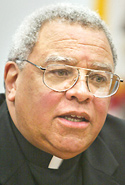
Bishop Murry discusses qualities of a pope
 Photo
Photo
Bishop Murry
By LINDA M. LINONIS
Youngstown
Bishop George V. Murry of the Diocese of Youngstown said connecting with the faithful is one of the most important abilities that the new pope should possess.
The conclave of cardinals continues at the Sistine Chapel in Rome to pick a new pontiff.
Bishop Murry said the man selected to lead the world’s 1.2 billion Catholics should be a theologian who understands and sees God’s presence in the world; an evangelist with energy to reach out to the faithful verbally, personally and physically; an administrator with appropriate skills; and a teacher who is able to instruct the faithful.
“That’s who I would vote for,” said the bishop, who doesn’t have a vote. But he added: No one “has everything.”
Candidates who have been named as frontrunners in the media include Italian Cardinal Angelo Scola, Brazilian Cardinal Odilo Scherer, Canadian Cardinal Marc Ouellet and American Cardinal Timothy Dolan.
Bishop Murry said he knows Cardinal Dolan and has met Cardinal Ouellet. They have qualities that the bishop believes are important to leadership.
“There is nothing stronger than personal contact,” Bishop Murry said. The new pope must be diligent about “learning about what is important” to Catholics worldwide. “That will be a strong connection,” he said. The new pope also must use technology — the Internet, TV and social media, he added.
Contemporary times have witnessed a change. The bishop pointed out that up until Pope Paul VI, people went to Rome to see the pope. “Pope Paul VI began the traveling ... he went to the United Nations, Israel, the Philippines,” the bishop said, noting it is now expected of the pontiff. While John Paul I died shortly after being installed, Pope John Paul II “went to the world,” the bishop said.
The bishop called Pope John Paul II’s travel as the “foundation stone” for all future pontiffs. “The pope must have the energy to travel and evangelize,” he said.
Bishop Murry said the “level of energy depends on the person.” He said he believed the cardinals will consider that.
Bishop Murry noted that picking a new pope “comes down to numbers.” The number of voting Italian, Brazilian and American cardinals are in the same range. Up to four rounds of voting are allowed per day and two-thirds or more of the 115 cardinals must vote for one candidate who will be the 266th pope. As the votes are taken and balloting continues, the bishop said, the cardinals will see “who’s gaining and who’s losing votes.”
Given the time difference — Rome is six hours ahead of the United States — the bishop said most of America probably will be asleep when a new pope is chosen. Mass and prayer take up a portion of the cardinals’ days; voting in the Sistine Chapel runs roughly from 4:30 to 7:30 p.m.
Bishop Murry said the process is “exciting” and “fascinating to see how it evolves.”
Right now, all the cardinals are possible popes. “It could be any one of the cardinals who believe deeply in God, believe Jesus is the son of God and believe God’s presence works through the Holy Spirit,” he said.
Once a new pontiff is chosen, there will be a special Mass in the diocese to celebrate, the bishop said. “We will work with the new pope to advance the Gospel,” he said.
Bishop Murry acknowledged that former Pope Benedict’s resignation “took the world by surprise because it hadn’t happened in 600 years.”
He described Benedict as “brave” to realize his physical limitations. “Who at that level of power gives it up?” the bishop asked. “He did it for the good of the church.”
Bishop Murry addressed mention in the media of “uncertainty in the church.” “There’s no change in foundation; there will be a change in style,” he said. “Nothing changes in fundamental beliefs.”