 43
43

4 gadgets that defined 2013 Vegas electronics show
 Photo
Photo
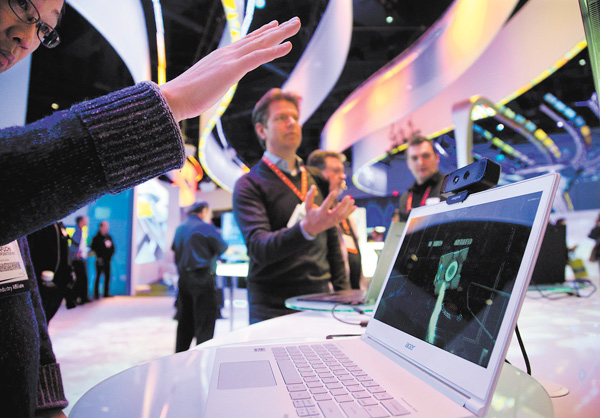
Convention attendees tried out Intel’s Creative Interactive Gesture Camera development kit at the Consumer Electronics Show on Friday in Las Vegas.
Associated Press
LAS VEGAS
The world’s largest gadget show wrapped up Friday, and the organizers said it was the biggest ever, beating last year’s record in terms of the floor space companies purchased to display their wares.
What was it that drew more than 3,500 companies and 150,000 people to Las Vegas for this mega-event? Here are four gadgets that exemplified the top trends at this year’s International CES:
Sony’s 55-inch ultra-high-definition TV: At the show, the companies unveiled smaller “ultra-high-definition” television sets, measuring 55 inches and 65 inches on the diagonal. They will go on sale this spring. Prices were not announced, but will presumably be a lot lower than for the 84-inch sets, perhaps under $10,000.
Both the size and price of these smaller ultra-HD TVs should make them easier buys, but the higher resolution will be a lot less noticeable on a smaller screen, unless viewers sit very close. Analysts expect ultra-HD to remain an exclusive niche product for some years. There’s no easy way to get ultra-HD video content to the sets, so they will mostly be showing regular HD movies. However, the sets can “upscale” the video to make it look better than it does on a regular HD set.
LG’s 55-inch OLED TV: Organic light-emitting diodes, or OLEDs, make for thin, extremely colorful screens. LG is shipping a 55-inch OLED TV set in Korea, and is expected to bring it to the U.S. this spring for about $12,000.
Beyond being thin, power-thrifty and capable of extremely high color saturation, OLEDs are interesting for another reason: They can bend. Samsung showed off a phone that can bend into a tube.
The Pebble Watch: The Pebble is a “smart” timepiece that can be programmed to do various things, including showing text messages sent to your phone. The high-resolution display is all digital, so it can be programmed with cool “watch faces.”
Creative Technology Ltd.’s Interactive Gesture Camera: This $150 camera, promoted by Intel, attaches to a computer much like a Webcam. From a single lens, it shoots the world in 3-D, using technology similar to radar. The idea is that you can perform hand gestures in the air in front of the camera, and it lets the computer interpret them. CES was boiling with gadgets attempting to break new ground when it comes to how we interact with computers and appliances such as TV sets. The Nintendo Wii game console, with its innovative motion-sensing controllers, and the Microsoft Kinect add-on for the Xbox 360 console, which has its own 3-D-sensing camera, have inspired engineers to pursue ways to ditch the keyboard, mouse, remote control and even the touchscreen.