 43
43

Bezos determined to reverse slide of The Washington Post
 Photo
Photo
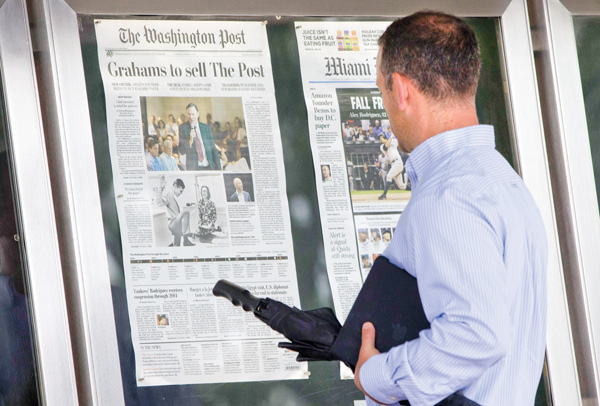
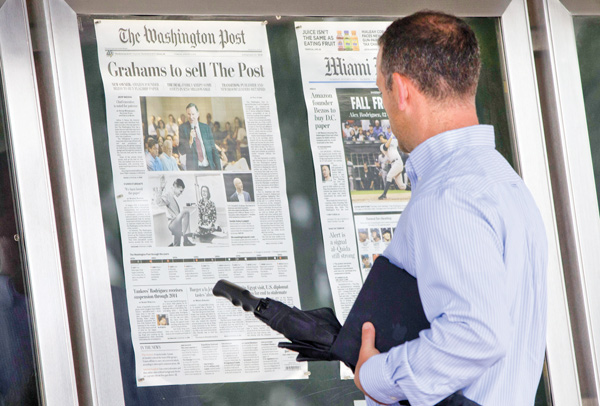
A visitor views the front page of The Washington Post displayed outside the Newseum in Washington on Tuesday, a day after it was announced that Amazon.com founder Jeff Bezos bought the Washington Post for $250 million. Bezos is determined to face the challenge of reversing the newspaper’s financial slide.
Associated Press
SAN FRANCISCO
Amazon.com CEO Jeff Bezos is revered as one of the brightest minds in corporate America, but even he is still puzzling over how to reverse the financial slide threatening The Washington Post and other major U.S. newspapers.
Nevertheless, Bezos is determined to face the challenge, raising hope that his $250 million purchase of The Washington Post announced Monday will provide the newspaper industry with a template for making the leap from the printed page to digital devices.
“The marriage between the newspaper industry and technology has never been consummated, but it could happen at The Washington Post now,” said media analyst Ken Doctor of Outsell Inc.
Although Bezos bought The Post with his own money, most experts believe he is likely to tether the newspaper to Amazon.com Inc.’s products. He also might infuse the newspaper with some of the concepts that helped turn the Seattle company from an online bookstore into a multi-dimensional business that sells a multitude of merchandise and runs data centers that power other websites around the world.
“Just having his brain in the room [at The Washington Post] will force people to confront digital in a way they haven’t before,” predicted Jerry Ceppos, a former newspaper editor who is now dean of mass communications at Louisiana State University.
Bezos, 49, made it clear that he has no magic formula for turning The Post around. The broadsheet is the anchor of a newspaper division that lost $54 million at The Washington Post Co. last year while generating annual revenue of $582 million — 39 percent less than it did in 2005.
“There is no map, and charting a path ahead will not be easy,” Bezos wrote in a Monday letter sent to Post employees after his surprise acquisition was announced. “We will need to invent, which means we will need to experiment.”
Amazon’s nearly two- decade history under Bezos’ leadership suggests the Post is likely to try things that other newspapers steeped in tradition have never dared to attempt.
“Ever since he was a little kid, it got deeply ingrained into Jeff that experimentation is the answer to everything,” said Hal Gregerson, who interviewed Bezos for his 2011 book, “The Innovator’s DNA.” “Exploring the edges is one of Jeff’s counter-intuitive skills. If you go back to when he started Amazon, he was paying attention to something out of the corner of his eye and turned it into something that others didn’t see.”
It’s impossible to predict the bright ideas Bezos might explore, partly because reviving the Post probably will take years to pull off. Experts are floating a host of ideas. Bezos could, for instance, deploy the technology that Amazon uses to recommend books, movies and music to consumers to enable the Post to automatically tailor digital news packages to each reader’s interests.