 43
43

Urban farm reaps harvest
 Photo
Photo
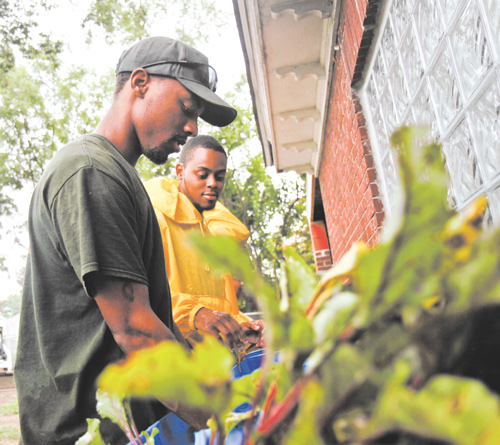
Anthony Fultz and Demetrius Pugh, both of Youngstown, wash beets harvested at the Iron Roots Urban Farm in the Idora Neighborhood on the city’s South Side. The farm is part of Youngstown Neighborhood Development Corp.
YOUNGSTOWN
The Iron Roots Urban Farm, which grows numerous varieties of vegetables on 1.7 acres of previously abandoned city land, is reaping a bountiful harvest this year.
Crops already harvested were spinach, radishes, carrots, beets, escarole, Swiss chard, onions, tomatoes, green beans, hot peppers and arugula.
Crops still to be harvested are romaine lettuce, collard and mustard greens, a ton of potatoes and more green beans, beets, escarole, onions, carrots, radishes and Swiss chard, said Curtis Moore, farm manager.
Other crops still to be harvested are kale, turnips, corn and pumpkins.
The farm at 820 Canfield Road, which is enjoying its first year of crop production, is located in the Idora Neighborhood on the city’s South Side.
“This is really a big symbol of the rebirth of the neighborhood,” said Ian J. Beniston, deputy director of the nonprofit Youngstown Neighborhood Development Corp., which owns the farm.
“The goals of the Iron Roots Urban Farm are to train folks in how to create viable market gardening businesses or other sorts of food-related businesses, to give people sustainable job skills, and to catalyze other kinds of vacant land reuse projects,” said Liberty Merrill, YNDC’s Lots of Green vacant land reuse coordinator.
The small plot intensive farm is part of YNDC’s Lots of Green program.
The farm’s name reflects the roots of the crops and the strength of the region’s iron-and-steel heritage, Beniston said. “We decided we needed a hands-on facility,” Beniston said, explaining why the farm was established.
“There is at least one whole generation, maybe two, that have lost their agricultural background,” Moore observed. “The training program is key to getting people back involved in growing their own food,” he added.
The farm’s crops are sold from 3 to 7 p.m. Thursdays at a stand at Glenwood and Parkview avenues, weather permitting, and on Saturdays at the North Side and Poland Farmer’s Markets. Some are sold to area restaurants or donated to the Rescue Mission of the Mahoning Valley.
Projects such as Iron Roots enhance neighborhoods by transforming vacant, abandoned land into attractive and well-managed urban enterprises that bring fresh, locally grown food to underserved communities, YNDC says.
Trainees, ages 18 to 24, came to the farm for a March through early June Green Jobs Training Program funded by the U.S. Department of Labor and are now YNDC farm employees, who are working on obtaining their general equivalency diplomas.
“I love the training. I love working the farm. ... I enjoy working outside,” said Demetrius Pugh, 21, of Youngstown. Pugh said he will likely use what he has learned at Iron Roots to start his own backyard garden.
After he completes his on-the-job training at the farm, Pugh said he hopes to continue his education and obtain a full-time job in food production or sales or landscaping or construction. Pugh said the most valuable things Iron Roots has given him are “a great work ethic and job experience.”
“I get to grow food and learn new things about foods,” said Anthony Fultz, 22, of Youngstown, who added that he hopes to eventually undergo training in construction or graphic design. “You get to meet new people. It gets you prepared for life,” Fultz said of the urban farm training experience.
Rick Price, 28, of Boardman, completed a summer internship as an Americorps Vista volunteer at the farm, which he said will augment his study of botany at Youngstown State University.
“It’s been fun. It’s something I’m interested in, and it was a good chance to get real-world experience,” Price said of his urban farm internship. “There’s not a lot of places to learn this kind of thing around here. I might want to actually start my own farm some day.”
Besides crop production fields, the farm features a greenhouse, vegetable chiller, demonstration and research gardens and a composting area. Solar panels atop the vegetable chiller help supply the farm’s electricity.
This spring, a team of Americorps National Civilian Community Corps volunteers removed litter, built garden beds and tables in the greenhouse and worked on the solar panel shed at the farm.
An unheated hoop house, with roll-up sides, is designed to allow hardy greens to grow year-round inside, Merrill said.
Recently, the farm received a $75,000 grant from the JPMorgan Chase Foundation toward renovation this year of a 2,700 square-foot, two-story, 1922-vintage brick house, for classroom training and community meetings.
YNDC also plans to demolish a vacant house on the Billingsgate Avenue side of the farm and replace it with a new building containing a training kitchen and workroom.
The farm practices crop rotation and organic farming methods, uses no chemical pesticides and uses only organic fertilizers, such as rock phosphate and green sand.
“We do weed control by means of cardboard and wood chips or laying down black plastic, killing the weeds that way, or good old-fashioned weeding,” Moore said.
YNDC started in 2009 in partnership with the city and the Raymond John Wean Foundation to promote strategic reinvestment in city neighborhoods.