 43
43

Study finds CEOs’ looks can reflect on their success
 Photo
Photo
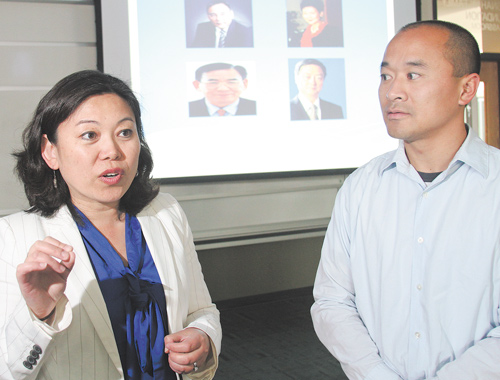
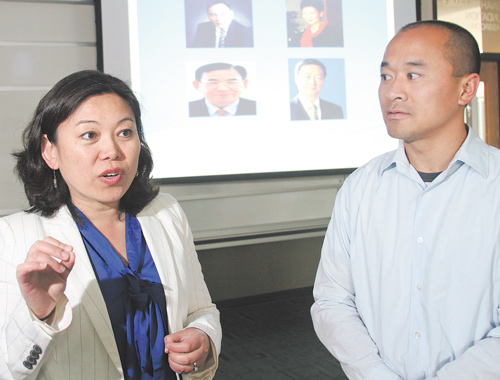
Youngstown State University professors Helen Han and Peter Chen have completed a paper on how chief executive officers’ portraits form individual views on a company’s success. They addressed a class at YSU recently. Portraits of CEOs are projected behind them.
By Denise Dick
Youngstown
You can’t judge a book by its cover or as the Chinese proverb says, you cannot understand the heart by reading the face.
Whatever the culture, though, people try to do both and research shows that in many cases, their conclusions aren’t far off.
But how reliable are those perceptions across different cultures?
Two Youngstown State University professors, along with lead author Peter D. Harms of the University of Nebraska-Lincoln, penned a study that appeared in February in the Journal of Leadership & Organizational Studies.
In “Recognizing Leadership at a Distance: A Study of Leader Effectiveness Across Cultures” Helen Han, assistant professor of management, and Peter Chen, associate professor of accounting and finance, both at YSU, examined whether it’s possible to connect personality ratings based on photographs of company leaders to their perceived effectiveness as company leaders and to more objective performance outcomes.
The study also added a cultural twist. Those doing the ratings were from a different cultural background than the CEOs whose photos they were evaluating.
“In the U.S., people who are viewed as dominant are thought of as successful,” Han said.
In China, those seen as approachable are perceived as successful.
The researchers asked 105 American college students from the U.S. to determine whether Chinese CEOs are effective leaders based solely on their photographs. The students rated each CEO’s appearance, personality and effectiveness as a leader.
The study aimed to show that Westerners’ beliefs about leadership characteristics “are robust across cultural boundaries but are not accurate predictors of actual effective leadership across cultural boundaries.”
The students associated the CEOs’ leadership effectiveness with their emotional positivity, intelligence and dominance, the study found.
Han said that while risk-taking proves to be a predictor of success in Chinese leaders, that wasn’t a key attribute associated with success by the American students.
“Although risk taking and supportiveness had been identified in previous research as being associated with leader effectiveness in China, these characteristics were not used by Western raters when making their judgments of perceived leader effectiveness,” the paper says.
China is an emerging market, but before embarking on ventures there, businesses and investors would do well to study the culture, Han said. That is likely true for any country, she said.
The professors’ paper reports that “raters appeared to be largely clueless about who would be effective leaders and were poor judges of what characteristics should be used to make such judgments.
“Thus, there appears to be strong evidence that Western conceptions of effective styles of leadership are not appropriate in the Chinese context,” it says.