 43
43

Butler masterpiece, ‘Snap the Whip,’ gets fitting frame
 Photo
Photo
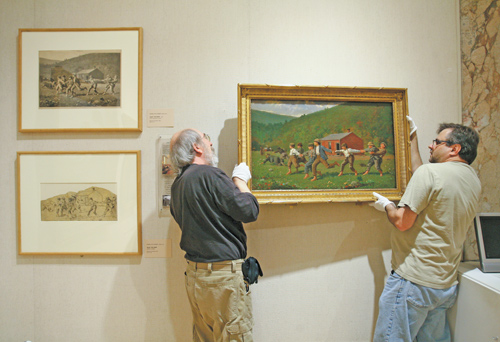
Butler Institute of American Art employees Ray Johnson, left, and Wayne Gruver hang the newly reframed painting “Snap the Whip” in a gallery at the museum Thursday.
By GUY D’ASTOLFO
YOUNGSTOWN
“Snap the Whip,” the priceless and iconic painting that long has been the signature piece of the Butler Institute of American Art’s collection, now has a frame that befits its stature.
The 1872 painting by Winslow Homer was remounted Thursday morning in a $10,000 gold-leaf frame.
“It’s something that we’ve wanted to do for a long time,” said Louis A. Zona, director of the museum.
The old frame dates to the 1950s and was made of wood. Upon seeing it, an art expert once said, “You’ve got a lousy frame on one of the greatest paintings in the world,” Zona recalled.
The old frame was modern in its design and “inappropriate for a 19th-century masterpiece,” he added.
The new frame is of the highly ornate Federal Period design and is 3.5 inches wide. It is finished in 22.75 karat antique burnished gold leaf.
“The addition of a period reproduction frame not only enhances the painting, but also adds prominence and visual importance to the work,” said Zona.
The frame was made by the prestigious Bonfoey Co. of Cleveland, which used 125 leaves of gold leaf in its construction. It features a steel infrastructure that would protect it in the event of a fall.
The frame’s $10,000 price tag was covered by a donation from a benefactor who wants to remain anonymous.
Workers at the Butler removed the old frame and placed the painting in the new frame in a ceremonial event in the gallery where “Snap the Whip” hangs with other 19th-century masterworks.
A new museum-quality glass plate covers the surface of the painting. It eliminates glare and protects the oil-on-canvas work from harmful ultraviolet rays.
It also makes for truer colors for the viewer. “The greens and reds are more vibrant,” said Zona.
“Snap the Whip,” which measures 29 inches by 33 inches, depicts a group of school children at play outside a school house in a wooded mountain valley. Lighthearted and displaying dynamic motion, it captures the essence of rural life in late 19th-century America, the era of Mark Twain.
The painting has been loaned several times over the years for exhibitions around the globe, including the Louvre in Paris in 1984.